Contemporary References to King James I in Shakespeare's Macbeth (1605-06)
One can connect Shakespeare's patron, King James I, to almost every significant dramatic alteration Shakespeare made to his source material on the historical Macbeth, as we can see in Shakespeare's Sources for Macbeth. But fascinating contemporary references and compliments to James also are found throughout the play.
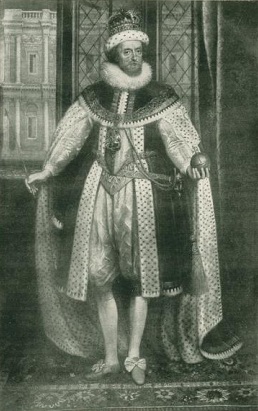
The two-fold balls and treble sceptres (4.1) is a reference to the double coronation of James, at Scone and Westminster, and the most overt homage to James in the play. The balls or globes "were the royal insignia which King James bore in right of his double kingship of England and Scotland, and the three sceptres were those of his three kingdoms of England, Scotland and Ireland" (Lilian Winstanley, Macbeth, King Lear and Contemporary History).
Another obvious tribute to James is Malcolm's reference to the evil (4.3) or scrofula, which James believed he could cure by his touch; a power supposedly inherited from Edward the Confessor.
A probable allusion to the Gunpowder Plot to assassinate James can be found in Lady Macbeth's words, look like the innocent flower, but be the serpent under't (1.5) and even more riveting is an allusion to a Jesuit priest named Father Henry Garnet, who had concealed his knowledge of the conspiracy:
Faith, here's an equivocator, that could swear in both the scales against either scale; who committed treason enough for God's sake, yet could not equivocate to heaven. O, come in, equivocator. (2.3)
Macbeth also, more so than any of Shakespeare's works, is overflowing with Biblical imagery, and, of course, one of King James's great passions was Scripture, culminating in the King James Version of the Bible in 1611. Another of James's interests was witchcraft, and woven into Macbeth are portions of James's own book on the subject, Daemonologie.
It is not surprising that Shakespeare aimed to please James. Shortly after his arrival in London, James insisted that Shakespeare's troupe come under his own patronage, giving them unlimited opportunities and making Shakespeare a wealthy man. More on the King's Men...
How to cite this article:
Mabillard, Amanda. Contemporary References to King James I in Shakespeare's Macbeth. Shakespeare Online. 20 Nov. 2011. < http://www.shakespeare-online.com/plays/macbeth/jamescompliments.html >.
Reference
Winstanley, Lilian. Macbeth, King Lear and Contemporary History. Cambridge: The University Press, 1922.
______________
More Resources
 Daily Life in Shakespeare's London Daily Life in Shakespeare's London
Life in Stratford (structures and guilds)
Life in Stratford (trades, laws, furniture, hygiene)
Stratford School Days: What Did Shakespeare Read?
Games in Shakespeare's England [A-L]
Games in Shakespeare's England [M-Z]
An Elizabethan Christmas
Clothing in Elizabethan England
Queen Elizabeth: Shakespeare's Patron
King James I of England: Shakespeare's Patron
The Earl of Southampton: Shakespeare's Patron
Going to a Play in Elizabethan London
Ben Jonson and the Decline of the Drama
Publishing in Elizabethan England
Shakespeare's Audience
Religion in Shakespeare's England
Entertainment in Elizabethan England
London's First Public Playhouse
Shakespeare Hits the Big Time
|
More to Explore
Macbeth: The Complete Play with Annotations and Commentary
The Metre of Macbeth: Blank Verse and Rhymed Lines
Macbeth Character Introduction
Metaphors in Macbeth (Biblical)
Figures of Speech in Macbeth
The Three Apparitions in Macbeth
Supernatural Solicitings in Shakespeare
Shakespeare on Omens
Macbeth, Duncan and Shakespeare's Changes
The Royal Patent that Changed Shakespeare's Life
Soliloquy Analysis: If it were done when 'tis done (1.7.1-29)
Soliloquy Analysis: Is this a dagger (2.1.33-61)
Soliloquy Analysis: To be thus is nothing (3.1.47-71)
Soliloquy Analysis: She should have died hereafter (5.5.17-28)
Explanatory Notes for Lady Macbeth's Soliloquy (1.5)
The Psychoanalysis of Lady Macbeth (Sleepwalking Scene)
Is Lady Macbeth's Swoon Real?
Explanatory Notes for the Witches' Chants (4.1)
Macbeth Plot Summary (Acts 1 and 2)
Macbeth Plot Summary (Acts 3, 4 and 5)
How to Stage a Production of Macbeth (Scene Suggestions)
A Comparison of Macbeth and Hamlet
The Effect of Lady Macbeth's Death on Macbeth
The Curse of Macbeth
On the Knocking at the Gate in Macbeth
Macbeth Q & A
Essay Topics on Macbeth
Aesthetic Examination Questions on Macbeth
What is Tragic Irony?
Stages of Plot Development in Macbeth
Time Analysis of the Action in Macbeth
Macbeth Study Quiz (with detailed answers)
Quotations from Macbeth (Full)
Top 10 Quotations from Macbeth
Shakespeare's Workmanship: Crafting a Sympathetic Macbeth
Origin of the Weird Sisters
Temptation, Sin, Retribution: Lecture Notes on Macbeth
Alchemy and Astrology in Shakespeare's Day
Characteristics of Elizabethan Tragedy
Why Shakespeare is so Important
Shakespeare's Language
Shakespeare's Influence on Other Writers
|