| directory |
| home | contact |
|
|||||||||||||||
| search | |||||||||||||||
MacbethPlease see the bottom of the page for full explanatory notes and helpful resources.
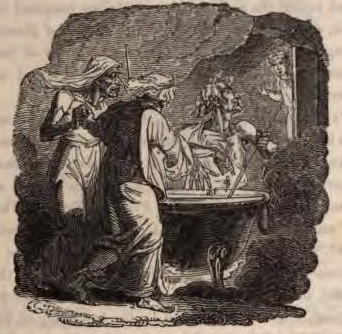
Next: Macbeth, Act 4, Scene 2 _____ Explanatory Notes for Act 4, Scene 1 From Macbeth. Ed. Thomas Marc Parrott. New York: American Book Co. (Line numbers have been altered.) _____ The interest in this act centres around Macbeth's relation to Macduff, who has been already pointed out as his sole opponent among the Scottish nobles. In the first scene, Macbeth is warned against him by name and resolves to put him to death; in the second, assassins, who have come too late to find him in his castle, massacre by Macbeth's orders his entire household; in the third we find him in England stirring up Malcolm to war against the tyrant, receiving the terrible news of the slaughter of his wife and children, and vowing revenge upon their murderer. We see less of Macbeth in this act than in any other, but we see enough to show us how, by this time, he has wholly given himself over to evil. The difference between the Macbeth whom the witches waylaid and the Macbeth who seeks them out has been already pointed out. Even more terrible is the difference between the Macbeth who was "too full o' the milk of human kindness to catch the nearest way," and the Macbeth who orders the massacre of Macduff's wife and children. The wanton cruelty of this crime, by which Macbeth has absolutely nothing to gain, marks the lowest point of his fall. At the close of the act, we join with Macduff in thinking of him as "this fiend of Scotland," and look forward eagerly to the punishment that is about to be meted out to him. It will be shown later on with what art the poet contrives to regain for him a certain portion of our sympathy. The witches who know that Macbeth is coming to consult them are revealed in a cavern preparing their enchantments. We may suppose that the caldron with all its horrible ingredients was necessary to call up the apparitions which the witches mean to show Macbeth. The student should note carefully the forms and utterances of these apparitions, and consider in what way their words confirm Macbeth in his evil purposes, and embolden him against repentance. The speeches of the witches are thrown into the same trochaic metre that they have employed on their former appearances. The difference between this and the light iambic metre in which Hecate speaks, is one of the main reasons for rejecting that character as the interpolation of another poet than Shakespeare. Please click here for detailed explanatory notes for the Witches' Chants (4.1.1-47) and analysis. 50. conjure, adjure. The accent is on the first syllable. The whole speech is very characteristic of the desperate recklessness of Macbeth. He is determined to have an answer from the witches, no matter what storms their enchantments raise, and no matter what destruction of life and property results. 50. profess, make claim to know. 53. yesty, frothy, like yeast. 54. navigation, ships. 55. bladed corn, corn in the green ear. 55. lodged, beaten down. 57. pyramids, towers, or steeples. 59. germens, seeds of life. 63. our masters, the evil spirits, whom the witches serve and who presently take shape as the three apparitions. 64. eaten. According to an old Scotch law a sow who ate her pigs was to be stoned to death as a monster. 65. nine farrow, litter of nine. 67. high or low, great spirit or small. 68. deftly, fitly. 68. The "armed," i.e. helmeted, head represents Macbeth's own head which was destined to be cut off by Macduff. The bloody child represents Macduff, who had been ripped from his mother's womb. Note the concealed meaning in the witch's statement that this apparition is more potent than the first. 74. harp'd, touched. 78. Had I ... hear thee, if I had more ears than I have, I'd listen to you with all of them; a figurative way of saying that Macbeth is listening with eager attention. 83. double, used here as an adverb. 84. take a bond of fate. "Fate" is probably used here in the sense of "Death." Macbeth intends to kill Macduff, and by so doing he will obtain a "bond," a sure pledge, from Death that Macduff will never harm him. Thus he will be doubly sure, first by the prediction just uttered, next by Macduff's death. 86. sleep in spite of thunder. Macbeth has already complained of his restless sleeplessness. It is natural to suppose that a stormy night, recalling to him the terrors of the night in which he murdered Duncan, would still further heighten his distress. But he thinks that if he can get rid of his last fear by killing Macduff, he will be able to rest again. 86. The third apparition represents young Malcolm; the tree represents Birnam wood. 88, 89. round And top, the crown and highest attainment. 93. Birnam wood, a forest twelve miles from Dunsinane. In this line "Dunsinane" is accented on the second syllable, elsewhere in the play on the first. 95. impress, force into service. 96. bodements, predictions. 97. Rebellious head, an army of rebels. 98. our high-placed Macbeth. The phrase seems rather awkward, coming from Macbeth himself. Possibly "our" has something of the force of the royal "We" in it. "High-placed" is thought by Dr. Liddell to refer to Macbeth's situation on Dunsinane hill. 99. the lease of nature the allotted span. 100. mortal custom, the custom of mortality, i.e. death. 106. noise, music. 111. Eight King, the eight sovereigns of the Scottish house of Stuart, from Robert II to James VI, inclusive. According to Holinshed, this house traced its descent back to Banquo. 118. I'll see, I wish to see. 119. a glass, a magic glass by means of which one could foresee the future. The eighth king who bears the glass is James VI of Scotland, ruling in England as James I when this play was written. Shakespeare meant to pay him a compliment by declaring that many of his descendants should reign. The present king of England is descended on the mother's side from James I. 121. balls, the golden orb carried by the monarch at his coronation. James was twice crowned, once in Scotland, and once in England. 121. treble sceptres, indicating the official title of the English monarchs from James I to George III, viz.: "King of Great Britain, France, and Ireland." 122. A syllable is wanting in the third foot. Its place is supplied by the pause after Macbeth's ejaculation, "Horrible sight!" 123. blood-bolter'd, with hair matted with blood. 124. What, is this so? These words, and the following lines to 132, inclusive, are almost certainly interpolated. Macbeth has just said, "I see 'tis true," and it is therefore out of keeping for him to ask the witches, "is this so?" The metre of the witch's speech is like that of Hecate in iii. 5, and unlike that which Shakespeare uses for the witches, and the suggestion of the witch that she and her sisters cheer up Macbeth by a dance, is too absurd to need discussion. The passage is one of the spectacular interpolations with which the reviser sought to increase the drawing power of Macbeth. 132. Our duties ... pay, our dutiful service (shown in the dance) gave him a welcome; an awkward and un-Shakespearean line. 134. Stand ... calendar, became a day marked in the calendar as one of ill omen. 127. sprites, spirits. 130. antic, fantastic, grotesque. 135. Enter Lennox. Lennox, we must imagine, had accompanied Macbeth on his visit to the witches, but had been left outside the cave. There is a distinct significance in the fact that the lord who, in the preceding scene, had called Macbeth a tyrant, appears here as his confidential companion. In spite of his spies Macbeth did not know how his nobles hated him. 139. damn'd all those that trust them, Macbeth does not realize that he is pronouncing judgment on himself, for, in spite of the show of the kings, he still trusts in the predictions of the witches. 144. anticipatest, preventest. 145. flightly, fleeting. 147. firstlings, first offsprings. 153. trace him in his line, his relatives. 155. sights, apparitions. 155. no more sights. Macbeth has had more than enough of the witches and their apparitions. ________ How to cite the explanatory notes:________ More Resources  The Chronology of Shakespeare's Plays
Establishing the Order of the Plays How Many Plays Did Shakespeare Write? Shakespeare Timeline Shakespeare's Reputation in Elizabethan England Words Shakespeare Invented Quotations About William Shakespeare Portraits of Shakespeare Shakespeare's Boss: The Master of Revels Top 10 Shakespeare Plays Shakespeare's Metaphors and Similes Shakespeare's Blank Verse Shakespeare Timeline Edward Alleyn (Actor) What is Tragic Irony? Characteristics of Elizabethan Tragedy The Chronology of Shakespeare's Plays
Establishing the Order of the Plays How Many Plays Did Shakespeare Write? Shakespeare Timeline Shakespeare's Reputation in Elizabethan England Words Shakespeare Invented Quotations About William Shakespeare Portraits of Shakespeare Shakespeare's Boss: The Master of Revels Top 10 Shakespeare Plays Shakespeare's Metaphors and Similes Shakespeare's Blank Verse Shakespeare Timeline Edward Alleyn (Actor) What is Tragic Irony? Characteristics of Elizabethan Tragedy
|
More to Explore Macbeth: The Complete Play with Annotations The Metre of Macbeth: Blank Verse and Rhymed Lines Macbeth Character Introduction Metaphors in Macbeth (Biblical) Elizabethan Use of Mummified Flesh Three Apparitions in Macbeth Supernatural Soliciting in Shakespeare Explanatory Notes for the Witches' Chants (4.1) The Theme of Macbeth Origin of the Weird Sisters Crafting a Sympathetic Macbeth The Moral Character of Macbeth Explanatory Notes for Lady Macbeth's Soliloquy (1.5) The Psychoanalysis of Lady Macbeth (Sleepwalking Scene) The Effect of Lady Macbeth's Death on Macbeth Is Lady Macbeth's Swoon Real?
Macbeth, Duncan and Shakespeare's Changes King James I and Shakespeare's Sources for Macbeth Contemporary References to King James I in Macbeth The Royal Patent that Changed Shakespeare's Life Soliloquy Analysis: If it were done when 'tis done (1.7.1-29) Soliloquy Analysis: Is this a dagger (2.1.33-61) Soliloquy Analysis: To be thus is nothing (3.1.47-71) Soliloquy Analysis: She should have died hereafter (5.5.17-28) Macbeth Plot Summary (Acts 1 and 2) Macbeth Plot Summary (Acts 3, 4 and 5) How to Stage a Production of Macbeth (Scene Suggestions) Is Macbeth the Third Murderer? A Comparison of Macbeth and Hamlet Knocking at the Gate in Macbeth Shakespeare's Sources for Macbeth The Curse of Macbeth Macbeth Q & A Essay Topics on Macbeth Aesthetic Examination Questions on Macbeth What is Tragic Irony? Stages of Plot Development in Macbeth Time Analysis of the Action in Macbeth Macbeth Study Quiz (with detailed answers) Quotations from Macbeth (Full) Top 10 Quotations from Macbeth Temptation, Sin, Retribution: Lecture Notes on Macbeth Untie the winds: Exploring the Witches' Control Over Nature Shakespeare on Omens Characteristics of Elizabethan Tragedy
Why Shakespeare is so Important Shakespeare's Language Shakespeare's Influence on Other Writers | ||||||||||||||||||||||||||||||||||||||||||||||||||||||||||||||||||||||||||||||||||||||||||||||||||||||||||||||||||||||||||||||||||||||||||||||||||||||||||||||||||||||||||||||||||||||||||||||||||||||||||||||||||||||||||||||||||||||||||||||||||||||||||||||||||||||||||||||||||||||||||||||||||||||||||||||||||||||||||||||||||||||||||||||||||||||||||||||||||||||||||||||||||||||||||||||||||||||||||||||||||||||||||||||||
©1999-2021 Shakespeare Online. All Rights Reserved.