Macbeth
Please see the bottom of the page and the highlighted text for full explanatory notes and helpful resources.
| ACT II SCENE I | Inverness. Court within the castle. | |
| | Enter BANQUO, and FLEANCE, bearing a torch before them | |
| BANQUO | How goes the night, boy? | |
| FLEANCE | The moon is down; I have not heard the clock. | |
| BANQUO | And she goes down at twelve. | |
| FLEANCE | I take't, 'tis later, sir. |
| BANQUO | Hold, take my sword. There's husbandry in heaven; | |
| | Their candles are all out. Take thee that too. | |
| | A heavy summons lies like lead upon me, | |
| | And yet I would not sleep: merciful powers, | |
| | Restrain in me the cursed thoughts that nature |
| | Gives way to in repose! | |
| | Enter MACBETH, and a Servant with a torch. | |
| | Give me my sword. | |
| | Who's there? | 10 | |
| MACBETH | A friend. | |
| BANQUO | What, sir, not yet at rest? The king's a-bed: |
| | He hath been in unusual pleasure, and | |
| | Sent forth great largess to your offices. | |
| | This diamond he greets your wife withal, | |
| | By the name of most kind hostess; and shut up | |
| | In measureless content. |
| MACBETH | Being unprepared
Our will became the servant to defect
Which else should free have wrought. | |
| BANQUO | All's well. | |
| | I dreamt last night of the three weird sisters: | 20 |
| | To you they have show'd some truth. | |
| MACBETH | I think not of them: | |
| | Yet, when we can entreat an hour to serve, | |
| | We would spend it in some words upon that business, | |
| | If you would grant the time. |
| BANQUO | At your kind'st leisure. | |
| MACBETH | If you shall cleave to my consent, when 'tis, | |
| | It shall make honour for you. | |
| BANQUO | So I lose none | |
| | In seeking to augment it, but still keep |
| | My bosom franchised and allegiance clear, | |
| | I shall be counsell'd. | |
| MACBETH | Good repose the while! | |
| BANQUO | Thanks, sir: the like to you! | 30 | |
| | Exeunt BANQUO and FLEANCE. | |
| MACBETH | Go bid thy mistress, when my drink is ready, |
| | She strike upon the bell. Get thee to bed. | |
| | Exit Servant. | |
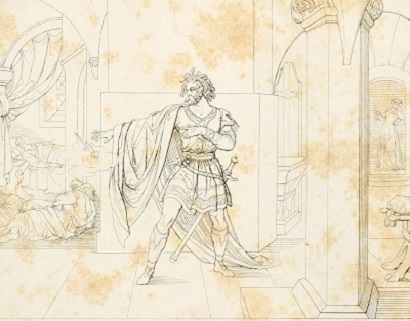
| | Is this a dagger which I see before me, | |
| | The handle toward my hand? Come, let me clutch thee. | |
| | I have thee not, and yet I see thee still.
| |
| | Art thou not, fatal vision, sensible |
| | To feeling as to sight? or art thou but | |
| | A dagger of the mind, a false creation, | |
| | Proceeding from the heat-oppressed brain? | |
| | I see thee yet, in form as palpable | 40 | |
| | As this which now I draw. |
| | Thou marshall'st me the way that I was going; | |
| | And such an instrument I was to use. | |
| | Mine eyes are made the fools o' the other senses, | |
| | Or else worth all the rest; I see thee still, | |
| | And on thy blade and dudgeon gouts of blood, |
| | Which was not so before. There's no such thing: | |
| | It is the bloody business which informs | |
| | Thus to mine eyes. Now o'er the one halfworld | |
| | Nature seems dead, and wicked dreams abuse | 50 | |
| | The curtain'd sleep; witchcraft celebrates |
| | Pale Hecate's offerings, and wither'd murder, | |
| | Alarum'd by his sentinel, the wolf, | |
| | Whose howl's his watch, thus with his stealthy pace. | |
| | With Tarquin's ravishing strides, towards his design | |
| | Moves like a ghost. Thou sure and firm-set earth, |
| | Hear not my steps, which way they walk, for fear | |
| | Thy very stones prate of my whereabout, | |
| | And take the present horror from the time, | |
| | Which now suits with it. Whiles I threat, he lives: | 60 | |
| | Words to the heat of deeds too cold breath gives. |
| | A bell rings. | |
| | I go, and it is done; the bell invites me. | |
| | Hear it not, Duncan; for it is a knell | |
| | That summons thee to heaven or to hell. | |
| | Exit. | |
Next: Macbeth, Act 2, Scene 2
______
Explanatory notes below for Act 2, Scene 1
From Macbeth. Ed. Thomas Marc Parrott. New York: American Book Co.
(Line numbers have been altered.)
______
The second act is devoted wholly to the murder of Duncan. There is practically no time interval between this and the preceding act. It begins after midnight on the day of the king's arrival at Inverness, with a scene devoted to the preliminaries of the murder,
and closes late in the following day with a scene telling us of the immediate consequences of the deed, the flight of the princes and
the election of Macbeth to the sovereignty.
The first scene falls into three parts; the dialogue between Banquo and his son, the dialogue between Macbeth and Banquo,
and the soliloquy of Macbeth before the murder. It is laid in the inner court of Macbeth's castle, from which there was easy access
to the bedchambers by means of the gallery that surrounded the court. Banquo is on his way to bed, accompanied by his son, who
bears the torch. On his way he hands over to Fleance his sword (line 4) and perhaps his dagger (line 5), which he will not need
to have by his bedside in a friendly house.
4. husbandry, frugality, economy.
5. thee, to thyself, the dative of interest.
6. A heavy summons, a drowsy influence.
7. I would not sleep. Banquo's reason for wishing to remain
awake is given in the next lines. On the night before this he had
dreamt of the witches (1. 20), and their prophecy has seemed to
him, in his sleep, a temptation to evil. This explains his prayer
to heaven to restrain "the cursed thoughts." Shakespeare, no
doubt, means us to contrast the two figures who appear in this
scene, both tried by the same temptation, Banquo praying against
its power over even his hours of sleep, Macbeth waking, and
watching to turn its suggestions into deeds.
9. Gives way to, gives free rein to.
9. my sword. It marks, perhaps, the excited state of Banquo's
mind, that when he sees the light of Macbeth's torch, he at once
calls to Fleance to return him his sword.
14. largess, gifts.
14. offices, servants' quarters.
16. shut up, concluded, i.e. finished the banquet, and went to
bed. Note the irony of the situation as described in these lines.
17-19. Being unprepared ... wrought. Since I was taken
by surprise, my desire, to entertain fhe king fittingly, was impeded
by unavoidable deficiencies; otherwise, it would have displayed
itself at full, liberally.
19. All's well, Banquo assures Macbeth that his entertainment
has been suitable.
22. entreat an hour to serve, beg an hour of your time for our
service. Note how Macbeth in this speech adopts unconsciously
the royal mode of speaking of himself in the plural. He knows
that when he has this conversation with Banquo he will be king,
and speaks as if he were already crowned.
25. cleave to my consent, Macbeth is throwing out a line, so to
speak, for Banquo. "If you join my party," he says, "you'll gain
new honours by so doing."
25. consent, counsel.
25. When 'tis. This phrase is purposely obscure; Macbeth does
not care to speak out plainly. We may take it, however, as referring to the proposed conference on the subject of the witches'
prophecy.
26-29. So I lose ... counsell'd, It is hard to decide just what
was in the mind of Banquo when he uttered these words. He may possibly have suspected Macbeth of wishing to form some conspiracy against the king. In this case he wished to give him a friendly but emphatic warning that he would be no party to it.
"I'll take your advice," he says, referring to Macbeth's phrase,
"cleave to my consent," "so long as I do not forfeit thereby my
character as an honourable man, but still keep my heart free from
guilt and my loyalty to my king unstained."
28. franchised, free.
28. clear, unstained.
29. Macbeth sees that nothing is to be gained from Banquo, and
closes the conversation.
32. The bell is really to let Macbeth know that everything is in
readiness for the murder.
36. sensible, perceptible.
33-64. In this long soliloquy we find Macbeth, whose mind is
wrought almost to madness by the deed he is about to perpetrate,
the victim of a hallucination. He thinks for a moment that he actually sees a dagger floating before him; but with a strong effort he recovers his self-possession and pronounces the vision unreal. Then he plunges into a gloomy reverie, illumined by lightning flashes of
poetic imagination. He is roused from this mood by the sound of
the signal for action, and without hesitating longer hurries to Duncan's chamber. [For more on this soliloquy please click here.]
44, 45. Mine eyes ... rest. If the dagger is unreal, his eyes,
which testify to its presence, are pronounced foolish by his other
senses. If on the contrary, the dagger is really there, the testimony of his eyes is more reliable than that of his other
senses.
46. dudgeon, handle.
46. gouts, drops.
46. Notice how the dagger seems to grow more real to Macbeth;
he can now distinguish drops of blood on its blade and handle.
48. informs, takes shape.
48. the bloody business, the murder, which is occupying his mind,
seems to take visible shape in the form of a dagger.
50. abuse, deceive.
51. An unaccented syllable is lacking in the third foot of this
line. Its place is taken by the pause between two clauses.
"Sleep" is here personified as a man resting in a curtained bed.
Evil dreams play about him and deceive his mind.
52. Hecate, one of the many names of Diana. In Shakespeare's day she was regarded as the goddess and queen of
the witches. Shakespeare always pronounces her name as two syllables.
52. wither'd murder, murder is here personified as a gaunt an
ghostlike man.
53. Alarum'd, called to arms. The word comes from the
Italian phrase all 'arme, "to arms."
54. Whose howl's his watch, the long howl of the wolf is thought
of as the call of a sentinel upon his watch.
55. Tarquin's, Sextus Tarquin who ravished Lucretia. The
adjective "ravishing" is transferred from Tarquin to the "strides"
that took him into Lucretia's chamber.
57. Hear not ... take. Hear not the direction my steps
take, i.e. toward Duncan's chamber. Macbeth fancies in his overwrought mood that if the very stones of the courtyard knew which
way he was going they would cry out and reveal his presence.
58. whereabout, purpose.
59. take the present horror, take away, by their outcry, the prevailing silence, "present horror," which so befits the time.
61. gives, another instance of the Northern plural. The line means that words blow cold upon the heat of action.
________
How to cite the explanatory notes:
Shakespeare, William. Macbeth. Ed. Thomas Marc Parrott. New York: American Book Co., 1904. Shakespeare Online. 10 Aug. 2010. < http://www.shakespeare-online.com/plays/macbeth_2_1.html >.
________
More Resources
 The Chronology of Shakespeare's Plays The Chronology of Shakespeare's Plays
Establishing the Order of the Plays
How Many Plays Did Shakespeare Write?
Shakespeare Timeline
Shakespeare's Reputation in Elizabethan England
Words Shakespeare Invented
Quotations About William Shakespeare
Portraits of Shakespeare
Shakespeare's Boss: The Master of Revels
Top 10 Shakespeare Plays
Shakespeare's Metaphors and Similes
Shakespeare's Blank Verse
Shakespeare Timeline
Edward Alleyn (Actor)
What is Tragic Irony?
Characteristics of Elizabethan Tragedy
|
More to Explore
Macbeth: The Complete Play with Annotations and Commentary
The Metre of Macbeth: Blank Verse and Rhymed Lines
Macbeth Character Introduction
Metaphors in Macbeth (Biblical)
Macbeth, Duncan and Shakespeare's Changes
King James I and Shakespeare's Sources for Macbeth
Contemporary References to King James I in Macbeth
The Royal Patent that Changed Shakespeare's Life
The Theme of Macbeth
Is Macbeth the Third Murderer?
Soliloquy Analysis: If it were done when 'tis done (1.7.1-29)
Soliloquy Analysis: Is this a dagger (2.1.33-61)
Soliloquy Analysis: To be thus is nothing (3.1.47-71)
Soliloquy Analysis: She should have died hereafter (5.5.17-28)
Explanatory Notes for Lady Macbeth's Soliloquy (1.5)
The Psychoanalysis of Lady Macbeth (Sleepwalking Scene)
Is Lady Macbeth's Swoon Real?
_____
|
Points to Ponder ... Just as talk of the murder is about to stifle his courage, Macbeth's intense illusion is shattered by the bell, a signal from Lady Macbeth that Duncan's chamberlains are asleep, and Macbeth races away to commit the heinous crime. One can only wonder if a few more moments of deliberation would have changed Macbeth's mind. More on Macbeth's soliloquy...
|
_____
Explanatory Notes for the Witches' Chants (4.1)
Macbeth Plot Summary (Acts 1 and 2)
Macbeth Plot Summary (Acts 3, 4 and 5)
How to Stage a Production of Macbeth (Scene Suggestions)
A Comparison of Macbeth and Hamlet
The Effect of Lady Macbeth's Death on Macbeth
The Curse of Macbeth
Shakespeare's Sources for Macbeth
Macbeth Q & A
Essay Topics on Macbeth
Aesthetic Examination Questions on Macbeth
What is Tragic Irony?
Stages of Plot Development in Macbeth
Time Analysis of the Action in Macbeth
Macbeth Study Quiz (with detailed answers)
Quotations from Macbeth (Full)
Top 10 Quotations from Macbeth
Crafting a Sympathetic Macbeth
The Moral Character of Macbeth
Origin of the Weird Sisters
Temptation, Sin, Retribution: Lecture Notes on Macbeth
Untie the winds: Exploring the Witches' Control Over Nature
Characteristics of Elizabethan Tragedy
Why Shakespeare is so Important
Shakespeare's Language
Shakespeare's Influence on Other Writers
|