| directory |
| home | contact |
|
|||||||||||||||
| search | |||||||||||||||
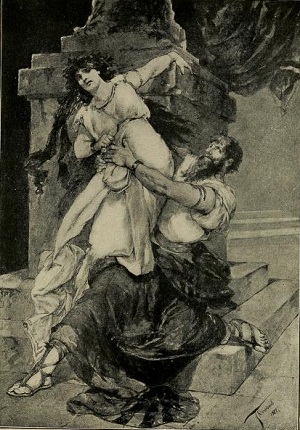
Pericles: Plot SummaryFrom Stories of Shakespeare's Comedies by Helene Adeline Guerber. New York: Dodd, Mead and company.Act IAn actor reciting the prologue before the palace at Antioch, tells us this is a new version of an old Greek story, which has often entertained the public, and which relates how Antiochus the Great, founder of this city, became guilty of incest, and compelled all who came to sue for his daughter's hand to solve a riddle on that unsavory subject or forfeit their lives.The first scene represents the palace, at the moment when the king is receiving Pericles, Prince of Tyre, who has come hither to woo the beautiful princess. After questioning whether he is willing to risk all and is aware of the terrible penalty, the king allows Pericles to behold the dazzling beauty of his daughter, which causes the new candidate for her favour to exclaim he realises the perils of the task but is ready to venture all for her sweet sake. After a little more conversation, intended to deter him from so rash a venture, Pericles induces Antiochus to propound the riddle, saying, 'like a bold champion, I assume the lists, nor ask advice of any thought but faithfulness and courage.' The enigma given him is framed in such oracular style that previous solvers have all lost their lives. It does not, however, baffle the superior intelligence of Pericles, who, on discovering its horrible purport, betrays such dismay in his changed countenance and in the gasping cry that he no longer aspires to the princess' hand, that Antiochus, wishing to ascertain whether his secret has really been guessed, forces him to give an answer. Driven thus to bay, the Prince of Tyre replies in so guarded a manner that only the criminals realise he has solved their riddle. Muttering in an aside that he will have this bold guesser's life, Antiochus remarks aloud that, although he could pass immediate judgment and retrench Pericles' life for failure, he means to grant him a respite of forty days, during which time he can think the matter over, and be entertained as 'doth befit our honour and your worth.' All going out after this statement, the unfortunate Pericles is left alone, and we overhear him bitterly commenting upon his ghastly discovery, and hotly reviling the criminals, whom he compares to serpents. Then, fearing lest they may murder him should he remain, Pericles suddenly decides 'by flight I'll shun the danger which I fear,' and hastens away. He has barely gone when Antiochus enters the apartment, wondering how he can slay this bold prince, and thus prevent his publishing abroad his shameful discovery. When joined by his confidant, Antiochus bribes this man with gold and the promise of advancement to poison the Prince of Tyre. His confidant is about to depart to execute these orders when a messenger rushes in, reporting that Pericles has fled. Bidding his confidant hasten after the fugitive like an 'arrow shot from a well-experienced archer,' and not return until he can report him dead, Antiochus hears him use this strange anachronism, 'if I can get him within my pistol's length, I'll make him sure enough: so, farewell to your highness.' We are next transferred to a room in the palace of Tyre, where Pericles, just arrived from Antioch, is explaining that since his discovery of Antiochus' guilty secret, he has not enjoyed a moment's peace, but constantly dreads being pursued and slain by this implacable foe. While he is talking, his chief friend, Helicanus, escorted by some Tyrian lords, comes to welcome him home. Greeting them kindly, the prince soon begs to be left alone with his friend, whom he wishes to consult on matters of state, and then, only, reveals to Helicanus his discovery of Antiochus' incest, his flight, and fear lest vengeance may be wreaked upon Tyre. Pericles vows that this 'drew sleep out of mine eyes, blood from my cheeks, musings into my mind, with thousand doubts how I might stop this tempest ere it came.' That such fears are not vain, Helicanus keenly realises, since he advises Pericles to go away and travel, meanwhile entrusting the government of Tyre to some one else. He vows that, should that charge be confided to him, 'day serves not light more faithful than I'll be.' Hearing which, Pericles decides to sail immediately for Tarsus, where he directs Helicanus to write and keep him posted how things are progressing. Shortly after, in an antechamber of the same palace, we behold the arrival of the confidant of Antiochus, who gazes fearfully around him, murmuring he has come here to kill the prince, and must either fulfil this task or be slain on his return home. All at once Helicanus enters with some other lords, and the confidant learns from their conversation how Pericles, having been so unfortunate as to incur Antiochus' displeasure, has banished himself from Tyre for a time, leaving its rule to Helicanus, and has gone to sea as a species of penance. Unable to reach his prey, yet sure Pericles will perish at sea, the confidant resolves to go back to Antioch and announce his death. This decision taken, he presents himself to the Tyrians, saying he had a message for Pericles which he perceives he will not be able to deliver. He accepts, however, the invitation they extend and feasts with them ere he returns home. We now behold a room in the governor's house, at Tarsus, where Cleon, the governor, is sadly remarking to his wife, Dionyza, that their woes have reached their culminating point, for the city has so long been a prey to famine that the inhabitants are reduced to the last extremity. No grief ever equalled theirs, Dionyza assures him, while she rejects his suggestion to forget her sufferings in sleep. Both mourn that a city, once so prosperous, should now be in such dire straits, that even cases of cannibalism have occurred. They are still talking, when a lord rushes in reporting that a vessel under full sail is bearing straight down upon the city in a threatening way. Sadly convinced that 'one sorrow never comes but brings an heir, that may succeed as his inheritor,' Cleon fancies this vessel is laden with foes about to capture his defenceless city. His fears are slightly allayed, however, when the messenger states white flags float from its masthead, although these peaceful tokens may be mere feigning, for he 'who makes the fairest show means most deceit.' After bidding the lord ascertain as soon as possible the intentions of the newcomers in regard to the stricken city, Cleon anxiously awaits further developments. A few moments later the same lord ushers in Pericles, who declares he has come here in a friendly spirit, having learned at Tyre that Tarsus was suffering from famine. Instead of hostile forces his ship is laden with provisions, which will 'give them life whom hunger starved half dead.' These joyful tidings cause delirious joy among the Tarsians, and Cleon gratefully assures Pericles they will never forget his timely help. In reply to an invitation to tarry with them, Pericles promises to 'feast here a while, until our stars that frown lend us a smile.' Act IIThe second act also opens with a prologue by the actor, recapitulating all that has already occurred, and describing how the inhabitants of Tarsus have gratefully erected a statue in honour of their benefactor Pericles. Then the curtain rises, and in dumbshow we behold Pericles entering by one door, apparently talking to Cleon and his train. Through another door appears a gentleman, who hands a letter to Pericles, which he soon passes on to Cleon, who rewards the bearer by knighting him. Then we witness the parting of Pericles and Cleon, ere the dumbshow ceases, and the actor resumes his explanations. He declares that this letter, forwarded by Helicanus, reports that Antiochus sent a messenger to Tyre to murder Pericles, and warns him not to linger long at Tarsus lest another assassin be despatched thither to slay him. It is on account of this caution that Pericles sails away and soon finds himself in great peril at sea.When the curtain next rises, we behold a beach near Pentapolis, just as Pericles has been cast there by the waves, which he reviles for swallowing up his ship and companions. While he is bidding them cease raging, since they have shown their power by depriving a prince of all he owns, three fishermen come forward to cast their nets. They are gossiping about their occupations and the storm, during which many lives were evidently lost, for distressing cries were repeatedly heard. They describe the signs which herald a great tempest, and mention the fact that big fishes live on small ones, just as misers thrive on the spoils of others, until Pericles, who is hiding in the rocks near by, learns from their conversation that he has been cast on the shores of Simonides, the most peaceful and benevolent of monarchs. After commenting upon the labours of these men and their shrewd wit, Pericles suddenly emerges from his hiding-place, and advancing toward them, wishes them peace and prosperity. Amazed at the sight of a stranger, the fishermen enquire whence he came, and on hearing he has been shipwrecked, offer all manner of assistance. They feel sure, however, that unless he is expert at their trade, he will never be able to make a living here. Still, because Pericles seems cold and hungry, they charitably promise him food and raiment, ere two of them go off to draw up their nets, while the third lingers behind to give the stranger further information in regard to the country and its king. Among other interesting items, the fisherman mentions that Simonides' daughter, Thaisa, will celebrate her birthday on the morrow, and that many princes and knights have 'come from all parts of the world to just and tourney for her love.' Hearing this, Pericles, - who is an adept in all chivalric games, - fervently wishes he had saved his armour, at least, so he might try his luck in this tournament. At that moment, the two fishermen loudly call for help, as their net proves too heavy to haul in, and unexpectedly find, caught in its meshes, the very armour Pericles mourns. Hailing this suit with rapture, Pericles explains to the men under what circumstances it was given to him; how lost; and adds that his shipwreck is now no ill since he has here his 'father's gift in's will.' He, therefore, begs the armour from the fishermen, saying he will don it and try his luck; and, promising that if he succeeds thereby in improving his fortunes, he will reward them richly for their aid. The fishermen consent to his wishes, and Pericles rejoices that he still possesses a jewel of sufficient worth to secure him a horse, ere he gratefully accepts the offer of a pair of trousers from one fisherman, and the services of another as guide to court. We now behold the pavilion where the king, princess, and lords have come to view the tournament. After enquiring whether all are ready to begin the knightly game, Simonides gives the necessary signal, announcing that Thaisa will first pass in review all the candidates about to strive for her favour. The princess, who is very modest, chides her father for overpraising her in this speech, although he proudly insists it is impossible to do so, ere he begs her to expound for his benefit the devices on each knight's shield. One champion after another now prances past the princess, holding aloft his shield for her inspection, and she readily reads not only the owner's name and country, but interprets the meaning of his Latin device. Five knights have passed by, and the princess has cleverly translated all their mottoes, when last of all Pericles appears. His graceful bearing distinguishes him amid the rest, and his device, a withered branch still green at the top, with the motto 'in that hope I live,' seems particularly appropriate, since all know he has lost everything at sea and hopes to mend his fortunes by triumphing in these games. The lords present, however, comment scornfully on the rustiness of his armour, and on his presumption in daring to appear among so many famous and wealthy candidates. Hearing this, Simonides reminds Pericles' detractors that 'opinion's but a fool, that makes us scan the outward habit by the inward man,' ere he leads his daughter up to the gallery. There, a few moments later, loud cries proclaim that Pericles, 'the mean knight,' has prevailed over every foe and has reaped all the honours of the day. We next behold a hall of state, where Simonides, his daughter, and court are entertaining the champions. After the king has addressed the assembled knights, the princess bestows upon the victor a crown, which he modestly assures her was won more by fortune, lady, than by merit.' Hearing this, the king insists it was no small feat to triumph over so many brave foes, and that Pericles has nobly earned the honour to sit beside his daughter. Wishing to show themselves true sportsmen, all the lords present declare 'we are gentlemen that neither in our hearts nor outward eyes envy the great nor do the low despise,' a courtesy for which Pericles returns hearty thanks. Meantime, the princess, who has been watching Pericles, murmurs in an aside that he is such 'a gallant gentleman' that she has fallen deeply in love with him. Her father also seems to approve highly of the youth, while Pericles is impressed by Simonides' resemblance to his own father, who used to sit in similar state, and for whom he always felt great admiration and respect. After some drinking of healths, Simonides, becoming aware of the fact that the stranger is melancholy, bids his daughter challenge him to drink. At first Thaisa demurs, thinking this too bold a step for a maid to take, and whispering that the stranger 'may my proffer take for an offence, since men take women's gifts for impudence.' Still, urged by her father, she finally turns to Pericles, remarking her father wishes to drink his health and would fain know his name. After duly acknowledging the proffered courtesy, Pericles states he is a gentleman from Tyre, who seeking adventures, was shipwrecked on their coast. He conceals his title, however, for fear lest An- tiochus may still be pursuing him; but such is the distinction of his bearing that father and daughter seem as well pleased with him as if he had proclaimed his real rank. To divert him from his melancholy, the king now orders the knights to dance, and encourages Pericles to take part in the revels by treading a measure with the princess. Such grace does the stranger display in this exercise, too, that he wins high praise ere the company separates for the night, Simonides declaring the time of rest has come, but that 'to-morrow all for speeding do their best.' We next behold a room in the governor's house at Tyre, where Helicanus is informing one of his friends how Antiochus and his daughter met due punishment for their heinous crime while riding together in a chariot of inestimable value. We are briefly told that 'a fire from heaven came and shrivelled up their bodies,' leaving both corpses in such loathsome condition that no one was willing to approach to bury them. Such a doom seems fitting to the listener, who has barely expressed approval when sundry other lords come in. After the usual exchange of civilities, these Tyrians inform Helicanus that, feeling sure their prince has perished, they have come to beg permission to seek for his remains, so they can bury them properly, ere they elect a new sovereign. They pronounce no one better fitted to govern than Helicanus, whom Pericles himself selected as his representative. When they unanimously cry 'Live Helicanus,' he implores them to be patient for another twelve-month, so as to make sure poor Pericles has perished at sea and will never return. It is only after considerable demur that the lords accede to this delay, which the faithful Helicanus insists upon, for he is not at all anxious to supplant his master. This agreement reached, Helicanus nobly concludes 'then you love us, we you, and we'll clasp hands: when peers thus knit, a kingdom ever stands.' We now return to Pentapolis, where Simonides enters a room in his palace, intently reading a letter, from which he glances up only to return the greetings of his knights. It is the day after the tournament has ended, and he announces that Thaisa has decided to postpone marriage for another twelve-month, meantime denying herself to all her suitors. On learning they will not even be favoured with a glimpse of the beautiful princess during these long, weary months, the knights regretfully depart. When they have gone, Simonides reveals that he has resorted to this stratagem because his daughter informs him in a letter that she will either marry the stranger knight, or nevermore 'view nor day nor light.' Because her choice fully coincides with his own wishes, Simonides decides Thaisa's decision shall not long remain a secret, just as Pericles steps into the room. After a little talk in regard to some music with which Pericles favoured them on the previous evening, Simonides carelessly asks his opinion of his fair daughter. In return he receives a flattering reply, which causes him to rejoin that Thaisa thinks well enough of Pericles to wish to become his scholar. Because Pericles seems incredulous, Simonides shows him the princess' letter, which so amazes the prince that he wonders whether this is not some crafty device to entrap a distressed stranger. His fears seem to be confirmed when Simonides suddenly accuses him of having bewitched his daughter, an accusation he hotly refutes, saying he considers it base to use magic arts to win a maiden's heart. When denounced as a villain, traitor, and liar, Pericles haughtily rejoins his actions are as noble as his thoughts, 'that never relish'd of a base descent,' and asseverates he came to this court 'for honour's cause,' as he haughtily offers to prove at the point of his sword. Seeing the princess enter just then, Pericles impetuously implores her as she is as virtuous as fair, to state whether he ever tried to make love to her. When Thaisa rejoins that even if he had, no one would take offence at it, her father is secretly delighted, for he is more and more convinced the stranger is far nobler than he has confessed. He, therefore, invites Pericles to respond to the princess' wooing, makes them join hands, and bids them kiss each other, ere he proceeds to wish them joy. Such a consummation of his hopes proves so delightful to Pericles, that he fervently swears to love the princess even as my life my blood that fosters it,' and the scene closes with Simonides' formal announcement that the wedding will take place without further delay. Act IIIThe third act also opens with a prologue by the actor, who describes how the marriage feast being over, quiet reigns in the palace, where the married couple dwell happily for several months. Then, in dumbshow, we see Pericles and Simonides greeted by an ambassador from Tyre, who delivers a letter. After reading this missive, Pericles hands it over to his father-in-law, and receives the homage of the Tyrian lords. While he is doing so, his wife, Thaisa, enters, closely attended by a nurse, and when she too has perused the letter, betrays signs of keen joy. We next see her and Pericles taking affectionate leave of Simonides, ere they pass off the stage escorted by the Tyrian lords, and the nurse. This dumbshow finished, the actor resumes his explanations, stating how Helicanus, after careful search, has at last discovered Pericles, and in this letter announces to him the death of his foe, and summons him to return to Tyre unless he wishes to forfeit his crown. For this reason Pericles decides to return home immediately, yet hesitates to expose his beloved wife to a rough sea-journey, since she is now in delicate health. Her entreaties, however, prevail over his fears, so the royal couple embark, Pericles fervently hoping the waters will be smooth so that they can land in Tyre before the critical moment comes. Instead of this, however, a terrible tempest overtakes his ship, and inspires poor Thaisa with such terror, that her babe comes into the world before its time.The rising curtain reveals this tossing ship, and we overhear the almost frantic Pericles calling alternately upon the god of the sea to abate his wrath, and upon the goddess of child-birth to watch over his beloved wife. While he is wildly praying, the nurse appears on deck with an infant, which she bids him take to his bosom as sole reminder of his dead queen. At first Pericles cannot realise his beloved wife has gone; then he wails, 'O you gods! why do you make us love your goodly gifts, and snatch them straight away? We here below recall not what we give, and therein may use honour with you.' The nurse, however, implores him to be manly for the helpless child's sake, words which touch unsuspected depths in Pericles' heart, for even while giving way to his grief, he fervently prays that his babe's life may be mild, although it has found in the world so rude a welcome. Just then two sailors appear, and Pericles enquires whether the storm will not soon abate, for he fears it may yet cost the life of the delicate babe as well as that of the mother. With true sailor superstition, these men no sooner hear the queen is dead than they fancy it is the presence of her corpse which is placing their lives in peril. They, therefore, insist that Pericles place her in a coffin and cast her overboard. Although loath to part so soon with Thaisa's beloved remains, Pericles feels compelled to yield to such superstitious terrors. He, therefore, calls for the coffin always carried on board ship, and gives orders that his wife be placed in it, enveloped in a white satin cerecloth. He also adds some jewels and a letter, which he writes himself, wherein he implores the finder for charity's sake to give this corpse a suitable burial. After a tender leave-taking of the remains which are to be cast into the sea, Pericles decides that instead of pursuing their journey to Tyre, they will land at Tarsus, to secure Cleon's care for the delicate babe. The next scene is played at Ephesus, in the house of the physician Cerimon, who is comforting some persons who have suffered shipwreck in this frightful storm. He and his attendants, while dealing out food and medicine to those who come in quest of them, converse with some gentlemen, who comment upon the fury of the storm, and compliment Cerimon on the skill which has enabled him to save so many lives. The physician assures them his calling brings its own reward, since there is 'more content in course of true delight than to be thirsty after tottering honour, or tie my treasure up in silken bags, to please the fool and death.' While they are still talking, servants stagger in with a huge chest, reporting with excitement that the biggest wave they ever saw cast it at their feet, and that it must contain great treasures. The gentlemen, however, opine it looks more like a coffin, for it is carefully sealed and closed. In the physician's presence it is now opened, and he is surprised to be greeted by a strong odour of spices and to discover therein a corpse carefully wrapped in a satin cerecloth. On discovering the jewels and paper Cerimon quickly reads Pericles' heart-broken appeal, exclaiming that the writer must have had a 'heart that even cracks for woe!' Then, true to his call, life is still lingering within it, for the lady is in a state of coma and not dead. As he concludes she has not been more than five hours in this condition, and knows of cases which recovered after nine, he immediately sets to work to revive her. Friction, heat, and all the applications skill can suggest are now brought into play, while soft music is played so that when the patient rouses she will be reassured by sweet sounds. After a period of suspense, during which nothing is heard save breathless exclamations, interrupted by the physician's curt, pertinent orders, the lady comes to life again, asking faintly where she is and where is her lord. To prevent her being startled, - for a relapse would mean death, - Cerimon has her borne into a neighbouring chamber, fervently praying the god of medicine to guide his efforts to save her. The curtain next rises on Tarsus, where Pericles is confiding his little daughter and her nurse, - at the end of a twelve months' sojourn, - to the kind care of Cleon and Dionyza, bidding them care for his child as tenderly as for their own. Mindful of the benefits he has conferred upon them and their people, Cleon rejoins that even should they be inclined to neglect Marina, - thus called because born at sea, - the people of Tarsus would insist upon their doing their duty to the child of their benefactor. It is only because Tyre will be lost unless he returns there, that Pericles now departs, but he vows to let his hair grow until he sees his daughter again, or until she is safely married. With endless assurances of fidelity on the part of Cleon and Dionyza, to whom he entrusts his babe and her nurse, Pericles finally departs. We are again transferred to Cerimon's house, just after the complete recovery of Thaisa, while he is relating to her in what state she was found, and exhibiting Pericles' letter. All Thaisa can remember is a terrible storm and her sudden illness, but, sure never to see her husband again, - for she deems he must have perished, - she decides to assume the duties and costume of a Vestal, spend the rest of her life in retirement, 'and never more have joy.' This resolution is approved by Cerimon, who knows of a fane near by, where his own niece can attend her. The curtain falls while Thaisa is still thanking her rescuer for his kind efforts in her behalf, and assuring him 'my good will is great.' Act IVThe fourth act also opens with a prologue by the actor, describing how Pericles dwelt sorrowfully at Tyre, while his wife served as a Vestal in the temple, and his daughter was being trained at Tarsus as befitted her position in life. By the time Marina is fourteen 'she hath gain'd of education all the grace, which makes her both the heart and place of general wonder.' Such is her talent that she far outshines her foster-sister, the child of Cleon and Dionyza, for which reason the latter becomes so bitterly jealous of her that she determines to injure her. Because every one admires the peerless Marina, and pays no heed whatever to her insignificant daughter, Dionyza decides that, since the nurse is dead, she must get rid of the little princess.When the curtain rises, we behold an open place near the seashore, where Dionyza is bargaining with a murderer, and reminding him how one blow, - which will never be known, - will settle the whole question. She fears, however, that his heart may fail him, for she sternly warns him 'let not conscience, which is but cold, inflaming love i' thy bosom, inflame too nicely; nor let pity, which even women have cast off, melt thee, but be a soldier to thy purpose.' These words nerve the murderer to accept this loathsome task, and he has barely said so when Marina comes upon the scene, carrying flowers to strew upon the grave of the nurse for whom she mourns in touching grief. She has vowed to keep this grave carpeted with flowers in memory of all her nurse did for her, ever since she took her from her dying mother on shipboard, and moans that 'this world to me is like a lasting storm, whirring me from my friends.' Seeing Marina appear, Dionyza enquires why her daughter is not with her; then, pretending to consider her pale, sends her off to walk on the seashore with the murderer, Leonine, declaring exercise will cause her to appear to better advantage when her father comes to get her. After a little idle conversation with her escort in regard to the wind and the tempestuous sea, - with sundry touching reminiscences of her nurse's descriptions of the stormy night when she was born, - Marina is startled when Leonine suddenly bids her say her prayers for he is going to kill her. This rough order terrifies poor Marina, who pleads that she never hurt anything in her life, and declares that when she once accidentally trod upon a worm she shed tears about it. Notwithstanding her entreaties, Leonine is about to execute Dionyza's orders, when pirates suddenly appear and drive him away. On perceiving a beautiful girl, these pirates decide to carry her off and sell her as a slave, vowing the money so obtained will be equally divided among them. Only after they have gone with their prey, does Leonine return, and, seeing their boat vanish in the distance, vows he will swear that he threw Marina into the sea. The next scene is played in a house of ill-fame at Mitylene, where, after considerable dialogue in regard to their loathsome business, the owners of the place conclude they had better purchase another girl. One of their number is, therefore, despatched to the slave-market, whence he soon returns with the pirates, who offer Marina for sale. Such is her beauty that she is immediately purchased and entrusted to the care of the pander's wife. Realising suddenly where she is, Marina bitterly regrets Leonine could not fulfil his evil purpose ere the pirates seized her, or that the latter did not cast her into the sea to join her dead mother. When the rough inmates of this place try to cheer her, their remarks fill her with such loathing that she promises herself, 'if fires be hot, knives sharp, or waters deep, untied I still my virgin knot will keep.' Meantime, her arrival is being diligently advertised, her owners rejoice to hear many patrons are most anxious to see her, and foresee her presence will bring them increased gains. The curtain next rises in Tarsus, where Cleon is reproaching his wife and the murderer for what they have done, and wondering what they shall say when Pericles comes to claim his child. This does not trouble Dionyza, who answers they will describe how Marina died and will take her father to the tomb they are going to erect in her memory. All she has done seems justifiable, because Marina so far outshone her own offspring that the latter had no chance to secure any attention as long as her companion was near. In the next scene, an actor, standing before Marina's monument at Tarsus, explains under what circircumstances it has been erected, and how Pericles is even now coming to claim his child. In dumbshow we next behold the arrival of Pericles and of his train, and the exhibition of Marina's monument. After lamenting and donning sackcloth, Pericles departs from Tarsus, angry at fate, and the actor reads aloud the lying inscription stating how Marina, daughter of the king of Tyre, born at sea, is buried close beside its waves. He adds that although Pericles, deeming his daughter dead, intends to mourn her forever, she is now in Mitylene, which we next behold. Several gentlemen are seen issuing from the house where Marina is detained, vowing never have such experiences befallen them, for they have been preached at to such good effect in this place that they come away resolved to lead virtuous lives hereafter. The owners of the house are indignant, however, that Marina's innocent talk should convert their clients, and when a new one enters, hope he will prove more successful than his predecessors, although they opine Marina 'would make a Puritan of the devil!' The newcomer is now introduced to Marina, whose refined speech, modesty, gentleness, and virtue soon convince him that she can have come here only by accident. In fact, Lysimachus, governor of Mitylene, is so impressed, that he finally cries, 'thou art a piece of virtue, and I doubt not but thy training has been noble,' and urges her to 'persever in that clear way thou goest, and the gods strengthen thee!' After giving Marina quite a sum of money, Lysimachus, too, departs. The owner of the house is about to resort to force in his wrath, when Marina, using the money the governor gave her, bribes him to listen to her, and urges him to practise any trade in preference to this. She explains how her early training has made her an expert in music, embroidery, dancing, and all the fine arts, and assures him, if he will only hire her out in the capacity of teacher, he can earn far more than in any other way. Such is her eloquence, that Marina finally wrings from this wretch a promise to place her, unmolested, among honest people, where she can carry out this programme and enrich him with the money she earns. Act VThe fifth act opens with a prologue by the actor, stating how Marina, having escaped from this evil den, lacks not pupils of 'noble race, who pour their bounty on her.' Her fame in town constantly increases, and Lysimachus rejoices to think she has proved so successful, One day, while she and her pupils are celebrating a festival on the shore, her father's vessel anchors in Mitylene harbour, where, as in duty bound, Lysimachus soon appears to welcome the travellers.As the curtain rises, we behold the deck of the Tyrian ship, where Pericles is lying in melancholy silence beneath an awning, for he has not spoken a word since hearing of his daughter's death. A Mitylene sailor, boarding the ship, enquires of one of the Tyrians for the master of the ship, whereupon Helicanus steps forward to answer in Pericles' name. While some conversation passes between them, Lysimachus boards the vessel, and greeting Helicanus, is duly thanked for his courtesy. After stating he is governor of the town, Lysimachus enquires who the owner of the vessel may be, and is surprised to learn it belongs to Pericles, King of Tyre, who is wrapped in such deep grief that he has not spoken for the past three months. In reply to his query in regard to the cause of this sorrow, Helicanus explains it is due to the loss of a beloved daughter and wife, and adds that, even if ushered into the king's presence, Lysimachus could not obtain a word. Anxious to make the attempt, Lysimachus has himself conducted beneath the awning, where, seeing he can gain no attention, he remarks that Pericles might be charmed into speech by a lovely maiden in Mitylene, who can beguile the most morose of men. Deeming it wise to try every means to effect a cure, Helicanus begs Lysimachus to send for this wonderful girl. While one of the governor's servants goes in quest of Marina, Helicanus explains that they are anxious to renew their stores, and offers to pay lavishly for supplies. Just as the conversation between Lysimachus and Helicanus draws to a close, the page returns with Marina and a female companion, both of whom are courteously greeted by Lysimachus. He then implores Marina to employ all her skill to rouse an august traveller from his melancholy, and noticing Helicanus' admiration, assures him he would fain marry her, for 'she's such a one, that, were I well assured came of a gentle kind, and noble stock, I'ld wish no better choice, and think me rarely wed.' On condition she and her maid may go into Pericles' presence together, Marina undertakes this novel task, and no sooner arrives under the awning, than she begins to sing. Watching from a distance, the rest notice that Pericles pays no heed to the music, and that Marina, becoming aware of this, begins to speak gently to him, for a mysterious voice urges her to use all her arts in behalf of this sufferer. Hearing the gentle stranger murmur she has endured griefs which would probably equal his, could they be measured, Pericles is so startled that he demands what she means. He passionately adds, 'tell thy story; if thine consider'd prove the thousandth part of my endurance, thou art a man, and I have suffer'd like a girl.' Only then does he look closely at her, and is startled by her great resemblance to his dead wife. In his surprise he comments that he beholds the same square brow, the same tall stature, the same willowy slenderness, and abruptly asks the strange maiden on what shore she was born. When Marina softly rejoins she was not born on any shore, and that, were she to relate her history, 'it would seem like lies disdain'd in the reporting,' he assures her he will credit whatever she says, and again urges her to speak. A moment later, when he hears her name is Marina, Pericles gives such a start that she pauses abruptly, and only after some encouragement ventures to continue her tale. She then reveals that she is daughter of a king, who named her thus because she was born at sea, little suspecting why Pericles' agitation constantly increases. When she mentions her nurse's name, however, he agonisingly bids her pause, as he cannot endure any more, for he remembers only too vividly the place where his daughter lies buried. After a while, however, he implores her to go on, and she explains how Cleon and his wicked wife sought to murder her, how cruel pirates rescued her, and is surprised to see the stranger's tears flow when she calls herself the daughter of 'good King Pericles,' should he still be alive. In his rapture, Pericles loudly calls for Helicanus, bidding him strike him or hurt him in some way, 'lest this great sea of joys rushing upon me o'erbear the shores of my mortality, and drown me with sweetness.' Then he blurts out the glad tidings that the maiden, who has hitherto kept her origin secret, is his own daughter. As sole additional proof of her identity, he bids Marina give her mothers name, and after rapturously embracing her, declares he no longer has cause to mourn, but will immediately don fresh garments. Then, he warmly greets the governor, heartily thanking him for having been kind to Marina. This recognition over, Pericles suddenly hears music, which none of the rest can descry, but which he poetically terms 'the music of the spheres.' It seems to have a peculiarly lulling effect upon him, for he soon sinks back asleep, and Lysimachus suggesting that this slumber may complete his cure, all present let him rest in peace. When all have withdrawn, Diana appears to Pericles in a vision, bidding him visit her temple at Ephesus, and return thanks before her altar, by relating aloud the story of his wife's tragic death and of his daughter's recovery. She vows that if he does so he will be happy, but if he does not he will live for ever after in woe. Just as Diana departs, Pericles awakens, and Helicanus, Lysimachus, and the rest, rejoining him, are told that, instead of going first to Tarsus to punish Cleon, they will sail directly to Ephesus to fulfil divine commands. Then Pericles accepts Lysimachus' invitation to step ashore, assuring the governor when he hints he has a boon to ask, that, after hearing how nobly he has behaved toward Marina, he will refuse him nothing, not even her hand. In the next scene, the actor warns us the story is nearing its end, for after being entertained by Lysimachus, who has been betrothed to Marina, the travellers are about to enter Diana's temple, where, after the goddess' orders have been fulfilled, the marriage will take place. As the curtain rises, we behold the temple of Diana, with the high priestess Thaisa, standing by the altar with her attendants, while Cerimon and other Ephesians appear among the audience, Next Pericles enters, followed by his train, and after hailing the goddess, proclaims he is Pericles, King of Tyre, who wed abroad fair Thaisa, a lady who died in child-bed at sea, leaving a daughter who still wears Diana's livery. This daughter, after escaping murder at her foster parents' hands was brought to Mitylene, where she made herself known to her father. The priestess, who recognised her husband the moment he entered, now sinks down in a swoon, whereupon the physician, hurrying forward, reveals to Pericles that she is his wife. The King of Tyre has difficulty in crediting this statement, having thrown the beloved corpse into a raging sea with his own hands. But when Cerimon relates how the chest was cast ashore, and how on opening it, he found letter and jewels, and was able to restore Thaisa to life, Pericles begins to believe it may be true. He is just asking to see the jewels, when Thaisa recovering, addresses him. The sound of her beloved voice, and the fact that she exclaims the ring he wears was given to him by her father at parting, causes him to cry with rapture, 'this, this; no more, you gods! your present kindness makes my past miseries sport,' while clasping his wife to his breast, saying, 'O, come, be buried a second time within these arms.' In her joy at finding her mother, Marina mutely kneels at her feet, and Pericles beholding her there, proudly introduces her to Thaisa as the babe born at sea, upon whom a mother's eyes never before rested. Then, enquiring whether his wife recalls the name of the friend who governed Tyre during his absence, Pericles presents the worthy Helicanus. A moment later, in reply to eager questions how she was saved, Thaisa reveals how Cerimon rescued her, while the doctor promises to produce all the objects found in her coffin. Turning to the altar, Pericles now gives fervent thanks for the vision vouchsafed him, and seeing no further cause for delay, informs his wife his daughter will here marry Lysimachus. In honour of this festival he proposes to shear off the luxuriant hair and beard he has allowed to grow during long years of mourning, for he now has no cause for anything save rejoicing, although the aged Simonides is dead. The epilogue is also recited by the actor, who states how, in the course of this play, poetic justice has been meted out; the criminals having suffered the penalty of their crimes, and Pericles and his family having, notwithstanding contrary fortunes, been 'led on by heaven, and crown'd with joy at last.' He quotes Helicanus as an emblem of truth, of faith, and of loyalty, and Cerimon as a model of 'the worth that learned charity aye wears,' ere he adds that Cleon and his wife, in punishment for their villainy, were burned in their palace. The play concludes with the actor's valediction 'so, on your patience evermore attending, new joy wait on you! Here our play has ending.' ______ Related Resources  Shakespeare's Pericles: The Complete Play Pericles Plot Summary Exploring the Nature of Shakespearean Comedy How to Pronounce the Names in Pericles Shakespeare's Blank Verse Top 10 Shakespeare Plays Elements of Comedy How many plays did Shakespeare write? Shakespeare's Attention to Details Shakespeare's Portrayals of Sleep Quotations About William Shakespeare Characteristics of Elizabethan Drama
Shakespeare's Reputation in Elizabethan England Shakespeare's Impact on Other Writers Four Periods of Shakespeare's Life Shakespeare's Writing Style Words Shakespeare Coined Quotations About William Shakespeare Shakespeare's Blank Verse Top 10 Shakespeare Plays How many plays did Shakespeare write? Shakespeare's Attention to Details Shakespeare's Portrayals of Sleep Why Shakespeare is so Important Shakespeare's Language Shakespeare's Pericles: The Complete Play Pericles Plot Summary Exploring the Nature of Shakespearean Comedy How to Pronounce the Names in Pericles Shakespeare's Blank Verse Top 10 Shakespeare Plays Elements of Comedy How many plays did Shakespeare write? Shakespeare's Attention to Details Shakespeare's Portrayals of Sleep Quotations About William Shakespeare Characteristics of Elizabethan Drama
Shakespeare's Reputation in Elizabethan England Shakespeare's Impact on Other Writers Four Periods of Shakespeare's Life Shakespeare's Writing Style Words Shakespeare Coined Quotations About William Shakespeare Shakespeare's Blank Verse Top 10 Shakespeare Plays How many plays did Shakespeare write? Shakespeare's Attention to Details Shakespeare's Portrayals of Sleep Why Shakespeare is so Important Shakespeare's Language |
|
©1999-2021 Shakespeare Online. All Rights Reserved.