| directory |
| home | contact |
|
|||||||||||||||
| search | |||||||||||||||
The Merchant of VenicePlease see the bottom of this page for extensive explanatory notes, commentary, and other helpful Merchant of Venice resources.
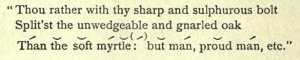
Next: The Merchant of Venice, Act 2, Scene 7 ______ Explanatory Notes for Act 2, Scene 6 From The Merchant of Venice. Ed. Felix E. Schelling. New York: American Book Co. 1. pent-house, a shed hanging out aslope of the main building. 2. This line, like many others, especially in the earlier work of Shakespeare, is too long, according to the metrical scheme of English blank verse. As a matter of fact, Shakespeare frequently employs, in the midst of the usual lines of five accents, lines which contain six, and which are known as Alexandrines. This is more often to be met where the dialogue is broken (that is, where the line is divided between two speakers) than elsewhere. In such cases we had better follow the advice of Dr. Furness, and "forego the pleasure of adjusting the rhythm of fragments of lines. As long as each fragment is in itself rhythmical, I doubt," continues the editor of the Variorum Shakespeare, "if Shakespeare troubled himself to piece them together." 3. out-dwells, outstays. 5. Venus' pigeons, doves were sacred to Venus, the goddess of beauty. See Tempest, iv. 1. 92: "I met her deity7. obliged, pronounced as three syllables. The termination ed was commonly pronounced in Shakespeare's day, although sometimes contracted. See below, in this scene, chased, line 13 ; scarfed, line 15; and placed, line 57. 9. sits down [with]. 10. untread again, retrace, repeat in reverse order; said to allude to a horse trained to perform tricks, as in a circus. 14. younker, stripling. 15. scarfed bark, ship decked with flags. 17. See Luke, xv. 1 1-32. 18. over-weather'd, weather-beaten. 21. abode, tarrying, stay. 24. I'll watch as long, etc. This line contains but nine syllables. But the pause after then takes up one of them, and the line becomes perfectly metrical. This is no uncommon device where there is a change in the thought, as here. Shakespeare, be it repeated, wrote for the ear and not for the eye, nor yet for the fingers. Compare Measure for Measure, ii. 2. 115-117: 30. who love I. Who for whom, as frequently in Shakespeare. This license extended to all the personal pronouns. Compare below, iii. 2. 321: "All debts are cleared between you and I." 35. exchange, change of costume to that of a boy. 41-50. What, must I, etc. Shames, in modern English shame. They in themselves [i.e. my shames] are only too manifest. Why, [a torch-bearer's] office [is one] of discovery, for he bears a light; I should be thrown into the dark. There is a play in this passage on both the words light and obscure. Jessica is far more concerned about her appearance in boy's clothes than about leaving her father and robbing him. 42. too too, the duplication of the adverb for emphasis is very common. Compare Hamlet, i. 2. 1 29: "O, that this too too solid flesh would melt." 45. garnish, costume. 47. play the runaway, is hurrying away. 47. close, secret. 48. stay'd, awaited. 51. by my hood. Gratiano swears appropriately by the masquerader's hood with which he is disguised. 51. Gentile, a heathen, with a play on the word gentle, one well born. 52. Beshrew me, dear me, verily. Much difficulty has been experienced in assigning the period of time during which the action of the play is supposed to take place. And this difficulty arises from the circumstance that Shakespeare hurries or retards the apparent lapse of time to suit the need of the given moment, and thus creates a double scale of time. Early in the play we are told that the bond is for three months and that period is infixed in our minds. Moreover Bassanio speaks of having his servants' liveries "put to making," which seems to imply a leisurely preparation. On the other hand, his ducats once "pursed," from other indications Bassanio is all impatience and hurry. Supper must be ready at latest at five, letters are to be delivered, purchases made and stowed aboard, servants are sent to and fro and bidden "hie thee, away," and, cutting short the masque, at nine o'clock he will instantly aboard. This lover's impatience of Bassanio has beguiled one commentator into supposing that but ten hours elapse between the opening of the action and Bassanio's setting forth to Belmont: a notion obviously false. It will be better for us to note Shakespeare's art in effecting the illusion of a lapse or a hurry of time than to seek for that mathematical accuracy which has its place, though not in a work of the imagination. _______ How to cite the explanatory notes:______ Related Articles  Setting, Atmosphere and the Unsympathetic Venetians in The Merchant of Venice Themes in The Merchant of Venice A Merry Devil: Launcelot Gobbo in The Merchant of Venice Three Interpretations of Shylock Introduction to Shylock Shakespeare Sisterhood: Exploring the Character of Portia Exploring the Nature of Shakespearean Comedy How to Pronounce the Names in The Merchant of Venice The Character of Antonio The Merchant of Venice: Q & A Conflicts of Law and Equity in The Merchant of Venice Shakespeare's Second Period: Exploring The Merchant of Venice and Romeo and Juliet The Merchant of Venice: Plot Summary Famous Quotations from The Merchant of Venice Shakespeare Quotations (by Play and Theme) Quotations About William Shakespeare Why Shakespeare is so Important Shakespeare's Language Shakespeare's Boss: The Master of Revels Shakespeare Timeline: Part 1 (1558-1599) A Shakespeare Timeline: Part 2 (1600-1604) A Shakespeare Timeline: Part 3 (1605-1616) Setting, Atmosphere and the Unsympathetic Venetians in The Merchant of Venice Themes in The Merchant of Venice A Merry Devil: Launcelot Gobbo in The Merchant of Venice Three Interpretations of Shylock Introduction to Shylock Shakespeare Sisterhood: Exploring the Character of Portia Exploring the Nature of Shakespearean Comedy How to Pronounce the Names in The Merchant of Venice The Character of Antonio The Merchant of Venice: Q & A Conflicts of Law and Equity in The Merchant of Venice Shakespeare's Second Period: Exploring The Merchant of Venice and Romeo and Juliet The Merchant of Venice: Plot Summary Famous Quotations from The Merchant of Venice Shakespeare Quotations (by Play and Theme) Quotations About William Shakespeare Why Shakespeare is so Important Shakespeare's Language Shakespeare's Boss: The Master of Revels Shakespeare Timeline: Part 1 (1558-1599) A Shakespeare Timeline: Part 2 (1600-1604) A Shakespeare Timeline: Part 3 (1605-1616) | ||||||||||||||||||||||||||||||||||||||||||||||||||||||||||||||||||||||||||||||||||||||||||||||||||||||||||||||||||||||||||||||||||||||||||||||||||||||||||||||||||||||||||||||

©1999-2021 Shakespeare Online. All Rights Reserved.