| directory |
| home | contact |
|
|||||||||||||||
| search | |||||||||||||||
The Merchant of Venice: Plot SummaryFrom Stories of Shakespeare's Comedies by Helene Adeline Guerber. New York: Dodd, Mead and company (1910).
Act IThe first act opens in a street in Venice, where Antonio, a wealthy middle-aged merchant, talking to two acquaintances, wonders why he feels vaguely sad and apprehensive. When his friends suggest that, having many vessels at sea exposed to all the winds that blow, he necessarily is anxious, he denies it, as he does also being in love.Before the cause of this strange melancholy is discovered, Bassanio joins this group with two companions, who talk and laugh and appoint a meeting at dinner, although Antonio seems disinclined for festivities. Still, as he has remarked that everyman has some part to play in the world, one of the speakers, Gratiano, expresses a preference for the role of fool, mirth and laughter being more desirable than melancholy. Left alone with Bassanio, Antonio comments on the nonsense just uttered, before inquiring with whom his friend has fallen in love. In reply Bassanio states that, although enamoured of a beautiful lady, he cannot sue for her hand, because he has squandered his fortune, and is deeply in debt to Antonio and others. Instead of reproaching him, Antonio generously consents to make another loan, which Bassanio accepts in hopes of making all good when he has won Portia, the lady of Belmont, with whom he has found favour, although she is besieged with suitors. Because all his funds are at present at sea, Antonio decides to use his credit to borrow the necessary sum for his friend's use. We are next transported to Portia's dwelling, where she is expressing great weariness of the world to Nerissa, her companion, who slyly suggests her mistress is suffering from superfluity, rather than from any other complaint. She supports the good advice she gives with- maxims, which Portia scorns or caps, ere she attributes her troubles to her father's lottery, which leaves her no choice in regard to her future husband. This father, however, was wise and virtuous, as Nerissa maintains, and his lottery scheme shrewd, for he decreed that Portia's suitors should select among three chests one of gold, one of silver, and one of lead that containing her portrait, or forfeit her hand. Many suitors have already come, whom Nerissa names w-hile Portia pithily describes them, vowing she feels little inclination for the horsey Neapolitan, the melancholy German, the fickle Frenchman, the dumb Englishman, the niggardly Scotchman, or the drunken Saxon, who have come to woo. She therefore feels no regret when told that these suitors, dreading the test, are about to depart, and joyfully exclaims, 'I dote on their very absence!' Then Nerissa states that no suitor ever seemed so attractive as the Venetian Bassanio, who visited them in her father's lifetime, a man whom Portia charily admits was worthy of praise. Their conversation is interrupted by the announcement that the strangers wish to take leave, and that a Moroccan prince has just arrived to undergo the casket test. After expressing great readiness to speed the parting guests, Portia idly wonders whether the newcomer will prove a bolder, or more acceptable suitor than his predecessors. We now behold a public square in Venice, where Bassanio is asking the money-lending Jew, Shylock, to loan Antonio three thousand ducats for three months. Gravely repeating each statement, Shylock thoughtfully remarks Antonio is a good man, although his funds, at present invested in fleets, seem in jeopardy. After some hesitation, he asks to confer with Antonio in person, so Bassanio invites him to dine with them both, an invitation the Jew scorns, fearing viands {their food} unclean. He therefore retorts in surly tones, 'I will buy with you, sell with you, talk with you, walk with you, and so following, but I will not eat with you, drink with you, nor pray with you.' They are about to separate, when Antonio appears; whereupon Shylock mutters he hates him for being a Christian, and for lending money without interest, whereby sundry debtors have been saved from his clutches. On that account, he cherishes an 'ancient grudge' against Antonio, and, brooding upon past insults heaped upon him, determines to be revenged. Pretending to consider the loan, he murmurs he can obtain the money from a fellow-countryman, so when Antonio joins them, there is some shrewd bargaining, in the course of which Shylock expresses ironical surprise that Antonio, who never deals with usurers, should apply to him. Confessing he has never done so before, and is breaking a rule merely to oblige his friend, Antonio listens to Shylock's exposition of Jacob's stratagem, which he quotes as a justification for usurious methods, adding piously that 'Thrift is blessing, if men steal it not.' Carelessly retorting that even the devil quotes Scripture to attain his ends, Antonio shows contempt for such reasoning, while Shylock apparently cogitates on the subject of the loan. On being pressed to give a definite answer, he wonders that Antonio, who has frequently rated him on the Rialto, should apply to him for funds. His eloquent speech betrays how deeply such treatment rankles, but his manner is so offensive that Antonio haughtily informs him he will probably treat him with contumely again, and proposes borrowing only on a business basis. But, when he rashly offers to bind himself by any penalty the Jew chooses to impose, Shylock suddenly becomes pliant and friendly, and offers to loan the money without interest, provided Antonio will sign a bond pledging himself 'in a merry sport' to allow the Jew to cut a pound of his flesh on payment day, should the necessary sum not be forthcoming. Believing such a condition imposed as a blind for granting a favour, Antonio gratefully accepts it, exclaiming: 'There is much kindness in the Jew' although Bassanio implores him not to subscribe to anything so extraordinary. To reassure his anxious friend, Antonio tells him that long before payment is due, he will have three times the amount at hand, and Shylock, fearing his revenge may escape him, urges immediate settlement, asseverating he would gain nothing by the forfeiture of the bond, as a pound of human flesh is of less value than the same amount of mutton. Thus persuaded of Shylock's good faith, Antonio promises to meet him at the notary's, where, the document being signed, the money will be paid. So the Jew prepares to return home, where, an unscrupulous knave being in charge of his property, loss may accrue to him. He has no sooner departed, than Antonio vows he is growing kind, while Bassanio, who likes not 'fair terms and a villain's mind,' dreads the outcome of this affair, in spite of all his friend's confidence in his ventures.
Act IIThe second act opens in Portia's house, where all is prepared for the solemn reception of the Moroccan prince, who, about to undergo the casket test, begs Portia not to be prejudiced by his dark complexion, which he would not change for any purpose save to win her heart. Thereupon Portia coldly rejoins that, her father having decreed her hand should be awarded to the discoverer of the right casket, she has no choice, but must first exact his promise that in case of failure, he will depart immediately, and will never marry or reveal the contents of the chest he opened. Then she proposes to accompany him to the temple and entertain him at dinner ere he try his fate.We are next transported to a street in Venice, where the Jew's servant, Launcelot, is soliloquising on the fact that the fiend tempts him to run away from his master, although his conscience disapproves of such a move. He is trying to justify himself under the plea that the Jew is a devil, and that no Christian should serve one, when his blind father appears, bringing a present of doves to Shylock. A practical joker, Launcelot amuses himself in bewildering poor old Gobbo, who little suspects he is asking directions of his own son. Still, after mischievously rousing his father's fears for his safety, Launcelot makes himself known, assuring Gobbo 'it is a wise father that knows his own child' and begging him to bestow his present, not upon the Jew, but upon Bassanio, whom he is now anxious to serve. Just then Bassanio is heard giving his servant sundry orders, so Launcelot and his father approach, humbly offering him the present intended for the Jew. In the ensuing scene, Bassanio engages Launcelot, ere father and son depart to take leave of Shylock. Then, Bassanio bids another servant hasten preparations, and have all ready for a feast, ere they two are joined by Gratiano, who begs permission to accompany Bassanio to Belmont, a request first denied, and granted only when Gratiano. promises to be discreet after tonight. We now behold Shylock's house, where his daughter Jessica, parting from Launcelot, regrets his departure, as he has been the one merry inmate of their house. After bestowing her farewell gift, she begs him deliver a letter to Lorenzo, who is to be his new master's guest, cautioning him, however, not to let her father know anything about it. Launcelot having departed amid tears and compliments, Jessica bewails her own weakness, for she is ashamed of her father, and has fallen in love with a Christian, whom she intends to marry, although she knows such a step will grieve Shylock. The next scene is played in the street, where Lorenzo explains to some supper guests that during the meal they will slip away to disguise themselves as mummers. When one of them exclaims no torchbearer has been provided, Lorenzo promises to supply one, just as Launcelot hands him Jessica's letter. Amorously vowing ' 'tis a fair hand; and whiter than the paper it writ on,' Lorenzo peruses his missive, while his friends envy him. Then he charges Launcelot to tell Jessica he will not fail her, and after dismissing him, informs his companions that a torch-bearer will meet them at Gratiano's lodgings. The others having gone, Gratiano inquires whether Lorenzo's letter was not from Jessica; and learns that it contains directions for their elopement, as Jessica is to leave her father's house in the disguise of a page, carrying off all the gold and jewels she can secure. Her clever device so delights Lorenzo, that he vows if Shylock ever reaches heaven, it will be for the sake of this gentle daughter, who is to personate the torch-bearer in their mummery. The rising curtain now reveals Shylock's house, where, encountering his former servant, the Jew swears he will soon perceive the difference between his old and new masters. Because Shylock repeatedly mentions his daughter's name, Launcelot, pretending to think he wants her, calls so loudly that Jessica appears. Then Shylock gives her his keys, saying he is invited to sup with Christians, whose courtesy he will accept to get something out of them. Meantime, he cautions his daughter to look closely after his property, for, having dreamed of money-bags, he is haunted by premonitions of evil. Afraid lest Shylock may remain at home, Launcelot urges him to accept the invitation, saying amasque is to be given to entertain the guests. Thereupon the Jew, knowing that robberies often occur under cover of diversions, bids Jessica close the windows and not look out, lest while she appear to take pleasure in Christian diversions, thieves steal into his house. But, Launcelot whispers that if she does peer out of the casement, she will behold a Christian whom she will like to see! Seeing her father suspicious of this whispering, Jessica informs him Launcelot is bidding her farewell, ere she gravely listens to the Jew's strictures on the man's laziness, and his cautions in regard to his property, closing with the well-known proverb, 'Fast bind, fast find.' But, as he departs, Jessica remarks in an aside, 'If my fortune be not crost, I have a father, you a daughter, lost.' In the same street a while later, Gratiano and a friend stand beneath an awning, wondering why Lorenzo is late, as lovers are proverbially impatient. A moment later he joins them, warmly thanking them for their devotion, and promising his aid when they wish to steal wives, before all three stealthily approach the Jew's dwelling. Here Jessica soon appears at an upper window, dressed as a boy, timidly inquiring who they are and what they want. After answering Lorenzo's amorous reply in kind, she bids him catch the casket she is lowering, whispering that it contains part of her father's fortune, and vowing she is afraid to be seen in her present garb, which love only has given her courage to don. When Lorenzo tells her she is to be torch-bearer, she ruefully exclaims a less conspicuous position should be allotted her, ere she prepares to join her lover, bringing with her all she can find, as she has systematically plundered the Jew. While she is descending, Lorenzo informs his waiting friends he loves her dearly because she has proved herself 'wise, fair, and true,' although modern readers of this play fail to agree with him. A moment after Jessica has joined them; the mummers depart, their movements being hastened by Antonio's coming to warn them Bassanio is about to sail. When the curtain again rises we behold the room in Portia's house where the caskets are stored. Entering with the Moroccan prince, Portia gravely bids him raise the curtain concealing the mysterious chests. Having done so, the suitor reads aloud the inscriptions, which are 'Who chooseth me shall gain what many men desire' on the golden casket; 'Who chooseth me shall get as much as he deserves' on the silver casket; and 'Who chooseth me must give and hazard all he hath' on the leaden casket. These inscriptions seem as perplexing as the chests themselves, so the prince hesitates which to choose, for only one contains Portia's portrait. After calling upon some god to direct him, he cons the inscriptions, and comes finally to the conclusion that no man would be rash enough to risk anything on base lead, and that, although he does not doubt his own deserts, it will be best not to open the silver chest. Vowing no other metal is worthy to enshrine Portia's image, he unlocks the golden casket, but instead of a portrait finds therein a skull, with a scroll beginning with the time-honoured words, 'All that glisters is not gold,' and closing with the mocking line, 'Fare you well; your suit is cold!' As he has solemnly pledged himself to abide by this test, the prince is obliged to take immediate leave of Portia, who, not sorry to see him go, expresses a hope that all those of his complexion who come to woo may be no more fortunate than he. In one of the streets of Venice on the morrow, some gentlemen are conversing about Bassanio's departure, saying they feel sure Lorenzo was not with him, although Shylock searched the vessel for his fugitive daughter and her lover. Then they gleefully describe the Jew's rage on discovering Jessica's flight with his property, mockingly repeating his wild cry of, 'My daughter! O my ducats! O my daughter! Fled with a Christian! O my Christian ducats! Justice! The law! My ducats, and my daughter!' Not only do they jeer at this mixture of exclamations, but describe how Shylock was followed by the rabble of the town while uttering this wail, and add that his missing daughter and ducats are evidently with Lorenzo, for it is reported the lovers were seen together in a gondola. A little while later they hint Antonio had better be careful, as the Jew, suspecting he had a share in his daughter's elopement, is determined to take a terrible revenge should not his debt be paid as soon as due. Besides, rumours are afloat of vessels wrecked at sea; news to be cautiously broken to the merchant, who so confidently assured Bassanio as he sailed away, that all would be well, and he need think of nothing save securing Portia's hand. We now return to Portia's house, where she and Nerissa are preparing for the Prince of Arragon, who is ushered in with a flourish of trumpets. After ascertaining that he understands the conditions, Portia allows him to examine the caskets, and he, too, comments upon the inscriptions ere he decides to open the silver chest, for, having a lively sense of his deserts, he deems himself quite worthy of Portia's hand. But, the lid raised, the over-confident suitor discovers the portrait of an idiot, with a slip of paper stating his chances are gone. He, too, therefore bids Portia farewell, and she comments, 'Thus hath the candle singed the moth,' while her maid vows it is evident that 'Hanging and wiving go by destiny.' It is at this juncture that a servant announces the coming of a Venetian to try his fate. Little suspecting who is to undergo the test this time, Portia idly wonders who this new suitor may be, while her maid secretly hopes Bassanio may appear.
Act IIIThe third act opens in the streets of Venice, where two of Antonio's friends discuss recent shipwrecks which have caused him severe losses. Their conversation is interrupted by Shylock, of whom they inquire the news, whereupon he reviles them for helping his daughter escape. The Jew seems depressed, not only by the loss of his daughter and ducats, but because the news of Antonio's bad luck makes him fear for his debt. In his wrath, he vows, should the money not be forthcoming, to exact his pound of flesh to feed his revenge, working himself up to the utmost against Antonio, and fiercely demanding whether a Jew has not eyes, hands, organs, dimensions, senses, affections, and passions, like any other human being? Then he reminds his hearers how if a Jew wrong a Christian, revenge is inevitably sought, adding that he doesn't see why the rule should not work both ways, ere he hisses, 'The villainy you teach me, I will execute, and it shall go hard, but I will better the instruction!'
The Jew's tirade against Christians is interrupted by the arrival of a servant, begging the gentlemen to join Antonio. When they have departed, a second Jew joins Shylock to report that he has not been able to trace the missing Jessica, although he has heard of her here and there. Shylock thus gathers that he has not only lost his jewels, but his daughter as well, and this being the first loss which has accrued to him, he bitterly vows that; 'The curse never fell upon our nation till now!' In a vain attempt to comfort him, his companion avers others have suffered even more, Antonio, for instance, having lost all he possessed. Although this news pleases Shylock, he sinks back into the depths of grief on hearing how his daughter is squandering the money she stole. Then, eager to work off his rage in some way, Shylock bids his companion retain an officer to arrest Antonio as soon as the bond comes due, grimly swearing, 'I will have the heart of him, if he forfeit!' We are next transferred to Portia's house, where she is cordially inviting Bassanio and Gratiano to tarry a month before undergoing the terrible test, for she is too loyal to reveal her father's secret even to the man she loves. Afraid lest some one else may win her, Bassanio refuses to postpone his choice, so preparations are made, and Portia, who has been softly comparing her lover to Hercules, sends him to the caskets, exclaiming, 'Go, Hercules! Live thou, I live: with much more dismay I view the fight than thou that makest the fray.'
Still doubtful that he has won, Bassanio begs Portia to confirm her father's choice in this manner, and as she has fallen in love with this suitor, Portia concedes the favour, ere stating she wishes she were a thousand times more fair and ten thousand times more rich, in order to bestow herself upon him, adding that although merely an unlessoned girl, she is happy in not being too old or too dull to learn, and ready to commit her 'gentle spirit' to his to be directed as by 'her lord, her governor, her king.' Having thus made Bassanio master of herself, her house, and all her possessions, Portia gives him a betrothal ring, warning him never to part with it, lose it, or give it away, lest 'it presage the ruin of your love.' Overjoyed at so complete a surrender, Bassanio swears to part with the ring only with life. Meantime, Nerissa and Gratiano, having decided that their fate also should rest upon the caskets, reach an understanding and exchange rings, before they offer congratulations to Bassanio and Portia, and beg permission to be married when they are. This betrothal scene is interrupted by the arrival of Lorenzo, Jessica, and a nobleman from Venice, the latter bringing Bassanio a message. The letter is from Antonio, and the messenger, who delivers it, compassionately warns the recipient it contains bad news. Then, overhearing Gratiano boast that he and Bassanio have won the golden fleece, he sadly exclaims they have been far more fortunate than Antonio, who has lost all he possessed. Bassanio, who has meantime perused his missive, shows such a changed countenance, that Portia tenderly insists upon sharing his anxieties. Thereupon he informs her he has just read 'the unpleasant'st words that ever blotted paper,' adding that whereas he told her part of the truth when he stated he was penniless, his condition is even worse, seeing he borrowed the money from Antonio to visit her. Then, after relating the story of the bond, he adds that his friend, having lost all, may be called upon to pay it, for the messenger assures him nothing will satisfy the Jew save the terms of the loan. This statement is confirmed by Jessica, who has overheard her father and his friends confer on this subject. Then Portia insists that her betrothed hasten to his friend's rescue, using her money to pay the debt, adding when told twenty merchants have vainly interceded, that she is willing to offer much more than the bond. She also insists upon Bassanio's marrying her immediately so he can dispose of her fortune in his friend's behalf, declaring that until his and Gratiano's return, she and Nerissa will live as widows, and tenderly adding, 'Since you are dear bought, I will love you dear,' before she bids him remember it is a friend's duty to sacrifice all for the sake of his friend. We now return to Venice, where Shylock, meeting Antonio and his jailor, expresses indignation that a prisoner should have the privilege of walking abroad. After fiercely enjoining upon the jailor to look well to his charge, Shylock prepares to depart, refusing to listen to Antonio's entreaties, and vociferating, 'I'll have my bond,' for since he has been called a dog, he is determined to justify the epithet. When he has gone, a Venetian spectator terms him 'the most impenetrable cur that ever kept with men,' although Antonio insists it is natural Shylock should hate him, seeing he has so often delivered debtors from his clutches. On that account he feels the duke's intercession will not avail, and knows the laws will have to be respected if Venice is to endure. Still, Antonio has undergone such anxiety of late, that he ruefully avers there will hardly be a spare pound of flesh on his body when payment comes due on the morrow; and, although resigned to his fate, he ardently hopes Bassanio will return in time to see him loyally acquit the debt. We now return to Portia's house, where Lorenzo is complimenting her on her unselfishness in sending off her new-made husband to rescue a friend, although he admits Antonio more than deserves all that Bassanio can do for him. After assuring him she has never yet had cause to repent doing right, and that a bosom friend of her husband must be worthy of all devotion, Portia announces that she and Nerissa are going to retire to a convent to pray for their husbands, leaving him and Jessica in charge of the estate. This trust accepted, Portia privately bids a servant carry a letter to her lawyer-cousin in Padua, bringing his answer to the ferry at Venice, where she will meet him. Then, turning to the amazed Nerissa, she gleefully announces they will see their unsuspecting husbands before long. In reply to Nerissa's inquiry how this may be, Portia next states they are going to assume men's garments, and joyously boasts what a pretty lad she will make, and how cleverly she will play her part. Then, seeing Nerissa still bewildered, but having no time to explain further at present, Portia leaves the apartment with her, promising a full explanation while they travel toward their goal. When the curtain again rises, we behold Portia's garden, where Jessica is talking to Launcelot, who, after explaining how the sins of the fathers are visited upon the children, states her only hope of salvation lies in having married a Christian, although he fears many conversions may raise the price of pork. This scene is interrupted by the arrival of Lorenzo, to whom Jessica gives an amused account of what has just been said, ere Launcelot is bidden prepare supper; but before obeying, this facetious servant exercises his wit upon his temporary master, and proves that words can be used in queer ways. Left alone with his bride, Lorenzo comments on Launcelot, before he begins to make love, and asks Jessica's opinion of Portia, whom he is pleased to hear her praise. Then, after a little more lover-like conversation, the pair depart for supper.
Act IVThe fourth act, containing the grandest scene in the play, opens in a court of justice in Venice, where the duke, sitting in state, summons Antonio, and expresses regret he should have fallen into the clutches of so 'stony an adversary.' Duly grateful for the duke's efforts to release him, Antonio thanks him, ere stating he knows the bond must be paid. The Jew is next summoned, and the duke asks him whether he has not thought better of his decision, adding he feels sure he has driven things so far, only to show mercy at the last minute. Then, urging the barbarity of the bond, he suggests half the debt be remitted, in consideration of Antonio's great losses, ere he bids Shylock speak, adding warningly, 'We all expect a gentle answer, Jew.'But Shylock asserts that, having sworn 'to have the due and forfeit of his bond,' nothing save a pound of flesh will satisfy him ; he also finds a ready answer to Bassanio's objections, and obstinately refuses to listen to reason or to accept the money offered him. Every word he utters denotes his rankling grudge for the wrongs perpetrated against his race for centuries past, and although Bassanio openly calls him an unfeeling man, he insists that he is justified in his claim. Seeing the hopelessness of the case, Antonio thinks they might as well 'stand upon the beach and bid the main flood bate his usual height,' as try to change his foe's mind. With a last hope that cupidity may get the better of cruelty, Bassanio offers Shylock twice the amount of the debt, only to be grimly told six times that sum would not tempt him, and that, having bought his pound of flesh, he is entitled to it. The duke, who has vainly appealed to the Jew's mercy, now declares, unless the doctor from Padua, who is to decide the case, soon appears, he will have to adjourn it, as he cannot allow things to take such a course. He has barely finished speaking, when the arrival of the Paduan doctor is announced. The duke orders him admitted, and while the messenger goes in quest of the judge, Bassanio tries to cheer Antonio by saying he will force the Jew to take his own 'flesh, blood, bones, and all,' before he will allow his friend to lose a drop of blood for his sake. In reply Antonio cries, 'I am a tainted wether of the flock, meetest for death,' adding that ill-luck has so dogged his footsteps, that, having lost all the rest, he is glad life will not be prolonged, and bidding his friend write his epitaph. It is at this juncture that Nerissa, as lawyer's clerk, enters the hall and delivers a letter to the duke. While he examines the seal and peruses this missive, the attention of the spectators is diverted to Shylock, who is whetting his knife on the sole of his shoe in anticipation of putting it soon to use, doing so with such fiendish delight, that Antonio's friends revile him, Gratiano exclaiming he must have wolf's blood in his veins. In spite of all they say, Shylock continues his whetting process, until the duke announces that the learned doctor, unable to appear in person, has sent his colleague, who, although young, is nevertheless competent. While an attendant goes out to summon this substitute, the duke orders his clerk to read aloud the letter, before he greets the Paduan lawyer's representative. This is, of course, Portia, as doctor of laws, who gravely states she has come to settle the case, having studied it in detail with her learned colleague. Then, turning gravely to the two principals in the trial, she begins her legal interrogations, charging Shylock to be merciful, in a speech which is justly considered one of the finest passages the poet has left us. Notwithstanding her eloquence, Shylock maliciously insists on his bond, although Bassanio again offers to pay twice, ten times the amount, and forfeit hands, head, and heart, rather than permit his friend to suffer for his sake. To the horror of all present, save the Jew, Portia announces 'there is no power in Venice can alter a decree established,' a sentence which so delights Shylock that he hails her as a 'Daniel come to judgment!' When she asks to see the bond, he eagerly produces it, insisting upon his pound of flesh, although she again offers money and suggests that mercy is better than justice. Utterly despairing by this time, Antonio, who has been long enough on the rack, demands that his sufferings be ended by an immediate decision, whereupon Portia regretfully bids him prepare for the knife, a decree Shylock receives with an outburst of fiendish joy. Then, while Antonio bares his breast, Portia reads aloud the document stating the pound shall be taken from the spot nearest Antonio's heart, ere she inquires whether balances are ready to weigh the amount, and a surgeon at hand to check the bleeding of the wound. But, although Shylock has carefully prepared knife and scales, he deems a physician superfluous, grimly vowing it was not 'nominated in the bond,' upon whose fulfilment he insists so frantically. Deeming his end near, Antonio now bids farewell to Bassanio, saying he is glad to die since he has outlived prosperity, and sending his compliments to Portia, who has so generously but vainly sent her husband to his rescue. He adds that if the Jew only cuts deep enough, all will be over in a moment, and reminds Bassanio he has loved him so truly that he is about to pay his debt with all his heart. Overcome by grief, Bassanio wildly cries that although married to a wife he adores, he would give her, and all he owns to save his friend, a sacrifice the judge gravely reminds him might not please Portia. Unwilling to show less devotion than Bassanio, Gratiano also exclaims he wishes his new-made wife were in heaven, to intercede for Antonio and save him from the Jew, a statement the lawyer's clerk mutters it is well his wife does not overhear! Such friendly devotion, however, seems incomprehensible to Shylock, who once more wishes his daughter had not married a Christian, before he again urges the judge to decide the case. After going through the usual formula, Portia decrees the rabid Jew shall have his pound of flesh, whereupon Shylock, almost beside himself with revengeful fury, starts forward to claim it. But his advance is checked by the judge gravely warning him that, whereas the flesh is his, he must not shed a single drop of blood, there being a law in Venice to the effect that should a Jew attempt to shed Christian blood, he forfeits his estates! This reminder, which almost paralyses Shylock, delights Gratiano; but the incredulous Jew asks sundry questions, until baffled, he sullenly volunteers to accept thrice the amount of his bond, which has been repeatedly offered in exchange for the pound of flesh. Although Bassanio immediately steps forward with the money, the judge decrees that since Shylock insisted upon strict justice and refused anything save the terms of the bond, nothing else will now be granted him, adding the warning that should he cut more or less than the stipulated amount, he will die and his property be confiscated. While Gratiano rapturously cries this is indeed a 'Daniel come to judgment,' the Jew grimly proposes to accept the principal of the debt and depart. Even that the judge will not allow Bassanio to pay, declaring that the Jew, having conspired against the life of a fellow-citizen by inducing him to sign such a bond, one-half of his property falls by law to Antonio, and the other half to the state. He adds that Shylock's life also is forfeit unless the duke forgive him, a pardon the Jew hardly heeds, for, hearing his property is gone, he hoarsely bids them take his life! Portia now inquires whether Antonio is willing to show mercy to the man who showed him none, and notwithstanding Gratiano audibly advises him to give the Jew a halter, Antonio decides Shylock will be sufficiently punished by losing half his property, accepting baptism, lending him sufficient money to trade with, and making a will in behalf of the daughter, who has married a Christian. This decision satisfies the duke, who bids Shylock submit and recant. Thoroughly cowed, the Jew sullenly promises to obey the court's decree, ere he retires under plea of illness, asking that the paper he is to sign be sent after him. When the duke invites the wise judge to dine, Portia graciously declines under plea of an immediate return to Padua. This being the case, the duke bids Antonio express his gratitude to his saviour; so when he has left, Bassanio exclaims that he and his friend owe their lives to the learned judge, who is begged to accept, as reward for his trouble, the money he saved from the Jew. Besides, Antonio adds in heartfelt tones that they will ever feel indebted 'over and above, in love and service to you ever more!' To the surprise of both friends, the judge refuses the money, stating, 'He is well paid that is well satisfied,' and then, being urged to accept a souvenir of the occasion, suddenly demands Antonio's gloves and Bassanio's ring. At this request, Bassanio demurs, under plea the ring is unworthy of the judge's acceptance; but, when their saviour insists, he explains with embarrassment that he cannot part with a token given to him by his wife, who made him vow never to sell, give away, or lose it. Pretending to consider this a subterfuge to avoid parting with a trifle, the judge leaves the room offended, whereupon Antonio urges his friend to send him the ring, promising to justify such an action to his wife. On that account Bassanio draws Portia's gift from his finger, and bids Gratiano deliver it to the departing judge, ere he leaves the court with Antonio, who is to accompany him to Belmont on the morrow. The curtain next rises on a street in Venice, along which the judge is striding, giving directions to his clerk to discover the Jew's house and make him sign the document which Lorenzo will welcome. They are now overtaken by Gratiano, who humbly begs the judge to accept Bassanio's ring; but, although Portia takes it, she refuses an invitation to dinner, and begs Gratiano to direct her clerk to Shylock's house. Then she watches Nerissa walk off with him, after slyly whispering she, too, is going to win from her husband the token she gave him. Meantime, gleefully stating 'We shall have odd swearing that they did give the rings away to men,' Portia returns to her lodgings, where Nerissa will join her as soon as the document is signed. Act VThe fifth act opens in an avenue leading to Portia's house, where Lorenzo and Jessica, strolling by moonlight, talk of lovers and vow they will never forget these evenings. A noise of rapid footsteps interrupts them, and on challenging the newcomer, Lorenzo hears of Portia's return with her maid before morning, as she is merely pausing at the wayside shrines to pray for a happy married life. When the messenger inquires whether news has come from Bassanio, Lorenzo assures him that, although no tidings have been received, he will arrive before long. He and his wife are about to return to the house to welcome the travellers, when Launcelot announces that Bassanio is on his way. After once more dwelling on the beauty of the starry night, and listening to music which adds charms to the scene, the married lovers are about to leave when Portia and Nerissa appear.Drawing near, Portia points out the light in her house, saying it 'shines like a good deed in a naughty world,' before she begins to praise the music. Then, perceiving Launcelot, she eagerly inquires for her husband, and on learning his return has been announced, gives orders for his reception, just as the noise of an arrival is heard, which is soon followed by Bassanio's appearance. After warmly greeting his bride, Bassanio bids her welcome his friend Antonio, to whom he is 'so infinitely bound,' whereat his wife rejoins he is indeed indebted to him, before she welcomes Antonio to Belmont. Meantime, Gratiano, too, has embraced his bride, who, discovering the loss of his ring, reproaches him, for he is soon heard vehemently protesting her token was given to the clerk of the lawyer who saved his master's friend from Shylock's clutches. Of course, this dispute attracts Portia's attention, and when she inquires what it means, Gratiano indignantly replies his wife is making a fuss about an insignificant ring. Then Nerissa retorts that, however trifling the value of her token, he should have prized it for association's sake, paying no heed when he insists it was given to 'a little scrubbed boy,' to whom he could not deny the reward he selected. Thereupon Portia gravely agrees with Nerissa that Gratiano was wrong to part with her keepsake, adding confidently that her husband would never have acted thus, a statement which causes Bassanio to mutter beneath his breath it would have been wiser to cut off his hand and swear he lost her ring defending it. But, before he can invent an excuse to account for the absence of his token, Gratiano blurts out, in justification, that he has merely followed the example of Bassanio, who bestowed his keepsake on the judge. As her husband is unable to deny this accusation, Portia gravely vows she will never be his wife until she sees her ring again, and Nerissa follows suit. Such a decision staggers both husbands, but when Bassanio eagerly claims that if Portia knew to whom he gave the ring, for whom he gave the ring, for what he gave the ring, and how unwillingly he gave the ring, she would surely 'abate the strength' of her displeasure, she mockingly retorts that if he only knew the virtue of the ring, the worthiness of the one who gave it to him, and realised his honour was bound up with it, he would never have parted with such a token! Like Nerissa, she pretends to believe their tokens were bestowed upon women, although Bassanio swears his w r as given to the judge, eloquently describing how Antonio's saviour, after refusing all pecuniary reward, demanded that only. He adds that honour would not permit ingratitude, and that she herself would have implored him to give it to the doctor had she been present. Still feigning to be implacable, Portia declares that since the doctor has the ring, Bassanio must watch her, should that worthy ever visit their house, for whenever he is absent, she intends to spend all her time in the doctor's company. Then Nerissa announces she will do the same with the lawyer's clerk, whereupon both husbands protest, while Antonio expresses regret to be the unhappy cause of such matrimonial differences. When Bassanio humbly begs his wife's forgiveness, swearing never to break faith with her again, Antonio again volunteers to be his bondsman, staking his soul this time, notwithstanding his late terrible experience. Thereupon, Portia, pretending to relent, hands Antonio a ring to place on her husband's hand, bidding him guard it more sacredly than her first token. To his intense surprise, Bassanio recognises in it the token he bestowed upon the judge, and Portia, to tease him, confesses that the judge gave it to her, when she spent last night in his company. At the same time, Nerissa admits having passed hours alone with the lawyer's clerk! When both husbands exclaim, Portia produces a letter, proving she was the doctor and Nerissa her clerk, calling upon Lorenzo to testify how both wives left the house immediately after their husbands, and returned just before them, having meantime succeeded so well in their undertaking. Then, while Bassanio and Gratiano show relief that their wives have not been as faithless as they seemed, Portia delivers to Antonio some letters which prove that certain of his ships have reached port safely. In her turn, Nerissa produces the document proving that Shylock's wealth will eventually come to Lorenzo's wife, who fancied she had forfeited it by marrying a Christian. Then Portia invites all present into the house, where further questions can be answered, and all joyfully follow her, Gratiano solemnly declaring that as long as he lives he will 'fear no other thing so sore as keeping safe Nerissa's ring!' _________ Related Articles
|
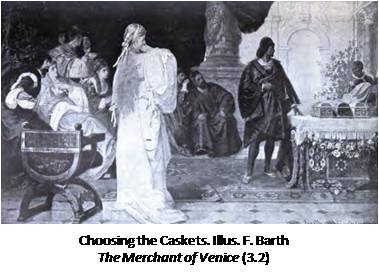 While music is played and a song is sung, Bassanio softly comments upon caskets and inscriptions, declaring at last, that although the rest of the world
might be deceived by glitter, or ready to commit crimes for the sake of silver, he is inclined to think that the leaden casket, which threatens rather than
promises, will be best. As he comes to this conclusion, Portia, in an aside, expresses her ecstasy and watches him open the leaden receptacle, which contains a portrait, over whose beauty he raves, bedore he reads the inscription declaring that since he has not chosen by view, he has chosen fair and true, and
concluding with an injunction to claim his lady with a loving kiss.
While music is played and a song is sung, Bassanio softly comments upon caskets and inscriptions, declaring at last, that although the rest of the world
might be deceived by glitter, or ready to commit crimes for the sake of silver, he is inclined to think that the leaden casket, which threatens rather than
promises, will be best. As he comes to this conclusion, Portia, in an aside, expresses her ecstasy and watches him open the leaden receptacle, which contains a portrait, over whose beauty he raves, bedore he reads the inscription declaring that since he has not chosen by view, he has chosen fair and true, and
concluding with an injunction to claim his lady with a loving kiss.

©1999-2021 Shakespeare Online. All Rights Reserved.