The Death of Polonius and its Impact on Hamlet's Character
From The System of Shakespeare's dramas. by Denton Jaques Snider. St. Louis: G. T. Jones and Company.
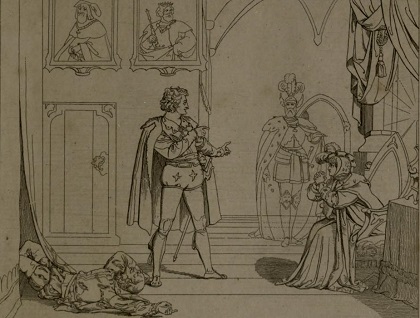
The death of Polonius has given great difficulty, and even offense; its object should be fully comprehended,
for it not only illustrates the character of Hamlet, but also is one of the leading motives of the play. No other incident shows so deep a design, or is so appropriate for its purpose. Hamlet, acting blindly through impulse, slays the wrong one; the result is — guilt. This warning, therefore, speaks
from the rash act: Let no rational being give up control to impulse which cannot see, cannot distinguish, the
nature of a deed. Man must, therefore, reflect before proceeding to action. But, through reflection, Hamlet is
unable to slay the right one; thus he cannot perform the great injunction laid upon his soul. Such is his dilemma; if he acts, it is through impulse, and he falls into guilt; if he reflects, he cannot act — that is, he cannot do the Great Deed of his life, and so commits, at least, a sin of omission.
What will be Hamlet's solution? He tells it himself in the latter part of the play. Throw yourself back into impulse,
and abandon control through intelligence. But what will be the result of such a doctrine? Death — the thinking being who cannot act from thought must perish.
Through the death of Polonius, Hamlet has committed the very crime which he was seeking to punish; the son of
a father murdered has himself murdered a father. Retribution will call up against him a son, at whose hands he
will meet his fate. So this incident offers the profoundest illustration of Hamlet's character, and, at the same time, furnishes the motive of his death. Polonius deserved to die for his offences but Hamlet had no right to slay him.
How to cite this article:
Denton, Jaques Snider. The System of Shakespeare's dramas. St. Louis: G. T. Jones and Company, 1877. Shakespeare Online. 20 Aug. 2009. < http://www.shakespeare-online.com/plays/hamlet/hamletpolonius.html >.
_______
More Resources
 Ophelia's Burial and Christian Rituals Ophelia's Burial and Christian Rituals
The Baker's Daughter: Ophelia's Nursery Rhymes
Hamlet as National Hero
The Elder Hamlet: The Kingship of Hamlet's Father
Claudius and the Condition of Denmark
In Secret Conference: The Meeting Between Claudius and Laertes
O Jephthah - Toying with Polonius
Blank Verse and Diction in Shakespeare's Hamlet
Hamlet's Silence
An Excuse for Doing Nothing: Hamlet's Delay
Foul Deeds Will Rise: Hamlet and Divine Justice
Defending Claudius - The Charges Against the King
Shakespeare's Fools: The Grave-Diggers in Hamlet
Hamlet's Humor: The Wit of Shakespeare's Prince of Denmark
All About Yorick
Hamlet's Melancholy: The Transformation of the Prince
The Significance of the Ghost in Armor
The Significance of Ophelia's Flowers
Ophelia and Laertes
Mistrusted Love: Ophelia and Polonius
Divine Providence in Hamlet
What is Tragic Irony?
Seneca's Tragedies and the Elizabethan Drama
Shakespeare's Sources for Hamlet
Characteristics of Elizabethan Tragedy
Why Shakespeare is so Important
Shakespeare's Language
Shakespeare's Influence on Other Writers
Queen Elizabeth: Shakespeare's Patron
King James I of England: Shakespeare's Patron
The Earl of Southampton: Shakespeare's Patron
Going to a Play in Elizabethan London
|
More to Explore
Hamlet: Explanatory Notes and Study Questions
Hamlet Basics
The Hamlet and Ophelia Subplot
The Norway Subplot in Hamlet
Deception in Hamlet
Hamlet: Problem Play and Revenge Tragedy
The Purpose of The Murder of Gonzago
Study Questions on Laertes and Ophelia
The Dumb-Show: Why Hamlet Reveals his Knowledge to Claudius
_____
|
Do You Agree? ... "It is constantly asserted that Hamlet wept over the body of Polonius ... but there is no warrant in the text for the assertion. It is based on some words of the Queen (iv. i. 24), in answer to the King's question, 'Where is he gone?'" A. C. Bradley. Read on...
|
_____
Analysis of the Characters in Hamlet
Plot Summary of Hamlet
Hamlet's Antic Disposition: Is Hamlet's Madness Real?
Sewing in my closet: Ophelia's Meeting with Hamlet
Hamlet's Relationship with the Ghost
Philological Examination Questions on Hamlet
Quotations from Hamlet (with commentary)
Hamlet Study Quiz (with detailed answers)
Analysis of I am sick at heart (1.1)
Hamlet: Q & A
Soliloquy Analysis: O this too too... (1.2)
Soliloquy Analysis: O, what a rogue and peasant slave am I!... (2.2)
Soliloquy
Analysis: To be, or not to be... (3.1)
Soliloquy Analysis: Tis now the very witching time of night... (3.2)
Soliloquy Analysis: Now might I do it pat... (3.3)
Soliloquy Analysis: How all occasions do inform against me... (4.4)
|