Shakespeare of Stratford
 Shakespeare's Ancestry Shakespeare's Ancestry
Shakespeare's Parents
Shakespeare's Birth
Shakespeare's Siblings
Shakespeare's Childhood
Shakespeare's Lost Years
Shakespeare's Marriage
Shakespeare's Children
Shakespeare as Actor and Playwright
Four Periods of Shakespeare's Life
Shakespeare's Influence
Shakespeare's Language
Portraits of Shakespeare
Quotes About Shakespeare
Shakespeare in Court
Shakespeare and the Gunpowder Plot
Was Shakespeare Shakespeare?
Was Shakespeare Italian?
Shakespeare's Death
Shakespeare's Burial
No Eulogy for Shakespeare?
Shakespeare's Will
Shakespeare Timeline
Richard Burbage (Actor)
Edward Alleyn (Actor)
William Kempe (Actor)
Shakespeare's Boss
Shakespeare's Lasting Impact
Shakespeare's Sexuality
Shakespeare's Power of Assimilation
Preface to The First Folio
Classification of Shakespeare's Work
Shakespeare Q & A
Shakespeare's Pathos
Shakespeare's Portrayal of Youth
Shakespeare on Old Age
Shakespeare's Heroines
Shakespeare's Attention to Details
Shakespeare's Portrayals of Sleep
______
Bardolatry
"The fact is, Shakespeare was not sectarian; he pleaded nobody's mission, he stated nobody's cause. He has written with a view to be a mirror of things as they are; and shows the office of the true poet and literary man, which is to re-create the soul of man as God has created it, and human society as man has made it."
George Dawson (1821-1876), Shakespeare and Other Lectures
|
Bard Bite
Shakespeare's friend and fellow actor, Richard Burbage, amazed and delighted audiences with his stirring interpretation of the outrageous villain Richard III. On March 13, 1602, a lawyer and diarist named John Manningham recorded a now-famous anecdote about Shakespeare and Richard Burbage:
"Upon a time when Burbage played Richard the Third there was a citizen grew so far in liking with him, that before she went from the play she appointed him to come that night unto her by the name of Richard the Third. Shakespeare, overhearing their conclusion, went before, was entertained and at his game ere Burbage came. Then, message being brought that Richard the Third was at the door, Shakespeare caused return to be made that William the Conqueror was before Richard the Third."
|
More Bard Bites
The Chamberlain's Men was an acting company created in early 1594. Shakespeare himself joined the troupe later that year and remained a key player and partner for the rest of his career. In 1603 the newly crowned King James I, a lover of the theatre, became the patron of the Chamberlain's Men, and thus the company was thenceforth known as the King's Men.
___
In 1613, the King's Men twice performed a play called Cardenio, based on a story from Miguel de Cervantes' work. In 1653, an editor named Mosley published the play and said that the authors were Shakespeare and Fletcher. We have no surviving copies of the play so we cannot judge for ourselves. Interestingly, William Shakespeare and Cervantes, the most celebrated writer in Spanish literature, died on the same date – April 23, 1616.
___
|
|
Shakespeare's England
Daily Life in Shakespeare's London
Shakespeare's Wealth and Income
Back in Time: Visit the Globe
What Did Shakespeare Read?
Life in Stratford (structures and guilds)
Life in Stratford (trades, furniture, hygiene)
Shakespeare's Scandal in 1601
Allusions to his Profession
An Elizabethan Christmas
Clothing in Elizabethan England
Queen Elizabeth: Shakespeare's Patron
James I of England: Shakespeare's Patron
Southampton: Shakespeare's Patron
Going to a Play in Elizabethan London
Ben Jonson and the Decline of the Drama
Publishing in Elizabethan England
Shakespeare's Audience
Religion in Shakespeare's England
Alchemy and Astrology in Shakespeare's Day
Entertainment in Elizabethan England
London's First Public Playhouse
Shakespeare Hits the Big Time
Essential Globe Information
Shocking Elizabethan Drama
The King's Men
Games in Shakespeare's England [A-L]
Games in Shakespeare's England [M-Z]
______
On Shakespeare's Humanity
"Shakespeare's gentleness toward the evil in human nature is his rarest quality. We seem to find in every line of him a sentiment which he has put, strangely enough, in the mouth of Henry V:
There is some soul of goodness in things evil,
Would men observingly distil it out.
He can hardly bear to draw a villain. In some cases, where the plot calls for a villain, as in Hamlet, The Tempest, or the Merchant of Venice, - cases in which any other playwright would have given us wickedness, - Shakespeare draws a weak or unfortunate character. In Hamlet the wicked King is half repentant. In the Merchant of Venice Shylock is a much-injured and very human
person. In the Tempest Caliban is convincingly good and unconvincingly bad, a rudimentary half-soul. Prospero, to be sure, considers the creature ungrateful; but we do not think him ungrateful, we think of him as a creature who has never had half a
chance, and we almost love him."
John Jay Chapman (1862-1933). A Glance Toward Shakespeare
|
|
In the Spotlight
Playing Fast and Loose with Shakespeare's Name
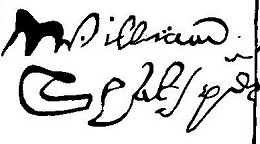 The Elizabethans cared as little for spelling as they did for the Spanish and nowhere is their comical disregard for simple consistency more evident than in their treatment of the surname Shakespeare. And how did Shakespeare spell his own name, anyway? Find out... The Elizabethans cared as little for spelling as they did for the Spanish and nowhere is their comical disregard for simple consistency more evident than in their treatment of the surname Shakespeare. And how did Shakespeare spell his own name, anyway? Find out...
______
|
Shakespeare's Contemporaries: Top 5 Most Fascinating
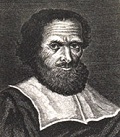 Shakespearean England was a treasure-trove of historical giants – Elizabeth I, Ben Jonson, the Earl of Essex, Edward Alleyn, John Lyly, William Kempe - to name a few. It was hard to choose, but here is a list of those five contemporaries of the Bard whose lives are most intriguing. See if you agree. Shakespearean England was a treasure-trove of historical giants – Elizabeth I, Ben Jonson, the Earl of Essex, Edward Alleyn, John Lyly, William Kempe - to name a few. It was hard to choose, but here is a list of those five contemporaries of the Bard whose lives are most intriguing. See if you agree.
______
|
Worst Diseases in Shakespeare's London
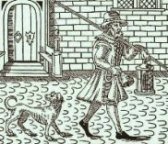 From a disease standpoint, Shakespeare was living in arguably the worst place and time in history. Shakespeare's overcrowded, rat-infested, sexually promiscuous London, with raw sewage flowing in the Thames, was the hub for the nastiest diseases known to mankind. Here are the worst of the worst. From a disease standpoint, Shakespeare was living in arguably the worst place and time in history. Shakespeare's overcrowded, rat-infested, sexually promiscuous London, with raw sewage flowing in the Thames, was the hub for the nastiest diseases known to mankind. Here are the worst of the worst.
______
|
What Did Shakespeare Drink?
 A rich and sweet wine brought to England from Greece in the 16th century, Malmsey is now produced on the island of Madeira. Shakespeare writes about Malmsey in Love's Labour's Lost (5.2.240) and 2 Henry IV (2.1.36), but the most famous reference to Malmsey in all of literature can be found in Richard III. Read on... A rich and sweet wine brought to England from Greece in the 16th century, Malmsey is now produced on the island of Madeira. Shakespeare writes about Malmsey in Love's Labour's Lost (5.2.240) and 2 Henry IV (2.1.36), but the most famous reference to Malmsey in all of literature can be found in Richard III. Read on...
______
|
Quick Quote
 My lord, they say five moons were seen to-night; My lord, they say five moons were seen to-night;
Four fixed, and the fifth did whirl about
The other four in wondrous motion.
King John (4.2), Hubert
Although Shakespeare would have not even known the planet Uranus existed, 24 of its 27 known moons are named after his characters. Bianca and Umbriel are named after characters in Alexander Pope's Rape of the Lock and, surprisingly, John Herschel named the brightest moon of Uranus, Ariel, after the character in Pope's work, not the more famous Ariel in Shakespeare's The Tempest.
_____
|
On Shakespeare's Imagination
"Shakespeare is, above all, imagination. Now - and this is a truth to which we have already alluded, and which is well known to thinkers - imagination is depth. No faculty of the mind penetrates and plunges deeper than imagination; it is the great diver. Science, reaching the lowest depths, meets imagination. In conic sections, in logarithms, in the differential and integral calculus, in the calculations of sonorous waves, in the application of algebra to geometry, the imagination
is the coefficient of calculation, and mathematics becomes poetry....The poet philosophizes because he imagines."
Victor Hugo (1802-1885). William Shakespeare
|
New Book: Imagining Shakespeare's Wife
Shakespeare fans will enjoy Katherine West Scheil's book exploring the cultural depictions of Shakespeare's wife, Anne Hathaway, throughout the centuries. You can find out more by visiting the Cambridge University Press website (non affiliate link).
|
|
 Sometime between 1556 and 1558 William's father, John Shakespeare, married Mary Arden, the daughter of the wealthy Robert Arden of Wilmecote. Although we know very little about Shakespeare's mother, she is revealed through the many details of the lives of her family.