| SONNET 71 |
PARAPHRASE |
| No longer mourn for me when I am dead |
You can mourn for me when I am dead, but no longer |
| Then you shall hear the surly sullen bell |
Than when you hear the solemn-sounding bell |
| Give warning to the world that I am fled |
Announce to the world that I have gone |
| From this vile world, with vilest worms to dwell: |
From this vile world, to live with the worms (in the grave): |
| Nay, if you read this line, remember not |
If you read this line, do not remember |
| The hand that writ it; for I love you so |
The hand that wrote it; for I love you so much |
| That I in your sweet thoughts would be forgot |
That I would rather you forget me completely |
| If thinking on me then should make you woe. |
If thinking about me when I am gone would make you upset. |
| O, if, I say, you look upon this verse |
O, if you look upon this sonnet |
| When I perhaps compounded am with clay, |
When my body has become mixed with the dust and dirt, |
| Do not so much as my poor name rehearse. |
Do not even mention my insignificant name. |
| But let your love even with my life decay, |
But let your love decay in the same way that my life rots away, |
| Lest the wise world should look into your moan |
So that the malicious people in world do not pry into your grief |
| And mock you with me after I am gone. |
And use your relationship with me to mock you after I am dead. |
Notes
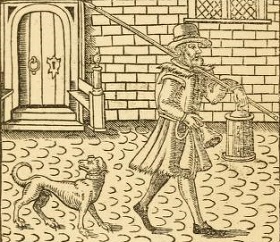
hear the surly sullen bell (2): At funerals during the Renaissance, one could pay to have the "passing-bell" rung as many times as the years the deceased was alive, as a tribute to his or her life. See Macbeth and the "fatal bellman" (2.2.5-6) for more on London's bellmen.
_____
Sonnets 71-74 are usually grouped together and are linked by the poet's thoughts on his own mortality. In the relationship with his dear friend, the poet is the older man, and, believing he will die before his young man, he creates this verse, in part, to help console his friend. It becomes clear as we read the many sonnets focused on the ravages of time that Shakespeare was consumed by a profound melancholia brought about by persistent pondering on loss and death. In other sonnets, the poet finds solace in his dear friend, who is presented as his redeemer, both spiritually and emotionally. But even his lover cannot release him from the sadness that comes with knowing he will die, and "with vilest worms to dwell." The hopelessness expressed in this sonnet seems to indicate that the poet's faith, at least at the time of writing this particular poem, was deeply lacking. Moreover, the last two lines reveal the poet's intense insecurity and anxiety over his relationship with the idealized young man, as he fears that their friends will mock the lover's regard for him, illustrating the lover's lack of good taste and judgment.
With Sonnet 71 we can see the tremendous influence Shakespeare had on the great romantic poets like Keats and Shelley. Keats was known to work next to the bust of Shakespeare at all times, and we can imagine he had worn thin his copy of this sonnet.
In terms of the form, the three quatrains of this sonnet are of a parallel structure, serving to persuade the young man to forget the poet, and, in the final couplet, the reason for the request is revealed. And, to find out more about the man who many scholars believe to be the object of Shakespeare's devotion, the Earl of Southampton, click here.
How to cite this article:
Shakespeare, William. Sonnet 71. Ed. Amanda Mabillard. Shakespeare Online. 8 Dec. 2012. < http://www.shakespeare-online.com/sonnets/71detail.html >.
______
Even More...
 Shakespeare in Old English? Shakespeare in Old English?
Shakespeare's Influence on Other Writers
An Elizabethan Christmas
Clothing in Elizabethan England
Queen Elizabeth: Shakespeare's Patron
King James I of England: Shakespeare's Patron
The Earl of Southampton: Shakespeare's Patron
Going to a Play in Elizabethan London
Ben Jonson and the Decline of the Drama
Publishing in Elizabethan England
Shakespeare's Audience
Religion in Shakespeare's England
Alchemy and Astrology in Shakespeare's Day
Entertainment in Elizabethan England
London's First Public Playhouse
Shakespeare Hits the Big Time
|
More to Explore
Introduction to
Shakespeare's Sonnets
Shakespearean Sonnet
Style
How to Analyze a Shakespearean Sonnet
Theories Regarding the Sonnets
The Rules of Shakespearean Sonnets
Shakespeare's Sonnets: Q & A
Are Shakespeare's Sonnets Autobiographical?
Petrarch's Influence on Shakespeare
Themes in Shakespeare's Sonnets
Shakespeare's Greatest Love Poem
Shakespeare and the Earl of Southampton
The Order of the Sonnets
The Date of the Sonnets
Who was Mr. W. H.?
Are all the Sonnets addressed to two Persons?
Who was The Rival Poet?
_____
|
Points to Ponder ... "In the Sonnets we may read of the poet's intense hopes and fears regarding his fate, and we
learn of his all-consuming desire for immortality. Begin as he may with his theme, he almost invariably merges into allegory, and represents himself as
the contestant of death. Bodily death he does not fear: oblivion he dreads. He therefore argues incessantly on the course he shall pursue to defy the ravages of time and prevent the loss of reputation. He may have the applause of the day (on the stage); or he may command lasting renown (by his pen). His "fair friend," his "better angel," bids him to seek immortality; his "dark" mistress, the alluring woman with the "mourning eyes," tempts him to delights of the present. The two series of
poems are almost wholly allegorical and antithetical." John Cuming Walters. (The Mystery of Shakespeare's Sonnets)
|
_____
Shakespeare on Jealousy
Shakespeare on Lawyers
Shakespeare on Lust
Shakespeare on Marriage
Blank Verse and Diction in Shakespeare's Hamlet
Analysis of the Characters in Hamlet
Shakespeare on the Seasons
Shakespeare on Sleep
|