| directory |
| home | contact |
|
|||||||||||||||
| search | |||||||||||||||
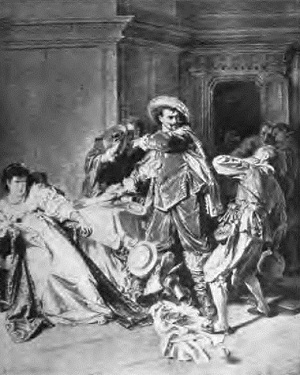
The Taming of the Shrew: Plot SummaryFrom Stories of Shakespeare's Comedies by Helene Adeline Guerber. New York: Dodd, Mead and company.Induction.The opening scenes of The Taming of the Shrew are often cut out, as the play itself is intelligible without them, the omitted part showing an inn, at the door of which the hostess reproaches Sly for not paying his debts, ere she departs in quest of a constable to arrest him. Too drunk to heed threats, Sly falls asleep near the door, in spite of the noise of an approaching hunting party.A lord, dashing upon the scene, gives orders to the huntsmen for the care of his hounds, and, suddenly becoming aware of Sly's presence, is seized with a mad desire to play a practical joke upon him. He, therefore, bids his servants pick up the unconscious tinker, giving them elaborate directions to put him to bed in a luxurious chamber, pretending, when he awakes, that he is their beloved master, who has been insane for some time. The servants, delighted with the idea, remove the unconscious man, just as strolling players arrive and are hired to perform that evening for Sly's benefit. These preparations completed, the lord directs that his page dress up like a lady, to play the part of Sly's wife, using an onion, if necessary, to produce artificial tears. The next scene is played in the lord's house, where Sly awakens, surrounded by obsequious attendants, proffering garments, drink, and food. When the bewildered tinker insists that he never owned more than one suit of clothes at a time, the attendants pity his delusions, and reproach him for not inquiring for his devoted wife, who has mourned his sad state for the past fifteen years. It is while Sly is muttering in surprise, that the page enters, dressed as a lady, and weeping profusely, begins to lavish caresses upon him, while he, in his bewilderment, asks the servants how to address this woman. Under pretence of preventing Sly's falling back into his sad state of melancholy, a play is proposed, and it is this "play within a play" which gives its title to this chapter. Although Sly shows so little appreciation for it that he wishes it were done at the close of the first scene, it has delighted the public for the past three hundred years. Act I.The rising curtain reveals the public square in Padua, where Lucentio is telling his servant Tranio he has come here to attend the university, hoping to make good use of the opportunities his father affords him to enlarge his mind. Sent not only to wait upon his young master, but also to watch over him, this servant gives Lucentio the wise advice to vary his studies, working hardest at what he likes best, adding sagely, "No profit grows where is no pleasure ta'en: in brief, sir, study what you most affect."They are still talking, while awaiting Lucentio's second servant, when people arrive in the square. The newcomers are Baptista, a rich gentleman, accompanied by his two daughters, Katharine and Bianca, and the latter's two suitors, Gremio and Hortensio. Drawing aside, master and man comment on what is going on, thus overhearing Baptista's decision to allow Bianca to receive no further attentions until her elder sister has secured a husband; and his intimation that, should either of Bianca's suitors fancy Katharine, he is welcome to her. Neither gentleman, however, seems inclined to avail himself of this privilege, as Katharine is known for a temper so violent that none dare approach her. Baptista's decision, and the evident reluctance of both men to sue for her hand, drive Katharine to rude remarks, which prove that her reputation for shrewishness is well deserved. This violence also attracts remarks from the eavesdroppers, the servant averring the lady must be mad, while his master opines her manners present a startling contrast to those of her sister, the most attractive woman he has ever seen. While Lucentio is thus falling in love with Bianca, Baptista informs her he is going to banish her into the house where she can amuse herself studying, because, as long as she is visible, her sister will never be able to secure a mate. Although Bianca submits without murmur, her lovers protest so vehemently, that her father, who evidently prefers his younger child, offers to sweeten her captivity by supplying her with masters of all kinds, inquiring whether the suitors know of any good teachers in town. Although Baptista bids Katharine remain behind while he conducts her sister into retirement, this contrary damsel follows them both, leaving the two pretenders to procure not only masters for Bianca, but, if possible, a suitor willing to overlook the shrew's temper in consideration of her large dowry. Hortensio and Gremio having gone, the first-comers resume their interrupted conversation, Lucentio rhapsodising about Bianca until Tranio reminds him of her father's decree. The youth then boldly decides to become master of literature to the lady, his servant personating him, in the meantime, in town. Charmed to play such a part, the man suggests his companion in service can wait upon him, so he and his master immediately change clothes. They have barely done so when the second servant comes on the scene, whereupon Lucentio explains to him that, having killed a man in a duel, he is obliged to hide to avoid punishment, and that, while one of his servants represents him, the other must serve his comrade with all outward respect. This matter has just been settled when Petruchio and his servant appear, the former remarking he has come to Padua to visit Hortensio, before whose house he now stands. He bids his man knock at the door, using the expressions, 'knock me, rap me,' etc., — terms the servant is too simple to interpret otherwise than literally, but dares not carry out. Angry at not being obeyed, Petruchio pulls his man's ears, thus attracting Hortensio, who explains the verbal misunderstanding. The servant now drawing aside, the friends converse confidentially, Petruchio revealing that, his father's death having made him a man of means, he has come to Padua to secure a rich wife. On hearing this, Hortensio eagerly suggests he espouse Katharine, warning him loyally that, however rich she may be, she has the reputation of a shrew. Attracted by the lady's large dowry, Petruchio, — who deems himself competent to cope with any woman's temper, — enthusiastically declares he will woo and win her. The servant, perceiving Petruchio pays no heed to Hortensio's strictures, hints that when his master has once gotten an idea into his head, it can never be dislodged, adding that, having learned Katharine has money, Petruchio will marry her whether or no, and that, being a clever actor, he will doubtless scold harder than she, should occasion arise. In reply to eager questions, Hortensio gradually reveals who the lady is, and Petruchio, learning their fathers were once friends, feels sure of a good reception. As he is determined not to sleep until he has met the lady whose dowry and temper fascinate him, Hortensio tells him of his love for her sister Bianca, suggesting that in return for the chance of securing so wealthy a bride, Petruchio should introduce him disguised to Baptista, as a master of music, fitted to teach all a lady cares to learn. It is while they are discussing the details of this scheme that Lucentio comes on the scene, disguised as a master of languages, boastfully assuring Gremio, — whom he has secured as patron, — that he is an adept in his profession. Hoping to win Bianca's favour by providing her with an instructor who will also prove a friend at court, Gremio proudly announces he is bound for Baptista's house. On learning that Petruchio is also going thither to woo Katharine, Gremio is overjoyed, feeling like Hortensio, that the elder sister once out of the way, Bianca can easily be won. It is, therefore, for the sake of disposing of Katharine, that he and Hortensio bury all rivalry for the present, and vie in giving Petruchio instructions, warning him, however, to prepare for the worst. To all their cautions this bold suitor confidently replies a little noise will not daunt him, as he has heard lions roar, and sea-waves beat against the shore, and that the crash of thunder and the din of battle have so hardened his ears that a woman's tongue has no terrors for him. They are about to set out for Baptista's house, when overtaken by Lucentio's servant, impersonating his master, and closely attended by his comrade. The false Lucentio pretends to have come to town to sue for Bianca's hand, and simulates great surprise when informed that he cannot press his suit until her sister is married. When he learns that Gremio and Hortensio are also candidates for her favour, he pettishly demurs; but finally consents to join them in furthering Petruchio's suit, feeling, like the rest, deeply indebted to the man whose wooing of Katharine is their only hope. All, therefore, agree to meet at a banquet that evening, where they will drink to Petruchio's success. Act IIThe second act opens in Baptista's house, where Bianca, hands bound behind her, is undergoing torture at her sister's hands. Although she is piteously begging to be set free, cruel Katharine vows she shall remain a prisoner until she has confessed which suitor she prefers. Thinking her sister covets the possession of one of these lovers, — and not caring for either, — Bianca shows suspicious readiness to abandon both, and thus so rouses Katharine's anger that she strikes her.The father, appearing at this moment, chides his eldest daughter, who, instead of taking this reproof to heart, lets her sister escape, while she reviles him for his preference of his youngest child. Then, Katharine flounces out of the room, leaving Baptista alone to lament his ill-fortune at being plagued with such a daughter. His soliloquy is interrupted by the arrival of the suitors, and, no sooner have the usual courtesies been exchanged, than Petruchio makes himself known, declaring that, having heard of the beauty, wit, and affability of Baptista's eldest daughter, he has come to sue for her hand. He adds that, to insure a welcome, he brings a master for Bianca, and then introduces the disguised Hortensio. In his turn, Gremio boasts of the acquirements of his candidate, while the false Lucentio eagerly proffers books and a musical instrument for the use of the young lady whom he, too, hopes to win. Baptista has just bidden a servant carry away these gifts, and introduce the new masters to his daughters, when Petruchio, as if unable to brook further delay, impetuously exclaims, "My business asketh haste," inquiring what dowry Baptista will bestow upon his elder daughter. Anxious to get rid of troublesome Katharine, Baptista promises to will her one-half of his wealth, giving her immediate possession of twenty thousand crowns, — an amount so alluring to Petruchio that, after stating what he is ready to settle upon his wife, he proposes the immediate signing of a contract. But to this Baptista objects that, before proceeding any further, the lady's favour should be won, a feat Petruchio thinks he can easily perform, being as peremptory as Katharine herself, and fully aware of the fact that a great gust puts out a small fire. When Baptista cautiously endeavours to prepare him for what awaits him, this strange suitor adds the significant statement that he is "rough and wooes not like a babe," a boast which he carries out, as you will see. They are still conversing when Hortensio bursts into the room, holding his hands to his head, for, having attempted to teach Katharine music, he so incensed her, that she brought the new instrument down upon his head, with sufficient force to smash it and cause him pain. The father seems unspeakably shocked at such behaviour, but Petruchio loudly vows such manners inspire him with a still livelier desire to see the lady. Baptista, therefore, goes off in quest of Katharine, taking with him the unfortunate Hortensio, whom he encourages by promising that henceforth he shall instruct Bianca only, whose gentleness is proverbial. Left alone to await the appearance of the fair Katharine, Petruchio lays his plans, proposing to woo the lady "with some spirit," pretending when she scolds that she is singing sweetly, when she frowns that she is smiling upon him, when she is mute that her loquacity is charming, and vowing that, even should she bid him begone, he will assume she is suggesting the immediate publication of their banns. No sooner does Katharine appear, therefore, than Petruchio greets her with a familiarity which she resents by making all manner of biting and cutting remarks, all of which he receives in the most amiable fashion. After a spirited interview, wherein Katharine's sharp speeches are answered wittily and wisely, the girl, discovering she cannot otherwise anger this bold suitor, deals him a blow. Although sorely tempted to retort in kind, Petruchio forbears, pressing Katharine to accept him, and declaring that, notwithstanding evil reports, he finds her gentle and loving. He adds that he is determined she shall marry him and no one else, and cautions her not to contradict any statement he makes when her father returns. A moment later, when Baptista appears with Gremio and the false Lucentio, Petruchio swaggeringly declares it was impossible he should not speed in his wooing, although the wrathful Katharine denies giving her consent, and reviles her father for expecting her to accept a madman. None of her stinging remarks disturb Petruchio, who coolly announces that, having found Katharine an epitome of all virtues, he will marry her Sunday next; assuring Baptista, when she contradicts him, that she does so merely to appear coy, having been most tractable when they were alone together. Paying no further heed to her denials, therefore, he says he will go to Venice to procure wedding garments, and, after bidding Baptista prepare a feast, takes courteous leave of the sullen girl, who turns her back upon him. When Katharine and Petruchio have left the stage in opposite directions, Gremio and the false Lucentio wonder aloud how any one dare woo so thorny a bride, and marvel at the speed with which this match has been concluded; while Baptista openly congratulates himself upon disposing of a daughter, so troublesome that he never expected to find a mate for her. The matter of Katharine's marriage settled, both suitors deem the time has come to urge their claims to Bianca's hand, Gremio stating that, as an old man, he will make the better husband, while Lucentio pleads his youth as an advantage. When Baptista answers by announcing he will bestow his youngest daughter upon the suitor who can offer most, both begin to enumerate their possessions, eagerly trying to outbid one another. The offers of the false Lucentio finally so far surpass those of Gremio, that Baptista promises to favour him, provided his father comes to Padua to approve the match. He does not, however, doubt that this consent will be forthcoming, for he announces that, whereas Katharine will be married on the following Sunday, Bianca shall be awarded to her successful lover on the next. Baptista having gone, Gremio and his rival exchange taunts, and it is only when left quite alone on the stage, that the false Lucentio ruefully wonders how he can procure a false father to act as his sponsor, seeing he dare not appeal to the real Vincentio. Act IIIThe third act begins in Baptista's house, where Bianca is sitting with her masters, both of whom are eagerly striving to monopolise her attention. In their anxiety to win her favour, they prove extremely rude to one another, for when Hortensio insists that music comes first, Lucentio retorts it should only be considered as refreshment after serious study. The young lady, evidently greatly taken by Lucentio, now invites him to help her construe Latin, directing Hortensio meanwhile to tune his instrument, so as to give her a music lesson later on.Taking advantage of his position as Latin teacher, Lucentio construes two lines from Ovid to signify that he, Lucentio, has come hither in disguise, merely to win Bianca's favour, while his servant sues with her father in his name. He has barely gotten thus far in a declaration to which Bianca listens with praiseworthy attention, when he is interrupted by Hortensio, who pronounces his instrument in perfect tune. Wishing to learn more about this interesting Latin lesson, Bianca pretends to discover a discord and sends the musician away to retune his instrument, while she, in her turn, construes the same Latin sentence to signify that, not knowing who her new suitor may be, she dares not trust him; still he need not despair. The musician drawing near again, Lucentio, apparently satisfied for the present, allows his rival to instruct Bianca in his turn. But, although Hortensio, too, makes use of his art to further his suit, Bianca proves strangely inattentive, finds fault with his method, and gladly leaves the room when summoned away by a servant. Finding no attraction in the room when Bianca is not present, the true Lucentio departs, leaving his rival alone on the stage, to express dark suspicions of the strange master who has so quickly captivated his fair pupil's attention. The next scene is played in front of Baptista's house, where the wedding party vainly await the bridegroom, due long before. Baptista is explaining to the false Lucentio that Katharine's wedding would have been concluded earlier in the day, had it not been for Petruchio's absence, which makes them appear ridiculous. His remarks so enkindle Katharine's smouldering wrath, that she suddenly declares the man who "wooed in haste" evidently "means to wed at leisure," and rushes off the stage in tears. Anxious to see her safely married, Tranio warmly protests that Petruchio is honest, although he cannot but agree when Baptista remarks that, for once, Katharine's outburst of rage is justifiable, seeing "such an injury would vex a very saint!" It is while the men are standing there idly, that Lucentio's second servant bursts in, announcing Petruchio is coming, attired in disreputable garments, riding a nag whose saddle and bridle are held together with strings, and attended by a servant gotten up in similar poverty-stricken style. The wedding guests are commenting upon this strange behaviour, when Petruchio marches in, well pleased with himself, and calling loudly for his bride. Dreading the effect, of such an appearance upon Katharine's temper, Baptista vainly tries to induce him to don more seemly apparel; but Petruchio insists that the lady is to marry him and not his clothes, adding that he is so eager to embrace her, that he can brook no further delay. He, therefore, passes off the stage, escorted by the other wedding guests, only the true and false Lucentios remaining face to face. This being their first private interview since settling their programme, the servant hastens to report how he has played his master's part, announcing at the end that a false father will have to be found to vouch for the false son. On his part, Lucentio admits that, were it not for the fact his fellow-instructor watches Bianca so closely, he would try to run away with her, knowing that once married, he could hold her "despite of all the world." Master and servant are still discussing how to outwit Bianca's father and suitors, when Gremio returns from church, exclaiming over the wedding. He avers that, although the bride is noted for a shrewish temper, she is nothing but "a lamb, a dove, a fool," in comparison with the bridegroom; supporting his statement by a lively account of the manner in which Petruchio knocked down the priest, stamped, swore, called for wine, flung the pieces of toast floating upon it into the sexton's face, and wound up his unseemly proceedings by giving his new-made wife such a resounding smack, that it could be heard throughout the church. This account of the wedding is just finished, when music heralds the bridal procession, Petruchio proudly leading Katharine, and graciously thanking his friends for honouring their wedding banquet, which, alas, neither of them can attend. On hearing that he and his bride must depart immediately, Baptista, the guests, and even Katharine, try to persuade Petruchio to change his mind. But he parries all their entreaties, until, irritated by his refusal, his bride announces her intention to remain. After replying to this speech by a firm yet calm statement of his rights, Petruchio shows plainly he means to enforce them, for, after again bidding his friends enjoy the banquet without them, he calls upon his servant to help rescue his mistress from the hands of importunate friends, loath to part with her. While Petruchio thus sweeps the bewildered Katharine away, the guests wonder how so mad a marriage will turn out, even the gentle Bianca remarking that, "being mad herself, she's madly mated!" Then, all follow Baptista into the house, where they are invited to partake of the banquet, of which Bianca and the false Lucentio are to do the honours in place of the absent bride and groom. Act IVThe fourth act opens in Petruchio's house, where his servant has arrived cold, wet, and weary, and is loudly calling for help to build fires and prepare for the bridal couple. In conversation with a fellow-servant, this man gives a lively description of the homeward journey, including his mistress's tumble from her horse in a muddy spot in the road, and vows that, instead of helping Katharine rise, Petruchio, pretending to blame him for the fall, began to beat him, desisting only when the bride held his hand. On hearing this, the second servant sagely concludes that his master is even more shrewish than the new mistress, whose fame has come to his ears.All the servants are just receiving instructions in regard to their behaviour towards the newly married couple, when Petruchio marches in, gallantly leading Katharine, yet scolding vehemently at his reception. His servants rush forward with apologies, but are shortly dismissed, and it is only after humming a little tune, that Petruchio seems to remember the presence of his bride. With exaggerated courtesy, he now bids her welcome, calls for servants to remove his boots and bring water, treating them so roughly, however, that Katharine is again obliged to interfere. Supper being served, Petruchio escorts his wife to table, but soon after sitting down, angrily declares nothing is fit to set before her, and throws all the viands {food} on the floor. In spite of Katharine's entreaties, he rages on, and on, vowing at last that they will go to bed fasting, seeing there is nothing they can eat. The bridal couple having left the apartment, Petruchio's servants comment upon his strange behaviour, one of them slyly averring the bridegroom evidently intends to kill the bride "in her own humour." Then another servant joins them, gleefully reporting how Petruchio is continuing his angry fuss in his wife's bedroom, where he finds nothing suitable for her use, and is storming until she knows not "which way to stand, to look, to speak!" The servants vanish when Petruchio reappears, pleased with what he has done, and mischievously announcing that, although he knows his wife is hungry, he is going to treat her like a hunting falcon, and starve her into submission. He also means to prevent her from sleeping, under the pretext of looking after her comfort, declaring that his plan to tame the shrew consists in killing her with kindness. The curtain next rises showing Baptista's house in Padua, where the false Lucentio and Hortensio are discussing Bianca's evident infatuation for her new teacher. While they are thus talking, Bianca and her language master stroll upon the scene, and the latter is overheard sentimentally declaring that the only art he professes is love. The suitors in the background are amazed by this revelation, Hortensio, in his chagrin, revealing for the first time that he is a gentleman, disguised as a teacher in hopes of winning the fickle lady's affections. Both he and the false Lucentio now conclude their chances are gone, a fact made patent by the actions of Bianca and of the real Lucentio, in one corner of the stage. Hortensio, therefore, decides to resign his office as teacher, and marry a wealthy widow who has long sought his affections. When Hortensio has gone, the false Lucentio, turning to the lovers, announces this decision, twitting Bianca with losing a good chance, ere the lovers leave the scene. Just then the servant comes to inform his pretended master that, after long search, he has discovered a man to personate his father, and satisfy Baptista by consenting to his marriage. The man thus selected to play the part of Vincentio is a Pedant, weary from a long journey, who is no sooner introduced to the false Lucentio, than the latter craftily inquires whether he has heard that all travellers coming from Mantua are to be put to death. This news terrifies the stranger, to whom Lucentio graciously promises his protection, provided he will personate Vincentio and signify his consent to his nuptials. Under such circumstances the Pedant dares, of course, not refuse, and soon departs with his protector to assume the disguise which will enable him to play a father's part. The next scene is transferred to a room in Petruchio's house, where hungry Katharine is piteously imploring a servant to bring her something to eat, adding pathetically that even beggars were never turned away hungry from her father's door. Faint from lack of food, and giddy from want of sleep, — for Petruchio still pretends no meat or couch is worthy of her, — she hopes to procure a little sustenance surreptitiously. The malicious servant, after playing upon her feelings by proposing one dish after another, — which she no sooner implores him to serve, than he begins to demur, — finally refuses to bring her anything, for fear of incurring his master's displeasure; until, exasperated by these tantalising offers and subsequent refusals, Katharine finally loses patience and beats him. The man has gone off to nurse his bruises, when Petruchio comes in with Hortensio, bearing a dish of meat, which he has dressed himself to make sure it will suit his beloved bride. Katharine, sulking at one side of the stage, pays no attention to him, and vouchsafes no response to his lavish expressions of affection and devotion. Perceiving this, Petruchio assumes she scorns the food he has prepared for her; so he is about to order it removed, when she forces herself to utter a reluctant "thank you," as reward for his pains. The lady also allows him to lead her to the table, where, while they take their places, Petruchio whispers to Hortensio to eat as fast and as much as possible, as Katharine is not to get more than a taste of the meal. With elaborate courtesy, he then serves his wife an infinitesimal portion, interfering so cleverly with every mouthful she eats, that, long before her hunger is appeased, the table is cleared, and he is loudly calling for the merchants from whom he has ordered rich garments for his bride. Two dealers now enter and begin displaying hats and gowns, which Petruchio decries, but which his wife admires, finally becoming so anxious to possess them, that she tries to silence Petruchio by threatening to fly into a rage unless he cease annoying her by constant interference in women's affairs. Pretending her anger is fully justified by the unsuitability of the garments offered, Petruchio rudely dismisses the merchants, whispering to Hortensio to follow and indemnify them for their pains. Left alone with his friend and wife, Petruchio now proposes a visit to her father, stating they can easily reach Padua by dinner-time. But, still angry, Katharine tartly retorts that they will hardly arrive for supper, thus making Petruchio swear that he will never start at all unless she agrees with instead of constantly contradicting him. The next scene is played before Baptista's house, where the false Lucentio appears with the Pedant, now personating his father, Vincentio. A servant soon reports that Baptista, hearing of their coming, welcomes them heartily, a welcome confirmed a moment later by Baptista, himself, accompanied by his daughter's master of languages. After greeting the false father warmly, Baptista receives a formal consent to the young couple's union, the parent of the bridegroom regretting not to be able to grace the ceremony. Under plea of immediate departure, he urges the signing of the contract, in his son's lodgings, since Baptista refuses to do so in his own house lest the other suitors make trouble. Baptista, therefore, agrees to accompany father and son, bidding the language teacher follow promptly with his fair pupil. All the others having left the scene, the real Lucentio and his second servant decide that, for fear of discovery, Bianca's marriage must soon take place. The servant is, therefore, sent to engage the services of a priest, while Lucentio goes off to persuade Bianca to marry him on her way to join her father. The following scene is played upon a public highway, where Petruchio is riding with Katharine, who, for the sake of visiting her father, has been humouring her difficult husband. Although Petruchio makes sundry ridiculous tests of her new-born pliancy, and threatens to return home every time she shows the slightest contumacy, she is so weary of his continual outbursts of uncontrolled anger, that she agrees to all he says, even when he takes sly pleasure in making her contradict herself almost in a breath. This makes the listening Hortensio finally exclaim in triumph, "the field is won!" They do not proceed very far before encountering Lucentio's real father, on his way to Padua to visit his son. When Petruchio informs him that his only son is about to marry Katharine's sister, Vincentio asks many questions, while Hortensio, following in their wake, decides to espouse the widow without further delay, Petruchio having taught him not to fear a woman's tongue. Act VThe fifth act begins in Padua, before Lucentio's house, where Gremio stands wondering what is going on within. While he is cogitating thus, Lucentio and Bianca slip past him, guided by the servant, who says the priest awaits them at the altar. Gremio is just commenting on the master's strange absence, when Petruchio and his party halt to point out to Vincentio his son's abode, advising him to knock hard should he wish admittance.After repeated knocking, Gremio informs the stranger the people within are too busy to attend to him, whereupon Vincentio knocks so peremptorily that the Pedant, from a window, demands the meaning of this unseemly noise. False and true fathers now enter into a ridiculous dialogue, neither having the remotest idea of the identity of the other. In a reply to an inquiry for Lucentio, the false father states that, although at home, he is not at liberty, adding grandiloquently, when it is hinted how lads are always glad to admit fathers bringing money, that, being Lucentio's father himself, no one else shall supply him with funds. This statement naturally causes Petruchio to consider the traveller an impostor, whom he is about to have arrested, when Lucentio's second servant runs up, exclaiming the young people are safe in church. On coming suddenly face to face with his old master, this man, hoping to prevent the premature discovery of his young master's plans, decides to deny ever having seen Vincentio before. Indignant at what seems wanton impudence, Vincentio beats him, so that, after loudly calling for help, the man runs away, Katharine and Petruchio watching from the background. The clamour at the door brings out the false Lucentio, hotly demanding who dares beat his man. He, too, is amazed to find himself face to face with Vincentio, who, perceiving him tricked out in his son's clothes, suspects foul play. This servant, too, denies him, and Vincentio, learning that his son's father has been in Padua consenting to his wedding, wails so loudly for Lucentio, that the false bearer of that name summons an officer. Just as this man is about to lead the prisoner away Gremio establishes his identity. It is at that moment that the newly made bride and groom appear, and the old father, overjoyed to find his son safe and sound, embraces him rapturously, while Bianca falls at Baptista's feet, hysterically begging his pardon. Unable to understand what this means, Baptista wonders who the stranger may be who accompanies his daughter. The whole tangle is now unravelled, Lucentio proved the only rightful bearer of the name, and the man about to be arrested his beloved father. The marriage to Bianca is confessed, the bridegroom sagely declaring that "Love wrought these miracles!" and exonerating servants and Pedant. Justly indignant at having been gulled, both fathers leave the stage in anger, but Lucentio comforts his bride with the assurance that before long the irascible old gentlemen will be appeased. His hopes blasted by Bianca's marriage, Gremio wisely concludes to enjoy the wedding banquet, the only compensation offered for his disappointment. Next, Katharine and Petruchio, silent witnesses to all that has transpired, prepare to follow the rest into the house to partake of the wedding banquet. But first Petruchio demands a kiss, which his obedient wife bestows after slight demur, although still on the public street. The last scene is played in Lucentio's house, where the guests are partaking of the banquet, and the bridegroom's speech meets with general approval. As the feast progresses, the widow whom Hortensio has married, begins a battle of words with Katharine, which is greatly enjoyed by their respective husbands. Bianca ends it, however, by rising and leading away the ladies, leaving the gentlemen to discuss the verbal encounter. In the course of this conversation, the three bridegrooms challenge each other to test their wives' obedience, agreeing after some demur that their wager be fixed at one hundred crowns, and that each husband send for his wife in turn, the one obtaining the promptest obedience pocketing the stakes. These preliminaries settled, Lucentio bids a servant summon Bianca, only to hear the man report a moment later that his mistress is busy and cannot come; a message which causes Petruchio and Hortensio to ridicule their friend, whose wife is not as tractable as he supposed. Then Hortensio sends the same servant to entreat his wife to join him, but although he uses so diplomatic a phrase, the former widow sends back word he must be jesting, and that if he wants her, he must come to her. After a few jeers at his disappointed companions, Petruchio roughly bids the servant command his wife's immediate presence, and although the others loudly aver Katharine will never submit to such tyranny, he seems confident of success. His confidence is not misplaced, for, almost immediately, Katharine runs into the room, inquiring submissively, "What is your will, sir, that you send for me?" Then Petruchio bids her go in quest of the two rebellious wives, bringing them down by force if need be, since they know not their duty to their husbands. She has barely vanished to carry out these lordly commands, when Lucentio and Hotensio express surprise over the transformation effected in Katharine's temper, which Petruchio proudly avers, bodes "peace, and love, and quiet life." Baptista, silent witness of all that has gone on, now declares Petruchio has honourably won his wager, adding he is so overjoyed at the change in his once shrewish daughter, that he will double her dowry. This promise affords Petruchio such satisfaction that he offers to win the wager more fairly still, by giving his friends another proof of his wife's subjection. He does so when Katharine returns with Bianca and the widow, by greeting her with the remark that her cap is unbecoming, bidding her pluck it from her head, and trample it under foot. While Katharine unhesitatingly obeys, Bianca and the widow angrily chide their husbands for making foolish tests of their obedience, tests which the gentlemen ruefully confess have cost them dear. Turning to Katharine, Petruchio then bids her lecture these rebellious wives on their duties to their husbands, so, after chiding them, Katharine gravely informs them a woman's duty consists in implicit obedience, adding, "Thy husband is thy lord, thy life, thy keeper." Then she eloquently describes the perils and fatigues husbands are obliged to undergo to earn sustenance for their wives, adding that, in return for such sacrifices and devotion, they should meet with love and subjection at home. Her speech is so complete a vindication of Petruchio's proud boast that he has tamed the shrew, that he delightedly bids her come and kiss him, the play concluding with his remark to his friends, "'Twas I won the wager, though you hit the white; and, being a winner, God give you good-night!" ____ Related Articles  The Taming of the Shrew: The Complete Play The Taming of the Shrew Glossary - A to K The Taming of the Shrew Glossary - L to Z An Introduction to The Taming of the Shrew Essay Topics and Scene Questions on The Taming of the Shrew How to Pronounce the Names in The Taming of the Shrew The Taming of the Shrew: Questions and Answers The Purpose of the Induction in The Taming of the Shrew Introduction to Katharina
Introduction to Petruchio
The Most Famous Quotations from The Taming of the Shrew Elements of Shakespearean Comedy
Why, There's a Wench: Shakespeare's Unconventional Love Plots Elizabeth Taylor's The Taming of the Shrew Shakespeare Characters A to Z Top 10 Shakespeare Plays Shakespeare's Metaphors and Similes How Many Plays Did Shakespeare Write? How to Analyze a Shakespearean Sonnet How to Study Shakespeare Why Shakespeare is so Important Shakespeare's Language Shakespeare's Influence on Other Writers Shakespeare's Boss: The Master of Revels Shakespeare Quotations (by Play and Theme) Quotations About William Shakespeare Shakespeare's First Folio Facts Just what is a quarto? The Taming of the Shrew: The Complete Play The Taming of the Shrew Glossary - A to K The Taming of the Shrew Glossary - L to Z An Introduction to The Taming of the Shrew Essay Topics and Scene Questions on The Taming of the Shrew How to Pronounce the Names in The Taming of the Shrew The Taming of the Shrew: Questions and Answers The Purpose of the Induction in The Taming of the Shrew Introduction to Katharina
Introduction to Petruchio
The Most Famous Quotations from The Taming of the Shrew Elements of Shakespearean Comedy
Why, There's a Wench: Shakespeare's Unconventional Love Plots Elizabeth Taylor's The Taming of the Shrew Shakespeare Characters A to Z Top 10 Shakespeare Plays Shakespeare's Metaphors and Similes How Many Plays Did Shakespeare Write? How to Analyze a Shakespearean Sonnet How to Study Shakespeare Why Shakespeare is so Important Shakespeare's Language Shakespeare's Influence on Other Writers Shakespeare's Boss: The Master of Revels Shakespeare Quotations (by Play and Theme) Quotations About William Shakespeare Shakespeare's First Folio Facts Just what is a quarto?
|
|
©1999-2021 Shakespeare Online. All Rights Reserved.