| directory |
| home | contact |
|
|||||||||||||||
| search | |||||||||||||||
Love's Labour's LostPlease see the bottom of the page for explanatory notes.
Love's Labour's Lost, Act 4, Scene 1 _______ Explanatory Notes for Act 3, Scene 1 From Love's Labour's Lost. Ed. William Rolfe. New York: Harper & Brothers. Abbreviations Used in the Notes ______ Act III. Scene I. 2. Concolinel. Evidently a scrap of a song, but whether the beginning or the burden of it, the title or the tune, it is impossible to determine. The songs in the old plays were often omitted in the manuscripts and printed copies, being indicated, as here, by some abbreviation, or merely by a stage-direction, as "Here they sing" or the Latin "Cantant." 4. Festinately. Hastily, quickly. Cf. festinate in Lear, iii. 7. 10. 6. Master. Not in the folios. 7. Brawl. A kind of dance (Fr. branle). "It was performed by several persons uniting hands in a circle and giving each other continual shakes, the steps changing with the time" (Douce). Steevens quotes B[en]. J[onson], Time Vindicated: "The Graces did them footing teach;10. Canary to it. The canary was a lively dance. Cf. A. W. ii. 1. 77: "make you dance canary11. Turning up your eye. The folio reading; the 1st quarto has "eye-lids" for eye. Sometime. Used by S. interchangeably with sometimes. 14. Penthouse-like. 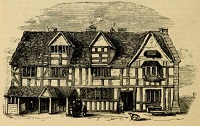 Like a penthouse, a porch with a sloping roof,
common in the domestic architecture of the time of S. There was one
on the house in which tradition says he was born. The accompanying
cut is copied from an old print. For penthouse, cf. Much Ado, iii. 3. 110,
and M. of V. ii. 6. 1. Like a penthouse, a porch with a sloping roof,
common in the domestic architecture of the time of S. There was one
on the house in which tradition says he was born. The accompanying
cut is copied from an old print. For penthouse, cf. Much Ado, iii. 3. 110,
and M. of V. ii. 6. 1.
15. Thin-belly doublet. Many of the modern eds. have "thin belly-doublet;" but the 1st quarto reads "thin bellies" and the folios "thin-bellie," "thinebellie," or "thin-belly." Cf. the description of the thick-bellied doublets in Stubbes's Anatomie of Abuses, 1583: "Their dublettes are noe lesse monstrous than the reste; For now the fashion is to haue them hang downe to the middest of their theighes . . . beeing so harde-quilted, and stuffed, bombasted and sewed, as they can verie hardly eyther stoupe downe, or decline them selues to the grounde, soe styffe and sturdy they stand about them . . . Now, what handsomnes can be in these dubblettes whiche stand on their bellies like, ... (so as their bellies are thicker than all their bodyes besyde) let wise men judge; For for my parte, handsomnes in them I see none, and muche lesse profyte. . . . Certaine I am there was neuer any kinde of apparell euer inuented that could more disproportion the body of man than these Dublets with great bellies, . . . stuffed with foure, hue or six pound of Bombast at the least." For bombast, as here used, see on v. 2. 771 below. 17. After the old painting. "It was a common trick among some of the most indolent of the ancient masters, to place the hands in the bosom or the pockets, or conceal them in some other part of the drapery, to avoid the labour of representing them, or to disguise their own want of skill to employ them with grace and propriety" (Steevens). 18. Complements. Changed by Hanmer to "'complishments;" but that was a common meaning of the word. See on i. 1. 166 above. 20. Do you note me? Hanmer's reading. The folio has "and make them men of note: do you note men that most are affected to these?" 23. By my penny of observation. Alluding to the famous old piece called A Penniworth of Wit (Fanner). The Coll. MS. changes penny ("penne" in the 1st quarto and 1st folio) to "paine." 25. The hobby-horse is forgot. Moth follows up the "But O, but O — " with the remainder of a line in an old song bewailing the omission of the hobby-horse from the May games. Cf. Ham. iii. 2. 142: "or else shall he suffer not thinking on, with the hobby-horse, whose epitaph is 'For, O, for, O, the hobby-horse is forgot !'" See also B. J., Entertaimnent at Althorpe: "But see, the hobby-horse is forgot;" B[eamount]. and F[letcher]., Women Pleased, iv. I: "Shall the hobby-horse be forgot then?" etc. This omission is said to have been due to the opposition made by the Puritans to the morris-dances of the May festivities. For a full account of these games, see Douce's Illustrations or Brand's Popular Antiquities. The hobby-horse, says Toilet, "is a spirited horse of pasteboard, in which the master dances and displays tricks of legerdemain." A ladle was hung from the horse's mouth for receiving money given by the lookers-on. 45. Message. Changed in the Coll. MS. to "messenger;" but the meaning seems to be that the foolish message is well sympathized (or has its appropriate counterpart) in the foolish messenger. 60. Voluble. The folio reading; the 1st quarto has "volable," which the Camb. ed. retains. For free the Coll. MS. has "fair." 61. By thy favour, etc. "Welkin is the sky, to which Armado, with the false dignity of a Spaniard, makes an apology for sighing in its face" (Johnson). 62. Most rude. The Coll. MS. has "moist-eyed." 64. A costard broken, etc. He plays on the word costard, which was used jocosely for head. See Lear, p. 248, or Rich. III. p. 195. 66. No salve in them all. The early eds. have "in thee male" or "in the male." Capell reads "in the matter," and Johnson conjectured "in the mail" (that is, in the bag) or "in the vale." The reading in the text was suggested by Tyrwhitt. It may be noted that mail is not used by S, except in T. and C. iii. 3. 52, where it is = armour. As Clarke says, Costard seems to take enigma, riddle, and l'envoy to be various kinds of salve. On the virtue of the plantain for a broken shin, cf. R. and J. i. 2. 52: "Romeo. Your plantain-leaf is excellent for that.Broken, by the way, means bruised so as to be bloody. See R. and J. p. 51, note on the passage just quoted. 74. Is not l'envoy a salve? Some see here a pun on salve and the Latin salve, which was used sometimes as a parting salutation. 77. Tofore. Cf. T. A. iii. 1. 294: "as thou tofore hast been." Sain is Armado's rhyming "license" for said. The folio has "faine." 86. Adding. Here and in 92 below the Coll. MS. reads "making." 95. The boy hath sold him a bargain. "This comedy is running over with allusions to country sports — one of the many proofs that, in its original shape, it may be assigned to the author's greenest years. The sport which so delights Costard, about the fox, the ape, and the humble-bee, has been explained by Capell, whose lumbering and obscure comments upon Shakespeare have been pillaged and sneered at by the other commentators. In this instance, they take no notice of him. It seems, according to Capell, that 'selling a bargain' consisted in drawing a person in, by some stratagem, to proclaim himself fool, by his own lips; and thus, when Moth makes his master repeat the I envoy, ending in the goose, he proclaims himself a goose, according to the rustic wit, which Costard calls selling a bargain well" (K[night]). 97. Fast and loose. A cheating game. See on i. 2. 147 above. 104. And he ended the market. Alluding to the proverb "Three women and a goose make a market" (Steevens). 108. No feeling of it. Costard plays on sensibly, which sometimes meant feelingly in the literal sense. Cf. Cor. p. 207. 114. Marry, Costard, etc. The folio has "Sirra, Costard," etc. Marry is the conjecture of K. and is favoured by the reply. The Coll. MS. has "Sirrah Costard, marry," etc. 118. Immured. As in 2d folio, the earlier eds. having "emured." 121, 122. Let me loose . . . set thee from durance. H. adopts Brae's transposition of let and set. The Coll. MS. has "let me be loose" and "set thee free from durance." The style of Costard and Armado hardly calls for such tinkering. 125. Ward. Guard, preservation. For its use as a term in fencing ( = posture of defence), see Temp. p. 122. 127. Like the sequel. That is, like the sequel of a story. Some have fancied an allusion to the French sequelle, a gang of followers. 128. Incony. Apparently = fine, delicate. Nares cites examples of the word from B. J., Marlowe, and others. [C. H. Hart gives the intended meaning as 'delicious.' -- Shk. Online] 129-135. O! my troth . . . nit! In the early eds. these lines are printed in iv. 1, after line 136: "Lord, lord, how the ladies and I have put him down!" There they are evidently out of place, and St[aunton] conjectured that they belong here. H[udson]. was the first to make the transposition. There is no line rhyming to 133, and some suppose one to have been lost; but it is quite as probable, as H. suggests, that 133 is either an interpolation, or a line struck out by the poet in revising the play, but accidentally retained by the transcriber or printer. See on iv. 3. 294 below. 131. Armado o' th' one side. The 1st quarto has "Armatho ath too then side," and the folio "Armathor ath to the side." The text is due to Rowe. W[hite]. reads "Armado o' th' to side" — "the to side" being an old expression for "the hither side." 133. To see him, etc. The Coll. MS. fills out the couplet with "Looking babies in her eyes his passion to declare." 135. Pathetical. The word has already been used by Armado in i. 2. 92 above. Just what either he or Costard means by it must be matter of conjecture. S. has it nowhere else, except in A. Y. L. iv. 1. 196, where it appears to be also an affectation. See our ed. p. 187. For the personal use of nit, cf. T. of S. iv. 3. no, the only other instance of the word in S. 138. Inkle. Tape. Cf. W. T. p. 196. 150. Good my knave. My good boy. See on i. 2. 65 above. For knave = boy, servant, ct. A. and C. p. 207, or M. of V. p. 137. 169. print. To the letter. Cf. T. G. of V. p. 131. Schmidt explains it as "sad." Hanmer reads "amorous." 173. Critic. Carper; the only sense in S. Cf. Sonn. 112. and T and C. v. 2. 131. See also on iv. 3. 165 below. 174. Pedant. Pedagogue; the only meaning in S. Cf. T. N. iii. 2. 80: "A pedant that keeps a school i' the church," etc. 175. Magnificent. Pompous, boastful; used by S. only here and in i. I. 188 above. 176. Wimpled. Hoodwinked, blindfolded. Cf. Spenser, F. Q. i. 1. 4: "Yet she much whiter; but the same did hidethat is, drawn close about her face, like a wimple, a kind of veil. Cf. F. Q. i. 12. 22: "For she had layd her moumefull stole aside,[177. Dan Cupid. Dan = Don, meaning master. -- Shk. Online] 181. Plackets. Explained by some as stomachers; by others as = petticoats, or the slit or opening in those garments. Placket-hole (cf. Wb.) is still used for the slit in a petticoat. The codpiece was a part of the breeches in front, made very conspicuous in the olden time. 183. Paritors. The same as apparitors, officers of ecclesiastical courts whose duty it was to serve citations. Johnson says that they are put under Cupid's government because the citations were most frequently issued for offences against chastity. 184. A corporal of his field. Farmer says: "Giles Clayton, in his Martial Discipline, 1591, has a chapter on the office and duty of a corporal of the field." According to Tyrwhitt, his duties were similar to those of an aide-de-camp now. 185. Like a tumbler's hoop. Alluding to its being adorned with coloured ribbons. 187. A German clock. Clocks were then chiefly imported from Germany, and the dramatists of the time were fond of comparing the feminine "make-up" to their intricate machinery. Steevens cites, among other passages, Westward Hoe, 1607: "no German clock, no mathematical engine whatsoever, requires so much reparation;" and A Mad World, my Masters, 1608: "She consists of a hundred pieces,188. Out of frame. Out of order; as in Ham. i. 2. 20: "disjoint and out of frame." 189. Going right. The early eds. have "aright ;" corrected by Capell. 193. Wightly. The early eds. have "whitly" or "whitely." which some explain as = whitish, pale (D. makes it = sallow); but Rosaline was dark. It seems probable that the word was a misspelling of wightly, which the Camb. editors substitute, and which means nimble, sprightly. Spenser has both wightly and wight in this sense, and the latter is found in Chaucer; as in C. T. 14273 (Tyrwhitt's ed.): "With any yong man, were he never so wight," etc. The Coll. MS. has "witty." 195. Do the deed. Cf. M. of V. i. 3. 86: "And in the doing of the deed of kind," etc. 196. Argus. For other allusions to the hundred-eyed guardian of Io, see M. of V. v. 1. 230 and T. and C. I. 2. 31. 201. Sue, and groan. The 1st quarto and 1st folio omit and. 202. Joan. Often = a peasant, or a woman in humble life. Cf. v. 2. 908 below. See also K. John, i. 1. 184: "now can I make any Joan a lady." How to cite the explanatory notes: _____ |
More to Explore  Love's Labour's Lost: The Play with Commentary Quotations from Love's Labour's Lost Love's Labour's Lost: Plot Summary Shakespeare Quotations (by Theme) Introduction to
Shakespeare's Sonnets Shakespearean Sonnet
Style How to Analyze a Shakespearean Sonnet The Rules of Shakespearean Sonnets
The Contents of the Sonnets in Brief Love's Labour's Lost: The Play with Commentary Quotations from Love's Labour's Lost Love's Labour's Lost: Plot Summary Shakespeare Quotations (by Theme) Introduction to
Shakespeare's Sonnets Shakespearean Sonnet
Style How to Analyze a Shakespearean Sonnet The Rules of Shakespearean Sonnets
The Contents of the Sonnets in Brief
Shakespeare's Treatment of Love in the Plays Shakespeare's Dramatic Use of Songs Shakespeare Quotations on Love Shakespeare Wedding Readings Shakespeare on Sleep |
 It is no coincidence that in all of Shakespeare's plays, the scene, no matter how dramatic or climatic, ends on a denumount, with the actors walking off or being carried off the stage. If the play required a change of place in the next scene, most times the actors would not leave the stage at all, and it would be up to the audience to imagine the change had occurred. If props were used, they were usually placed at the beginning of the play, and oftentimes would become unnecessary as the performance went on, but would remain on the stage regardless.
 ©1999-2021 Shakespeare Online. All Rights Reserved.