| directory |
| home | contact |
|
|||||||||||||||
| search | |||||||||||||||
Much Ado About Nothing: Plot SummaryFrom Stories of Shakespeare's Comedies by Helene Adeline Guerber. New York: Dodd, Mead and company.Act IThe opening of the first act shows Leonato, Governor of Messina, standing before his house with his daughter Hero, and niece Beatrice, to receive the gentleman messenger, announcing the victorious return of Don Pedro of Arragon. After perusing his letter, Leonato inquires how many lives have been lost, and is delighted to hear few have perished. He then remarks that the most lauded person in his dispatches is Claudio, who the messenger enthusiastically declares 'better bettered expectation.'The ladies, who have listened eagerly, now join in the conversation, Beatrice pertly inquiring whether Lord Mountanto is returning with the troops. As the messenger fails to recognise the person she mentions by this nickname, Hero explains her cousin means Signior Benedick, of Padua, who, Beatrice adds, once challenged a fool, and whose victims she has volunteered to eat, because she does not believe they exist. Although amused by his niece's pertness, the governor thinks she is making too much ado about nothing, for he good-naturedly exclaims she is taxing too sorely a good soldier. Then, as Beatrice continues to gird at her absent foe, Leonato explains how his niece and Signior Benedick never meet without indulging in a 'merry war' of wit. Tossing her head, Beatrice rejoins this youth has never yet gotten the better of her, and claims that in their last encounter she routed four of his five wits. Because the messenger adds Benedick is returning with his friend Claudio, she pities the latter, declaring he will pay dear for such intimacy. At this juncture Don Pedro of Arragon, his brother Don John, Claudio, and Benedick appear, and are courteously welcomed by Leonato, who, in reply to their apologies for troubling him with their entertainment, assures Don Pedro trouble never came into his house in the guise of his Grace. Turning to the ladies, Don Pedro next inquires whether one is not Leonato's daughter, and enters into conversation with Hero, just as a remark from Benedick calls forth Beatrice's scornful, 'I wonder that you will still be talking, Signior Benedick; nobody marks you.' This gibe is promptly returned by 'What, my dear lady Disdain! are you yet living?' whereto Beatrice avers Disdain will never die, so 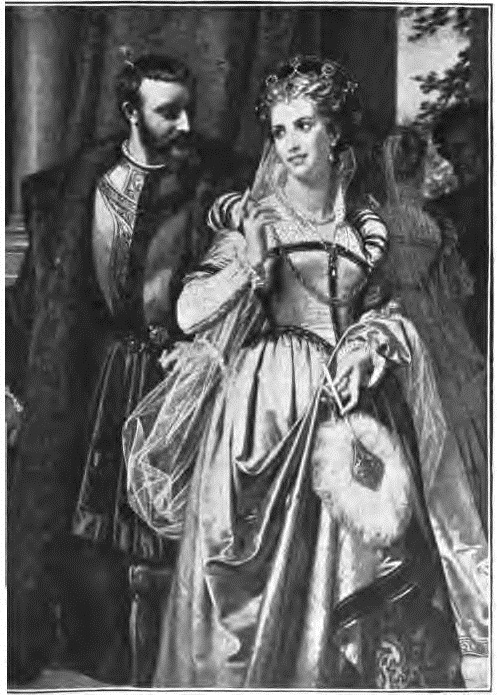 long as it has such food to feed upon as Signior
Benedick. These two continue thus to bandy bitter-sweet remarks, until Benedick, piqued by his companion's jeers, exclaims he wishes his horse had the speed of her tongue, and were so 'good a continuer.' Don Pedro, who has paid no attention
to this skirmish, now announces he has accepted Leonato's invitation to tarry in Messina a month, a
decision pleasing to his host, who welcomes even the obnoxious Don John, recently reconciled to the
brother against whom he rebelled. long as it has such food to feed upon as Signior
Benedick. These two continue thus to bandy bitter-sweet remarks, until Benedick, piqued by his companion's jeers, exclaims he wishes his horse had the speed of her tongue, and were so 'good a continuer.' Don Pedro, who has paid no attention
to this skirmish, now announces he has accepted Leonato's invitation to tarry in Messina a month, a
decision pleasing to his host, who welcomes even the obnoxious Don John, recently reconciled to the
brother against whom he rebelled.
While the princes of Arragon are escorted off the scene by Leonato and the ladies, the two young men linger on the stage. Seizing this favourable opportunity, Claudio asks Benedick whether he has noted Leonato's fair daughter, whom he admired before the war began, and with whom he now feels deeply enamoured, although fickle by nature. Benedick, the confirmed bachelor, ridicules his friend for yielding to feminine charms, and does his sarcastic best to find fault with Hero, pronouncing her attractions greatly inferior to those of Beatrice. Then, seeing his strictures remain without effect, he wonders whether he will 'never see a bachelor of three-score again' just as Don Pedro returns on the scene. When he pleasantly inquires what can detain them, Benedick playfully volunteers to reveal Claudio's secret, provided the prince command him to do so, and, enjoined to speak, reveals how dearly Claudio loves Hero. Unable to deny this, Claudio is overjoyed when Don Pedro pronounces the lady worthy of him, although Benedick continues to rail at him for contemplating matrimony. Good-naturedly remarking that even Benedick may yet change his mind, Don Pedro is told that, should such be the case, they may take him for a laughing stock, and adorn him with the sign, 'here you may see Benedick the married man!' A little more conversation ensues, ere Don Pedro sends Benedick to inform Leonato they will honour the supper to which he has invited them. Then turning to Claudio, his favourite, Don Pedro promises to aid him secure Hero's hand. In fact, his Grace proposes to sound the young lady in disguise that evening, and in case he finds her favourably inclined toward Claudio, to arrange with her father for an immediate marriage. The curtain next rises on a room in the governor's house, where Leonato is asking his brother Antonio whether music has been ordered for the evening's entertainment. After answering in the affirmative, Antonio reports that one of his servants overheard Don Pedro and Claudio discussing Hero, with whom the prince has evidently fallen in love. Delighted with this news, Leonato proposes to warn his daughter, so she may be ready to answer, should the prince sue for her hand. Scarcely have he and his brother passed off the stage when Don John draws near with one of his followers, who inquires why he seems sad. Replying in a misanthropic vein, Don John admits that he longs to show himself 'a plain-dealing villain,' and how he has determined to seize every opportunity to make trouble for Claudio, whom he hates. These two men are joined by another follower of Don John, who announces he has been royally entertained at supper, where he has heard that Hero is about to marry Claudio. Such a piece of good fortune as an heiress-wife for the man he detests, irritates Don John, who inquires how his friend discovered the secret, and proposes to devise a plot whereby this love-affair will be crossed. His two friends, equally ready for villainy, gladly promise to aid him as much as they can. Act IIThe second act opens in Leonato's house, while he is questioning his brother and the ladies of his household in regard to Don John's absence from the supper. Beatrice, who declares Don John always looks so sour that she suffers from heartburn whenever he is near her, seems glad he was away. She suggests that were he and Benedick blended together, they might make one fair-looking man, an opinion she expresses with so sharp a tongue, that her uncle vows she will never secure a husband until she learns to control it. This reproof calls forth further witticisms on Beatrice's part, for she avers she does not want any husband, but would far rather remain an old maid. When her uncle ventures to remind her that old maids 'have to lead apes into hell,' she pertly rejoins the devil will take the apes from her at the door, and send her back to heaven, to sit among the bachelors, and live 'as merry as the day is long.'Turning to his niece Hero, Antonio inquires whether she, too, proposes to follow her cousin's example. Whereupon Beatrice mocks Hero for tamely accepting any husband her father cares to choose. When Leonato exclaims he doesn't despair of seeing his niece married some day, too, Beatrice continues to gibe at the men, vowing her cousin's wedding will be a time of great annoyance for her, until the noise of approaching revellers forces the party to mask and receive the arriving guests. Among those who crowd in, wearing masks and dominoes, we discern Don Pedro, who, singling out Hero, engages her in conversation, and gradually draws her away from the rest, so as to be able to discuss serious matters. Meantime, one of his companions draws aside Margaret and Ursula, Hero's companions, and he and Antonio entertain them, while Beatrice, who has been joined by Benedick, immediately begins with him a wordy battle, wherein each shatters the other's lance as soon as possible. Still, they leave the room together, to join the dance, just as Don John appears with one of his followers and Claudio. Pretending to mistake the masked Claudio for Benedick, Don John, who is bent upon mischief, comments to him upon the fact of his brother's marked attentions to Hero; then, perceiving he has roused a lover's jealousy, he falsely states his brother intends to marry the governor's fair daughter. A moment later, Don John and his follower having gone, Claudio angrily mutters this is terrible news, for he now believes the prince is, indeed, wooing on his own account. He, therefore, bitterly concludes 'friendship is constant in all other things save in the office and affairs of love,' and that every man should do his own wooing, especially as Benedick joins him, and teasingly advises him to wear the willow, since the prince has secured his lady-love. Then, seeing Claudio depart greatly depressed, Benedick comments upon his disappointment, and wonders why Lady Beatrice called him 'the prince's fool,' an epithet which sorely rankles. Such is the wound his vanity has received, that he determines to be revenged, and is just about to seek Beatrice's society once more, when Don Pedro appears asking where Claudio may be. When Benedick describes his friend's melancholy, Don Pedro wonders what could have caused it, and when told it is because he has stolen his friend's nest, rejoins merrily he did so merely to teach the birds to sing for their rightful owner. Then, detecting a note of pique in his companion's tone, Don Pedro slyly inquires whether Benedick has again been quarelling with Beatrice. This opens the floodgates, Benedick vowing he would not marry so sharp-tongued a lady, were she 'endowed with all that Adam had left him before he transgressed.' He is still holding forth on this subject when Beatrice enters with a few of her guests, so seeing her draw near, Benedick implores Don Pedro to dismiss him, and vanishes after exclaiming, 'I cannot endure my Lady Tongue!' Addressing Beatrice, the prince teasingly informs her she has lost the heart of Signior Benedick, to which the young lady retorts it had only been lent to her for a while; finding an equally ready repartee to every remark he ventures. Turning to Claudio, Don Pedro then rallies him on his sadness, and, although the young man answers him shortly, kindly informs him he has so successfully wooed Hero in his behalf, that her father has given consent to the marriage, and all now remaining to do is to settle the wedding day. These tidings are gravely confirmed by Leonato, who invites Claudio to take his daughter's hand, a move the young lover accomplishes in silence. Noting this, Beatrice ventures to taunt him, whereupon he rejoins that 'silence is the perfectest herald of joy. I were but a little happy, if I could say how much.' Then, turning to his betrothed, Claudio tells her he loves her dearly, only to be urged by Beatrice to kiss her instead. Fascinated by Beatrice's merry ways, Don Pedro now playfully proposes to marry her, but she, catching his spirit, promptly returns his Grace would be too costly a husband for every-day wear, and that she would not think of accepting him unless she could have another for working days. It is only when her uncle begs her to attend to some household matters that Beatrice departs, while Don Pedro remarks that she is a 'pleasant-spirited lady.' This praise pleases Leonato, who vows his niece is never sad or cross, although she gibes so constantly at marriage. When Don Pedro suggests she would make an ideal wife for Benedick, Leonato exclaims they would talk themselves mad in the course of a week. Paying no heed to this comment, Don Pedro inquires of Claudio when his marriage is to take place, and, learning it will be only on the following Monday, a date too distant to suit the lover, although the father considers that space of time far too brief to accomplish all that must be done, proposes to beguile the time of waiting by bringing together Beatrice and Benedick, who, he feels certain, can easily be induced to fall in love. Enlisting Leonato's and Claudio's ready aid to carry out this scheme, Don Pedro bids them follow him, so he can instruct them what moves to make to compel these wayward young folks to love each other, gleefully boasting that a double marriage will result, and that Cupid is not the only matchmaker. This group has barely left the room when Don John and his friend return to resume their discussion of Claudio's marriage. Perceiving Don John's desire to cross this plan in some way, his interlocutor suggests it can be done, although not honestly. When Don John inquires what he means, he explains how, having won Margaret's favour, he can easily make her appear at her mistress's window at night. He suggests that, if he call her Hero, it will seem as if Claudio's bride were secretly entertaining a lover. This vile plot meets with such enthusiastic approval from Don John, that he and the courtier decide to draw Don Pedro and Claudio aside, and tell them Hero is faithless, offering to prove the truth of their words if they will lie in ambush beneath her window. There, Don John's friend will personate the lover, thus earning the reward of a thousand ducats. The next scene occurs in Leonato's orchard, where Benedick summons a boy and sends him for a book, as he wishes to enjoy a little solitude. Left alone, Benedick marvels that Claudio should have fallen so deeply in love, as hitherto this youth has been devoted to his profession as a soldier. It is evident love can effect strange transformations, for Benedick mockingly concludes it may some day transform him into an oyster. Still, he deems that day far distant, for he avers that, while one woman may be fair, another wise, another virtuous, 'till all graces be in one woman, one woman shall not come in my grace!' He further declares that his ideal much be rich, wise, virtuous, fair, mild, noble, capable of good discourse, an excellent musician, 'her hair being of what colour it please God.' This whole soliloquy betrays great self-appreciation, and when it is concluded, Benedick complacently withdraws to a leafy arbour, so as not to be disturbed in his meditations by the people drawing near. From this arbour Benedick notices Don Pedro, Claudio, and Leonato strolling in the garden, apparently listening to music, but in reality bent on carrying out the deception they have planned. After asking Claudio, in a whisper, whether their victim is at hand, Don Pedro calls for a pretty song with a senseless refrain, and compliments the singer upon his way of rendering it. Meantime, from his hiding-place, Benedick sarcastically criticises this music, averring that had a dog howled thus, he would have been hanged. After dismissing the musician, who is hired to serenade Hero that night, Don Pedro strolls nearer to the arbour, inquiring of Leonato whether he meant what he said when he stated his niece Beatrice loved Benedick madly. In spite of the fact that Claudio exclaims this cannot be true, Leonato asserts his niece dotes upon that cavalier, although she pretends to abhor him. The vanity of the hidden Benedick is so tickled at the thought of having achieved the conquest of so difficult a lady, that he greedily listens, only to hear the gentlemen repeat that Beatrice counterfeits dislike. So serious are they while making these statements that Benedick feels convinced they are telling the truth, even when Leonato declares his niece constantly writes love letters she never sends. After discussing at length these letters, Beatrice's tears, and her amorous exclamations, all of which information Leonato claims to have obtained from Hero, Don Pedro gravely suggests Benedick should be informed of this passion; but Claudio declares such a move would be passing cruel, as his friend does not believe in love, and would surely make fun of the lady. All three, therefore, decide to allow Beatrice to pine, hoping she may in time forget her mad passion for Benedick, whom they pronounce utterly unworthy of being beloved by so charming a lady. Having thus executed their plan, the three conspirators move away, Claudio whispering to his companions that if Benedick doesn't dote upon Beatrice hereafter, he will never trust his expectation. The gentlemen having gone, Benedick issues from his hiding-place, marvelling at all he has heard, and deciding it will never do to allow so lovely a lady to pine away. Instead, he proposes to sacrifice his desire to remain single, and has just decided to marry soon, when Beatrice comes into the garden, tartly stating she has been sent, much against her will, to summon him to dinner. Instead of answering this remark in kind, Benedick, convinced that Beatrice is doing violence to her feelings, proves so deferential that she fails to recognise him. Because she flounces off, he conceitedly comments that her manner is confirmation strong of all he has overheard, and declares that, if he does not take pity upon her, he is a villain, and that if he does not love her he is a Jew! Act IIIThe third act opens in the governor's garden, where Hero bids Margaret run into the parlour and whisper to Beatrice, who is conversing there with the prince and Claudio, that her cousin and Ursula are in the orchard talking about her, and that, if she cares to overhear them, she can do so by hiding in a neighbouring bower. Promising to induce Beatrice to come soon, the maid vanishes, while Hero instructs her companions to talk loudly about Benedick, praising him highly, and depicting him as desperately in love with Beatrice; for it is by such means Hero hopes to induce her cousin to fall in love with this swain. A moment later, having seen Beatrice steal to her hiding-place, Hero strolls in that direction, talking carelessly of her cousin's light ways, and of Signior Benedick's love for her. She declares this suitor deserves everything that is good, but, knowing Beatrice's scorn for him, she avers she has advised him never to make his love known. In support of her opinion, she describes how Beatrice ridicules every man who approaches her, and vows the only way to cure Benedick of his hopeless passion will be to 'devise some honest slanders' to stain her cousin with. Such a proceeding seems objectionable to Ursula, who inquires why Beatrice does not look favourably upon Benedick, whom she considers a fine young man. Thereupon Hero assures her the young man is, indeed, excellent, and that she regrets he has so sorely misplaced his affection. Then, feeling her work done, Hero suggests they return to the house to decide upon the wedding attire for the morrow.After they have gone, Beatrice emerges from her hiding-place, amazed at what she has heard, and radically cured of her most serious fault, by the lifelike picture her cousin has held up before her eyes. She now decides to cease gibing, to bid maiden pride and contempt farewell, and to reward Benedick for his great love. The next scene is played in a room in Leonato's house, where Don Pedro, talking to the governor and to others, states he is lingering in Messina to witness the marriage, after which he intends to return home. When Claudio volunteers to accompany him, he playfully rejoins that as it would be cruel to separate him from his bride, he has decided to take Benedick in his stead, knowing he is good company, and leaves no lady-love behind him. Hearing this, Benedick shamefacedly rejoins he is no longer what he has been, and when they twit him with having a toothache, mutters it is easy for every man to 'master a grief but he that has it.' Having observed his friend closely, Claudio now exclaims Benedick must be in love, for he has marked sundry tell-tale signs, such as hat-brushing, frequent barbering, fine dressing, and going to such unheard of sixteenth-century lengths as washing his face. After enduring their gibes for a while, Benedick begs Leonato for a secret hearing, so, while they two draw aside, Don Pedro and Claudio gleefully whisper that Hero and Margaret must have carried out their part of the plot, and that these 'two bears will not bite one another when they meet.' At this moment Don John joins them, and, after greeting his brother, states he has a matter to impart which concerns Claudio closely. Invited to speak, he asks Claudio whether he is really to be married on the morrow, looking so compassionately at him, that the youth anxiously inquires whether he has heard of any impediment to his nuptials. With pretended reluctance, Don John now declares Hero is disloyal, offering to prove the truth of his statement, provided Claudio station himself beneath her window that night. He adds that should Hero's lover choose to marry her after that, he may do so, but that he feels confident he will never wish to trust her again. His jealousy roused by these remarks, Claudio swears, should he behold any reason why he should not wed Hero, he will shame her in the face of the congregation on the morrow, a decision upheld by Don Pedro, who feels his honour, too, is at stake, and they are still discussing what steps to take when the curtain falls. When it rises again, it is night in the street before Leonato's house, where Dogberry and his henchman Verges are placing the watch. Giving them long-winded instructions, Dogberry misuses his words in a comical fashion, and cautions his men not to meddle with thieves or any wrongdoers, lest they run into danger. The watchmen wisely conclude to sleep rather than watch, closing their eyes tight when thieves pass by, lest they should be tempted to interfere with their occupations. The whole scene is ludicrous in the extreme, and when Dogberry goes away, he bids the men keep particular watch of the governor's door, as a wedding is pending and disturbances can be expected. No sooner have Dogberry and Verges gone, than two of Don John's men steal forward, closely noted by the watchmen, who have taken up their post on the church bench, to rest until it is time to go to bed. From this place of vantage they overhear one man boasting he has earned a thousand ducats in compassing an act of villainy, and mention how, posted beneath Hero's window, he called the chambermaid by her name, until he deluded the hidden Claudio into believing his lady-love faithless. Although only half understanding what they see and hear, the watchmen excitedly comment to each other about the plot they have discovered, and decide to arrest the malefactors, who protest vehemently. The scene is next transferred to Hero's apartments, on her wedding morning, just as she is calling for Beatrice and discussing fashions. In the midst of the voluble talk in regard to styles and the approaching ceremony, Beatrice seems so out of tune, that she is twitted for it by one of the attendants. This occasions a witty and wordy skirmish, which is interrupted by Margaret's announcement that all the gentlemen in town have come to escort the bride to church. Meantime, in another room in the same house, Leonato is interviewing Dogberry and Verges, bidding them state their errand briefly, as he is very busy. As it is an impossibility for Dogberry to be brief, he informs the governor with endless circumlocution that two knaves were caught last night, beneath his windows, who should be examined immediately. Unwilling to be detained by trifling matters, Leonato deputes Dogberry to examine these prisoners himself, whereupon, proud of this charge, the constable hurries his prisoners off, bidding Verges summon a secretary with pen and inkhorn to take down all they say. Just as Dogberry vanishes with men and prisoners, the governor is summoned to join his guests for the wedding. Act IVThe fourth act opens in the church, as Leonato is enjoining upon the friar to celebrate the marriage as briefly as possible. In compliance with these orders, the friar begins his momentous questions, and is startled to hear Claudio deny he has come here to marry Hero. Deeming this a mere quibble in regard to terms, he nevertheless propounds the same question to the lady, who returns the conventional answer. When the friar next asks whether any one knows any 'inward impediment why they should not be joined in marriage,' Claudio meaningly asks his bride whether she does not. Hearing her truthfully rejoin there is no obstacle as far as she knows, Claudio demands of Leonato whether he is giving away a maiden daughter. This question also being answered in the affirmative, Claudio turns toward the wedding guests, indignantly denouncing Hero as a whited sepulchre and vowing he has good reasons for knowing she is not pure. When the father tremblingly demands whether this means he anticipated his wedding, Claudio rejoins he has always treated Hero in brotherly fashion with 'bashful sincerity and comely love.' His villainous accusations are so incomprehensible to the innocent Hero, that fancying he has been taken suddenly ill, she speaks gently to him. Hearing this, Don Pedro interferes, angrily vowing he feels insulted because such a person was offered to his friend. Then, in the course of the lively dialogue which ensues, Don Pedro, Claudio, and Don John reveal how, standing beneath Hero's window last night, they saw a lover climb into her room. Their accusations prove so circumstantial, that Leonato tragically inquires whether there is no dagger-point for his heart, while poor Hero swoons, and is caught as she falls by her cousin Beatrice.Seeing Hero apparently lifeless, Don John nervously suggests they go away, and succeeds in hurrying his brother and Claudio out of the church. Meantime, Benedick and Beatrice, bending over the fainting Hero, call for help, which Leonato refuses to give, averring ' death is the fairest cover for her shame that may be wish'd for,' and saying he hopes Hero will never open her eyes again! His opinion is not shared by Benedick and Beatrice, for when he wails nothing can ever 'wash her clean again' his niece exclaims her cousin is belied. In hopes of clearing Hero's reputation, Benedick now asks Beatrice whether she slept with her cousin last night as usual, and is appalled to hear how, for the first time, she omitted doing so. Although the heartbroken father considers this an additional proof of his daughter's guilt, the friar insists no culprit ever bore so innocent a face, claiming that long experience would enable him to detect the slightest trace of wrong-doing. He is, therefore, ready to swear the sweet lady lies 'guiltless here under some blighting error,' although the father does not believe him. While they are talking, Hero's eyes open, so the friar eagerly inquires who has misled her. Truthfully, yet sadly, Hero rejoins she does not know what they mean, never having even conversed with a man at an improper time or in an improper way. This statement convinces the friar and Benedick that some treachery is afoot, which the latter unhesitatingly ascribes to Don John, 'whose spirits toil in frame of villainies.' Hearing this, Leonato vows that, should his daughter prove guilty, he will tear her to pieces with his own hands, but if she is wronged, 'the proudest of them shall well hear of it.' To check his rising wrath, the friar suggests that, since the wedding guests departed under the impression that Hero had died at the altar, it will be well to keep her recovery secret, and adds that when the rumour of her death spreads abroad, and the pretence of an interment is made, people will feel so sorry for her that their pity will 'change slander to remorse.' He fancies Claudio, in particular, will feel reproached, and adds that, should his accusation prove true, Hero's shame can be hidden in a religious house, the place which would best befit 'her wounded reputation.' This advice seems so wise that Benedick urges Leonato to follow it, so he arranges to carry out the friar's plan. All the rest now leaving the scene of this tragedy, Benedick tenderly addresses Beatrice, inquiring whether she has wept all the time, and showing such sympathy that she feels deeply touched. When he offers to be her friend, confessing he loves her, Beatrice rejoins that, although she does not love him, she thinks well of him. As usual, she relapses into efforts at wit, but instead of answering sharp speeches in kind, Benedick tries by every means in his power to disarm her. Hearing him vehemently offer to do anything she bids him, Beatrice calls out in righteous indignation she wishes he would kill Claudio, or at least prove him mistaken in accusing Hero. She vehemently adds that were she only a man, she would avenge this insult, whereupon Benedick gallantly pledges himself to challenge his friend for slaying Hero, since it is agreed she is to be considered dead. The curtain next rises on the prison, where Dogberry and his henchman are fussily cross-examining their prisoners. This whole scene is comical in the extreme, for Dogberry, full of his importance, bids the secretary write down one irrelevant statement after another. The only official showing any sense is the sexton, who has had experience in such matters. Still, amidst the confusion it gradually transpires that the courtiers were paid by Don John to play a vile part that Hero might be publicly disgraced. This testimony is written down, although Dogberry regrets the secretary has departed before one of his prisoners termed him an ass, as he deems it important this statement be put down on the minutes, too! The prisoners, having fully confessed their wrong-doing, are led away bound, so Leonato can deal with them as he sees fit. Act VThe fifth act opens in front of Leonato's house, just as Antonio assures his brother he will kill himself if he continues mourning in this extravagant way. There is, however, no consolation for Leonato's deep sufferings, so he states such counsel is as profitless as pouring water in a sieve! When he eloquently expresses his sorrow, and his brother accuses him of acting like a child, Leonato bitterly retorts, 'there was never yet philosopher that could endure the toothache patiently,' and vows his brother would show more heat if the wrong concerned him. His main object in life henceforth is to prove Hero has been belied by Claudio and the prince.It is at this moment that Don Pedro and Claudio try to pass by and are detained by Leonato, who reviles them for wronging him and his child. When he hotly terms them villains, and threatens to prove it at the point of his sword, Don Pedro and Claudio vainly try to soothe him. Such is the excitement of both Leonato and Antonio, that they challenge Claudio to fight, while Don Pedro temperately states they are sorry to hear the lady has died, although she was charged with nothing 'but what was true and very full of proof.' This reiterated insult sends Leonato and his brother off the stage in a rage. A moment later Benedick enters, and when Claudio inquires what news there is, answers in so cold and sarcastic a tone, that his companions fancy this is some new joke. Benedick, however, soon manages to draw Claudio aside, and challenges him in a whisper; in the same tone Claudio accepts this duel, although the prince, thinking they have made an appointment for an entertainment, chaffs them about it in a witty way. Then, still in pursuit of his former plan, Don Pedro reports how he heard Beatrice praise Benedick's wit, and urges Claudio to repeat the nice things she is supposed to have said about it. In spite of all this jocularity, Benedick returns haughty answers, and finally states he does not care to consort with them any longer, since he has heard that Don John has fled, not daring to remain in the city, now it is rumoured Hero's death is due to his machinations. Seeing Benedick go off in anger after this statement, Don Pedro expresses amazement, until he and Claudio realise the young man has manfully espoused Beatrice's cause. They are still discussing the question when Dogberry enters with his prisoners, in whom Don Pedro recognises with surprise two of his brother's men. When he questions the watch, Dogberry asserts they have been guilty of sundry misdeeds, becoming so verbose that Don Pedro finally turns to the prisoners themselves for information. They humbly confess their villainy, having been stricken with remorse on hearing the tragic result of their night's work. Their report positively staggers Don Pedro and Claudio, who can scarcely credit their ears, and only with difficulty realise how Don John started the slander which has such results. In his remorse, Claudio is loudly mourning for Hero, when Leonato bursts into the room, he, too, having, meantime, heard the news. Clamouring for the villain so he may take his revenge, Leonato is told the prisoner is not to blame for his child's death. He soon realises it is to be ascribed mainly to Don John, although the prince, and Claudio, have had their share in the evil work. Hearing his strictures, Claudio implores Leonato to impose upon him any penance he chooses, vowing his sin consisted solely in misapprehension. As the same excuse is pleaded by Don Pedro, Leonato declares he will hold himself satisfied, provided they both repair to Hero's tomb, and do penance there for the insult offered her. Not only do Claudio and the prince engage to fulfil this duty, but the lover further pledges himself to meet the irate Leonato on the morrow to learn what other atonement he can make. Then Leonato decides that, since Claudio can no longer be his son-in-law, he shall marry his niece, who is 'almost the copy of my child that's dead,' a reparation the penitent Claudio is ready to make. Meanwhile, Leonato intends to confront Margaret and the prisoners, so as to sift the whole story down to the bottom, although the courtier voluntarily testifies she has always been virtuous, and was not aware of their vile plot. After receiving Leonato's thanks for ferreting out this affair, Dogberry retires with his men, uttering a most involved speech. Then, taking leave of Don Pedro and Claudio, who are to spend the night at Hero's tomb, Leonato and his brother go off with their prisoners to cross-question Margaret. The next scene is played in the governor's garden, where Benedick is imploring Margaret to secure for him an interview with Beatrice. To tease this ardent suitor, Margaret bids him write a sonnet in praise of her beauty, and when he gallantly says she deserves it, enters into witty conversation with him, ere going away to summon her mistress. While waiting for Beatrice, Benedick sings to himself, musing upon the great lovers of history, and conning the rhymes he wishes to use in composing a poem in honour of his lady-love. Although Beatrice on joining him answers his remarks in her wonted strain, Benedick makes a greater effort than ever before to win a hearing. His evident solicitude for her cousin touches Beatrice's heart, and she has barely reported Hero very ill, when Ursula bursts in, full of excitement, exclaiming Leonato has just discovered how Hero had been falsely accused, and the prince and Claudio tricked! These tidings prove so joyful to Beatrice that she graciously invites Benedick to go with her and hear all about it, an invitation he gladly accepts. The curtain next rises on the church where Hero was disgraced, whither Don Pedro and Claudio have come with attendants and tapers to place upon her monument, a statement fully retracting the slanders they uttered on this spot. After singing a touching requiem, Claudio promises to do yearly penance in this style in memory of the lovely lady 'done to death' by his cruelty. It is only when Don Pedro warns him dawn is near at hand that Claudio departs, saying mournfully he and his friends must change garments, and hurry to Leonato's, where he is to atone for his wrongdoing by marrying the governor's niece. At the hour for the wedding, many people assemble in Leonato's house, where the friar triumphantly states he pronounced Hero innocent from the very first. All rejoice that the mystery has been solved, and Benedick is relieved not to have to fight his friend. Turning to his daughter, who stands among the guests in wedding array, Leonato bids her and her cousin withdraw, appearing masked only at his summons. Then, he warns the remaining guests that the prince and Claudio will soon appear, and bids them play their parts properly, his brother personating the bride's father and giving her away to Claudio, although the masked lady will be Hero, and not Beatrice, as the bridegroom supposes. Even the friar consents to aid in this mystification, and Benedick suddenly proposes to give the ceremony double importance, by being united to Beatrice, with whom he has finally reached an understanding. It is at this juncture that Don Pedro and Claudio enter, and, after greeting the assembled guests, gravely state they are ready to proceed with the marriage. While the governor's brother goes out to get the bride, the prince, Claudio, and Benedick indulge in sprightly conversation, which continues until the ladies appear. Hesitating which to approach, Claudio begs a glimpse of the bride's face, but Leonato tells him that is not allowed, and points out the lady he is to wed. After plighting troth by taking hands in the friar's presence, Hero removes her mask, saying, 'when I lived, I was your other wife, and when you loved, you were my other husband.' This sudden appearance of a lady he deems dead, causes Claudio to start back in terror, but when the bride assures him one Hero was done to death, but that another is alive to marry him, he is so relieved to think she is still on earth that he welcomes her with rapture. All Hero's statements are, besides, fully confirmed by the friar, who promises to explain everything after the wedding ceremony. Meantime, Benedick has approached Beatrice, who, removing her mask, asks what he wishes. When he inquires whether she loves him, she jauntily rejoins 'no more than reason,' although he claims her uncle, the prince, and Claudio swear such is the case. Turning the tables upon him, Beatrice then asks whether he loves her, and when he replies by repeating her words, and by revealing that Margaret, Ursula, and Hero aver she is sick of love for him, she seems surprised. Their witty difference finally attracts the attention of the rest, but when Leonato tries to make them publicly admit they like each other, they obstinately refuse to do so! Then Claudio slyly produces a paper on which Benedick was composing a sonnet to his lady, while Hero exhibits another on which Beatrice's sentiments for Benedick are betrayed. In face of this proof, the rebellious lovers no longer deny their passion, and Benedick stops all further protest on Beatrice's part by kissing her. When rallied by Don Pedro for breaking his oath, and becoming the very thing he vowed he would never be, 'Benedick the married man,' the youth glories in his new bonds, jocosely bidding the prince get a wife, too, and inviting all present follow him and his bride to the dancing hall. The wedding party has just vanished out of sight when a messenger announces that the traitor Don John has been caught, and is being brought back to Messina, where Benedick promises to help Don Pedro devise 'brave punishments for him.'
_________
Related Articles
|

©1999-2021 Shakespeare Online. All Rights Reserved.