| directory |
| home | contact |
|
|||||||||||||||
| search | |||||||||||||||
Twelfth NightPlease see the bottom of the page for full explanatory notes and helpful resources.
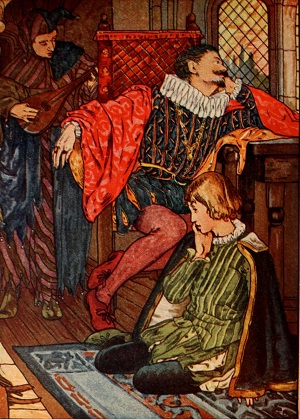
Next: Twelfth Night, Act 2, Scene 5 _________ Explanatory Notes for Act 2, Scene 4 From Twelfth Night Or What You Will. Ed. Kenneth Deighton. London: Macmillan. 1. good morrow, good morning; from "M.E. morwe, ... which again is from the older morwen, by loss of the final -n; and morwen = Mod. E. morn" ... (Skeat, Ety. Dict.). 2. but, merely. 5. recollected, has been variously explained as 'studied'; 'recalled'; 'repeated as composers often prolong the song by repetitions'; 'picked'; 'refined'; 'trivial'; 'gathered with pains, not spontaneous.' 8, 9. that should sing it, who would have to sing it, whose office it would be to sing it, if he were here; see Abb. § 324. 12. about the house, somewhere in or near the house. 13. the while, for the time being, till he is found. 17, 9. Unstaid ... beloved, variable and flighty in all impulses of the mind, except as regards the image of the loved one ever present in the mind; the sentence is not strictly logical as a constant image cannot be included among motions. skittish, "formed from the verb to skit, a Lowland Scotch word meaning 'to flounce, caper like a skittish horse,' Jamieson" (Skeat, Ety. Dict.). 20, 1. It gives ... throned. It echoes to the life the feelings of the heart in which love sits enthroned; cp. i. 1. 38, above; Oth, iii. 3. 348, "Yield up, O Love, thy crown and hearted throne"; R. J. v. 1. 3, "My bosom's lord sits lightly in his throne." 22. masterly, most skilfully; with full mastery of the subject; for the suffix -ly with nouns, see Abb. § 447. 23. My life upon 't, I would wager my life that, etc. 24. Hath stay'd ... loves; has dwelt lovingly upon the looks of some one; favour, personal appearance. 25. by your favour, playing upon the two senses of the word, kindness, and personal appearance; for by, which originally meant 'near,' see Abb. § 145. 26. complexion, looks; nowadays the word is used in the more limited sense of the colouring of the face. 29. still, ever, always. 30. so wears ... him, when such is the case she accommodates herself to him as clothes accommodate themselves to the figure by being worn. 31. So sways ... heart, when that is the case she "exercises an evenly balanced influence" (Wright) in her husband's affections; the metaphor seems to be from the spirit in a level. 34. More ... worn, more full of longings and caprice, sooner lost and worn out, effaced; for worn, in this sense, cp. ii. H. VI. ii. 4. 69, "These few days wonder will be quickly worn," Dyce follows Hanmer in reading 'won' for worn. 35. I think it well, I am well assured of that. 36. thy love, she whom you love. 37. Or thy ... bent, or your love for her will not continue what it was; a metaphor from a bow which if bent tight too long will snap the string and fly back to its original shape; cp. M. A. ii. 3. 232, "it seems her affections have their full bent," i.e. are stretched to the utmost, are intense. 39. display'd, fully opened out. 40. And so ... so; that is true indeed, and it is a pity it should be so; cp. Haml. ii. 2. 97, 8, "'tis true 'tis pity; And pity 'tis 'tis true." In perfection, applying not only to the blown beauty of the rose, but to the full loveliness of a woman when married to a man worthy of her, Cowden Clarke sees a corroboration of 'perfection' (in the sing.) in i. 1. 39, above. 41. To die ... grow! To think that they should die at the very moment when they reach their full perfection! 43. plain, simple. 44. spinster, like 'webster, etc., is feminine from its termination, -ster. 45. And the free ... bones, and the light-hearted maidens, who, etc.; this "describes the lacemakers who formerly used bones for pins in setting out the pattern of their work. In Beaumont and Fletcher's Scornful Lady, v. 2. among the accomplishments of a cood housewife it is said, 'she cuts cambric at a thread, weaves bone lace, and quilts balls'" (Wright). 46. Do use, are wont; we no longer employ use = accustomed, in the present tense: it is silly sooth, it is plain, artless, truth. 47. And dallies ... love, and trifles lovingly with the theme of innocent love. 48. Like the old age, as the old and simple times were wont to do. 51. Come away, sc. with me. 52. sad cypress, as Shakespeare uses cypress for the tree of that name, which was used as an emblem of mourning, and for the wood of that tree, out of which chests were often made, it is doubtful here whether he intended a coffin covered with cypress boughs or a coffin made of cypress wood. 55. My shroud of white. 'Shroud,' though now used only for garment in which the corpse is dressed, originally meant any garment or covering; "closely allied with 'shred,' ... the original sense was a shred or piece of cloth or stuff, a sense nearly retained in that of 'winding sheet'" [another name for shroud] ... (Skeat, Ety. Dict.). As both white and black crape are made, the shroud here may be made of that material: stuck ... yew, with sprigs of yew all about it; the yew, like the cypress, is used as an emblem of mourning, and both trees were of old planted in churchyards. 57, 8. My part ... it. "No one so true as I did ever take part in death's tragedy" (C. Clarke). 60. black, may refer either to the dark wood of the cypress, or to the covering of the coffin with black cloth which was and is common. 61. greet, meet my dead body at the grave to pay the last tokens of regard; 'greet' to salute, from A.S. gretan, to approach, visit, address. 63. A thousand ... save, in order to prevent innumerable sighs being wasted over my grave, lay me, etc. 65. lover, for the sake of the metre, some edd. alter this to "love"; find, may find; subjunctive. 67. thy pains, your trouble; the Clown pretends to take the word in the sense of suffering. 70, 1. and pleasure ... another: and sooner or later, pleasure (i.e. indulgence) will be requited by pain, will have to pay the penalty of pain. 72. Give ... thee. A polite and ingenious way of saying 'excuse my asking you to retire.' 73. Now ... thee; now may the god of melancholy take you under his protection. 74. doublet, a doublet was an inner garment, a double to the outer one, but is also used for a coat generally; taffeta is a thin glossy silk stuff, with a wavy lustre, and changeable taffeta, what is now called 'shot silk' (C. Clarke), i.e. silk in which the colours are so 'shot' in the loom that they vary to appearance according to the light in which the silk is seen, in this respect it resembles the opal, to which the Clown compares the Duke's mind. Cowden Clarke thinks that the variable hues of the Duke's mind as seen here and in the opening scene of the play harmonize with the subsequent facile transposition of his fancy from Olivia to Viola: but the restlessness with which the Clown charges him in wishing one minute to be sung to, and the next to be left alone, seems to be nothing more than the restlessness of all lovers. 75. of such constancy, i.e. of so little consistency: put to sea, go to sea. 76, 7. that their ... where; that they might find occupation in everything, and scope for their thoughts everywhere; might, in the constant change of scene and circumstance, always find something to divert their restless fancy. 77, 8. for that's ... nothing, for it is such constant change that ever lends a charm to a voyage of no settled purpose; for the emphatic it, see Abb. § 227. 79. give place, retire and leave us alone. 80. Get thee ... cruelty: betake yourself to that lady so supreme and unrivalled in her cruelty. Somewhat similar are Demetrius' words when, speaking of Helen's hand, he calls it "This princess of pure white," iii. M. N. D. iii. 2. 144: cruelty, abstr. for concr., as in i. 5. 269. 81. the world, people in general. 82. Prizes ... lands, values not the property she owns: dirty, in the double sense of what is mere dirt to him, i.e. valueless, and of what is made up of dirt, i.e. earth, soil. Wright observes that "like Osric, in Hamlet, Olivia was 'spacious in the possession of dirt,'" i.e. landed property. 83, 4. The parts ... fortune. Tell her that I pay as little heed to the gifts that fortune has bestowed upon her as I do to fortune herself, i.e. pay no heed to, care nothing about, them. 85, 6. But 'tis ... soul. But that which does attract my soul is the wonderful beauty with which she has been adorned by nature; that miracle ... gems, is a hendiadys for that miraculous and unequalled gem, sc. her beauty; to 'prank' is to deck out, cp. W. T. iv. 4. 10, "and me, poor lowly maid, Most goddess-like prank'd up," Cor. iii. 1. 23, "For they do prank them in authority." For the sentiment, cp. A. Y. L. i. 2. 44, 5, "Fortune reigns in gifts of the world, not in the lineaments of Nature." 87. But if ... sir? But if she says she cannot love you, what am I to say or do then? 88. I cannot ... answered. I refuse to take such an answer: Sooth, in truth. 89. Say that, suppose that. 90. as great ... heart, love as strong and as painful. 92. must she ...answer'd? Surely she must take that for an answer; must be contented with it. Cp. M. V. iv. 1. 42, "But, say, it is my humour; is it answer'd?" i.e. is not that sufficient answer. 93-5. There is ... heart; no woman's breast is strong enough to hold out against such heart-throes as my passionate love stirs up in me; cp. A. C. i. 3. 16, "the sides of nature Will not sustain it." For the inflexion in s, preceding a pl. subj., see Abb. § 335. 95, 6. no woman's ... much; no woman's breast is large enough to hold so much love; for the omission of as after so, see Abb. § 281: they lack retention, they are incapable of loving steadily for any length of time. 97-9. Alas, ... revolt; the love of women may be more fitly called appetite that is quickly subject to surfeit and revolts against the food which had before been so pleasant to it. The words No motion (i.e. impulse) ... palate (i.e. taste) are parenthetical. Most edd. retain 'suffer' of the folios and explain, "The love of women, etc., who suffer ...revolt," may be called, etc. But the fact that the Duke immediately afterwards contrasts his appetite as never suffering surfeit, etc., with that of women seems to show that that refers to appetite, and consequently that we must have the singular verb. The final s might easily be omitted before surfeit. The Duke's speech here contrasting so completely with what he had said above, ll. 33-6, indicates the restlessness of his mind. 101. compare, as a subs., is frequent in Shakespeare. 103. And that ... Olivia, and that which I bear to Olivia, hold as a debt due to Olivia; cp. A. W. iv. 5. 12, "I could mot have owed her a more rooted love." 107. had a daughter loved, had a daughter who loved; for the omission of the relative, see Abb. § 244. 110. A blank, i.e. her history is a blank, there is nothing to tell of the consequences of her love. 111. like ... bud, cp. K. J. iii. 4. 82, "But now will canker sorrow eat my bud, And chase the native beauty from his cheek." 112. damask cheek, her cheek which in its mixture of red and white rivalled the damask rose; the 'damask rose,' of a pale red colour with a very sweet smell, is supposed to have been brought from Damascus by the Crusaders or some of the early travellers in the East: in thought, in brooding over her love; cp. Haml. iv. 5. 188, "Thought and affliction, passion, hell itself She turns to favour and to prettiness." 113. And with ... melancholy. Shakespeare attributes to melancholy the effect which it produces upon those subject to it. So, in M. V. i. 1. 85, 6, he speaks of a man creeping "into the jaundice By being peevish," whereas in reality it is the jaundice that produces the peevishness. 114, 5. She sat, ... grief, she sat smiling at grief, like a figure of patience on a monument. Without the comma at sat, the sense would be she sat like a figure of patience on a monument smiling at another figure of grief, which is almost ludicrous. 116. say more, are more plentiful with our protestations of love. 117. Our shows ... will, our display of love is greater than our persistency, fixedness of purpose: still, ever, always. 120, 1. I am all ... too: an indirect way of leading the Duke to believe (while her statement was literally true) that her sister died of love: and yet ... not, said more to herself than to the Duke, she still trying to buoy herself up with the hope that her brother may have been saved. 122. that's the theme, that is what should be the subject of our conversation as it is ever of my thoughts. 124. My love ... denay, my love can know no withdrawal, can endure no refusal; for give place, cp. 1. 80 above, where it is used in the literal sense of the phrase: denay, an old form of deny = denial. Dyce compares Fairfax's translation of Tasso's Gerusalemme, "Of mild denaies of tender scornes." ________ How to cite the explanatory notes:________ |
 More to Explore Twelfth Night: The Complete Play with Explanatory Notes Types of Shakespearean Comedy Exploring the Nature of Shakespearean Comedy Shakespeare's Second Period: Exploring Twelfth Night Twelfth Night: Plot Summary Introduction to Shakespeare's Malvolio Introduction to Shakespeare's Feste
Spiritual Grace: An Examination of Viola from Twelfth Night
The Comic Relief of Sir Toby Belch and Sir Andrew Aguecheek
Introduction to Shakespeare's Olivia
Introduction to the Duke in Twelfth Night Twelfth Night: Q & A
How to Pronounce the Names in Twelfth Night
Shakespeare and Music Famous Quotations from Twelfth Night Shakespeare's Reputation in Elizabethan England Shakespeare's Impact on Other Writers Why Study Shakespeare? Shakespeare's Boss: The Master of Revels
The Chronology of Shakespeare's Plays
Establishing the Order of the Plays How Many Plays Did Shakespeare Write? Shakespeare Timeline Words Shakespeare Invented Quotations About William Shakespeare Portraits of Shakespeare Top 10 Shakespeare Plays Shakespeare's Metaphors and Similes Shakespeare's Blank Verse Edward Alleyn (Actor) Twelfth Night: The Complete Play with Explanatory Notes Types of Shakespearean Comedy Exploring the Nature of Shakespearean Comedy Shakespeare's Second Period: Exploring Twelfth Night Twelfth Night: Plot Summary Introduction to Shakespeare's Malvolio Introduction to Shakespeare's Feste
Spiritual Grace: An Examination of Viola from Twelfth Night
The Comic Relief of Sir Toby Belch and Sir Andrew Aguecheek
Introduction to Shakespeare's Olivia
Introduction to the Duke in Twelfth Night Twelfth Night: Q & A
How to Pronounce the Names in Twelfth Night
Shakespeare and Music Famous Quotations from Twelfth Night Shakespeare's Reputation in Elizabethan England Shakespeare's Impact on Other Writers Why Study Shakespeare? Shakespeare's Boss: The Master of Revels
The Chronology of Shakespeare's Plays
Establishing the Order of the Plays How Many Plays Did Shakespeare Write? Shakespeare Timeline Words Shakespeare Invented Quotations About William Shakespeare Portraits of Shakespeare Top 10 Shakespeare Plays Shakespeare's Metaphors and Similes Shakespeare's Blank Verse Edward Alleyn (Actor) | |||||||||||||||||||||||||||||||||||||||||||||||||||||||||||||||||||||||||||||||||||||||||||||||||||||||||||||||||||||||||||||||||||||||||||||||||||||||||||||||||||||||||||||||||||||||||||||||||||||||||||||||||||||||||||||||||||||||||||||||||||||||||||||||||||||||||||||||||||||||||||||||||||||||||||
©1999-2021 Shakespeare Online. All Rights Reserved.