Julius Caesar
Please see the bottom of the page for full explanatory notes and helpful resources.
| ACT V SCENE V | Another part of the field. | |
| | Enter BRUTUS, DARDANIUS, CLITUS, STRATO, and VOLUMNIUS. | |
| BRUTUS | Come, poor remains of friends, rest on this rock. | |
| CLITUS | Statilius show'd the torch-light, but, my lord, | |
| | He came not back: he is or ta'en or slain. | |
| BRUTUS | Sit thee down, Clitus: slaying is the word; |
| | It is a deed in fashion. Hark thee, Clitus. | 5 | |
| | Whispers. | |
| CLITUS | What, I, my lord? No, not for all the world. | |
| BRUTUS | Peace then! no words. | |
| CLITUS | I'll rather kill myself. | |
| BRUTUS | Hark thee, Dardanius. |
| | Whispers. | |
| DARDANIUS | Shall I do such a deed? | |
| CLITUS | O Dardanius! | |
| DARDANIUS | O Clitus! | 10 | |
| CLITUS | What ill request did Brutus make to thee? | |
| DARDANIUS | To kill him, Clitus. Look, he meditates. |
| CLITUS | Now is that noble vessel full of grief, | |
| | That it runs over even at his eyes. | |
| BRUTUS | Come hither, good Volumnius; list a word. | 15 | |
| VOLUMNIUS | What says my lord? | |
| BRUTUS | Why, this, Volumnius: |
| | The ghost of Caesar hath appear'd to me | |
| | Two several times by night; at Sardis once, | |
| | And, this last night, here in Philippi fields: | |
| | I know my hour is come. | |
| VOLUMNIUS | Not so, my lord. | 20 |
| BRUTUS | Nay, I am sure it is, Volumnius. | |
| | Thou seest the world, Volumnius, how it goes;
| |
| | Our enemies have beat us to the pit: | |
| | Low alarums. | |
| | It is more worthy to leap in ourselves, | |
| | Than tarry till they push us. Good Volumnius, |
| | Thou know'st that we two went to school together: | |
| | Even for that our love of old, I prithee, | |
| | Hold thou my sword-hilts, whilst I run on it. | |
| VOLUMNIUS | That's not an office for a friend, my lord. | |
| | Alarum still. | |
| CLITUS | Fly, fly, my lord; there is no tarrying here. |
| BRUTUS | Farewell to you; and you; and you, Volumnius. | |
| | Strato, thou hast been all this while asleep; | |
| | Farewell to thee too, Strato. Countrymen, | |
| | My heart doth joy that yet in all my life | |
| | I found no man but he was true to me. | 35 |
| | I shall have glory by this losing day | |
| | More than Octavius and Mark Antony | |
| | By this vile conquest shall attain unto. | |
| | So fare you well at once; for Brutus' tongue | |
| | Hath almost ended his life's history: | 40 |
| | Night hangs upon mine eyes; my bones would rest, | |
| | That have but labour'd to attain this hour. | |
| | Alarum. Cry within, 'Fly, fly, fly!' | |
| CLITUS | Fly, my lord, fly. | |
| BRUTUS | Hence! I will follow. | |
| | Exeunt CLITUS, DARDANIUS, and VOLUMNIUS. | |
| | I prithee, Strato, stay thou by thy lord: |
| | Thou art a fellow of a good respect; | 45 | |
| | Thy life hath had some smatch of honour in it: | |
| | Hold then my sword, and turn away thy face, | |
| | While I do run upon it. Wilt thou, Strato? | |
| STRATO | Give me your hand first. Fare you well, my lord. |
| BRUTUS | Farewell, good Strato. | |
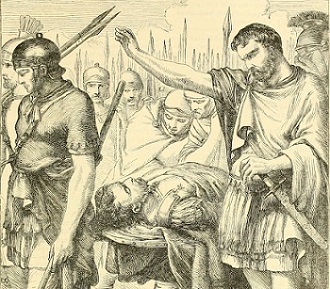
| | Runs on his sword. | |
| | Caesar, now be still: | 50 | |
| | I kill'd not thee with half so good a will. | |
| | Dies | |
| | Alarum. Retreat. Enter OCTAVIUS, ANTONY, MESSALA, LUCILIUS, and the army. | |
| OCTAVIUS | What man is that? | |
| MESSALA | My master's man. Strato, where is thy master? |
| STRATO | Free from the bondage you are in, Messala: | |
| | The conquerors can but make a fire of him; | 55 | |
| | For Brutus only overcame himself, | |
| | And no man else hath honour by his death. | |
| LUCILIUS | So Brutus should be found. I thank thee, Brutus, |
| | That thou hast proved Lucilius' saying true. | |
| OCTAVIUS | All that served Brutus, I will entertain them. | |
| | Fellow, wilt thou bestow thy time with me? | |
| STRATO | Ay, if Messala will prefer me to you. | |
| OCTAVIUS | Do so, good Messala. |
| MESSALA | How died my master, Strato? | |
| STRATO | I held the sword, and he did run on it. | 65 | |
| MESSALA | Octavius, then take him to follow thee, | |
| | That did the latest service to my master. | |
| ANTONY | This was the noblest Roman of them all: |
| | All the conspirators save only he, | |
| | Did that they did in envy of great Caesar; | |
| | He only, in a general honest thought | |
| | And common good to all, made one of them. | |
| | His life was gentle, and the elements |
| | So mix'd in him that Nature might stand up | |
| | And say to all the world 'This was a man!' | 75 | |
| OCTAVIUS | According to his virtue let us use him, | |
| | With all respect and rites of burial. | |
| | Within my tent his bones to-night shall lie, |
| | Most like a soldier, order'd honourably. | |
| | So call the field to rest; and let's away, | |
| | To part the glories of this happy day. | |
| | Exeunt | |
Back to Julius Caesar Scenes
_____
Explanatory Notes for Act 5, Scene 5
From Julius Caesar. Ed. Samuel Thurber. Boston: Allyn and Bacon.
____
ACT V
Scene 5
2. Statilius show'd the torch-light. Plutarch's account of this incident runs as follows: "There was one called Statilius, that promised to go through his enemies, for otherwise it was impossible to see their camp: and from thence, if all were well, that he would lift up a torch-light in the air, and then return again with speed to him. The torch-light was lifted up as he had promised, for Statilius went thither. Now Brutus seeing Statilius tarry long after that, and that he came not again, he said, 'If Statilius be alive, he will come again.' But his evil fortune was such that, as he came back, he lighted in his enemies' hands and was slain."
3. He came not back. We should say, "he has not come back." or ta'en or slain: either taken or slain. Where before have you noticed this or ... or construction?
5. Whispering. This stage direction is not found in the Folio edition of the plays, but was added by the early editors.
13. that noble vessel. The figurative use of the word vessel for a person, suggesting the fitness or capacity to contain something or other, was common in Shakespeare's time. Thus we find in the Bible: "he is a chosen vessel unto me"; "the vessel of wrath"; "giving honor to the wife as to the weaker vessel."
14. That it runs: so that it runs over. What is Brutus doing?
19. Philippi fields. "The Romans called the valley between both Camps, the Philippian Fields." (Plutarch, "Life of Brutus.")
23. have beat us to the pit: have beaten and driven us, as hunters drive animals, to the edge of the pitfall.
27. Even for that our love of old: for the sake of our old friendship. prithee. An old and abbreviated form of the expression pray thee. Who was it that earlier in the play said; "I prithee, boy, run to the senate-house"?
28. sword-hilts. For a similar use of the plural hilts see V,
3, 43, and note.
45. of a good respect: of good esteem; held in high regard. Similarly in I, 2, 59, Cassius said, "many of the best respect in Rome."
46. smatch: smack, taste.
50. Caesar, now be still. Brutus refers to Caesar's ghost, which, as we know, had been restless and walked the earth. Now that the murder has been avenged the spirit will "be still."
55. can but make a fire of him. This refers to the custom among the Romans of burning their dead on the funeral pyre.
60. I will entertain them: I will take them into my service.
61. bestow thy time with me: give up thy time to me; enter my service.
62. prefer: recommend. In the "Merchant of Venice" Bassanio says to Launcelot,
I know thee well; thou hast obtained thy suit:
Shylock thy master spoke with me this day.
And hath preferred thee.
69. save only he : except only him. The nominative case
after prepositions was common in all writers of Shakespeare's
time.
71, 72. in a general honest thought, etc. Brutus, declares Antony, acted, as he honestly thought, for the good of all. This is one of those involved Shakespearean sentences the meaning of which, however, is perfectly clear.
73, 74. the elements so mixed in him, etc. According to a commonly accepted belief of Shakespeare's time, man was composed of the four elements, earth, air, fire, and water. Human perfection depended upon a well-balanced mixture of these four elements or "humours."
76. virtue: worth, character.
79. ordered honorably: treated with honor.
80. call the field to rest: sound the signal for the army in the
field to cease fighting.
81. part: divide, share.
________
How to cite the explanatory notes and scene questions:
Shakespeare, William. Julius Caesar. Ed. Samuel Thurber. Boston: Allyn and Bacon, 1919. Shakespeare Online. 15 May. 2013. < http://www.shakespeare-online.com/plays/julius_5_5.html >.
|
Scene Questions for Review 1. What is the effect of the whispering and rapid conversation at the opening of this scene?
2. Why does Shakespeare have Brutus ask three of his companions to hold his sword before Strato consents to do the deed?
3. Comment upon Brutus' words:
My heart doth joy that yet in all my life
I found no man but he was true to me.
4. What effect have the one-syllable words of these two noble lines?
5. Contrast the deaths of Cassius and Brutus. Which seems to you to make the more pathetic scene?
6. Describe the setting of the stage as you would have it at the close of the play.
7. Discuss Antony's last speech in view of what you know of Brutus and the other conspirators.
8. Are you pleased with the conclusion of the tragedy? Would it have been better, in your judgment, to have Brutus
and Cassius live?
9. What decided the fate of the battle?
10. Do you think the play would be more appropriately entitled "Brutus"? Discuss fully.
____
|
More to Explore
 Julius Caesar: The Complete Play with Explanatory Notes Julius Caesar: The Complete Play with Explanatory Notes
An Overview of Julius Caesar
Julius Caesar Summary (Acts 1 and 2)
Julius Caesar Summary (Acts 3 and 4)
Julius Caesar Summary (Act 5)
Julius Caesar Study Questions (with Detailed Answers)
The Two Themes of Julius Caesar
Julius Caesar Character Introduction
Shakespeare's Ethics: Analysis of Julius Caesar
Blank Verse and Diction in Julius Caesar
Julius Caesar: Analysis by Act and Scene (and Timeline)
Adjectives to Describe the Characters in Julius Caesar
Julius Caesar Quotations (Full)
All About Et tu, Brute?
How to Pronounce the Names in Julius Caesar
Sources for Julius Caesar: Important Excerpts from Plutarch
Shakespeare’s Adaptation of Plutarch's Julius Caesar
Plutarch's Influence on Shakespeare
What is Tragic Irony?
Seneca's Tragedies and the Elizabethan Drama
Characteristics of Elizabethan Drama
|